

In a groundbreaking discovery that offers a profound glimpse into the resilience of life in Earth’s most extreme environments, scientists have uncovered extensive, meticulously organized fish nesting grounds in a previously inaccessible region of Antarctica’s western Weddell Sea. This extraordinary find, located beneath a section of ice shelf that had been sealed off for centuries by approximately 200 meters of solid ice, reveals a remarkably ordered ecosystem, challenging previous assumptions about the barrenness of such deep, frigid waters. The discovery was made possible by the dramatic calving of the A68 iceberg in 2017, an event that opened a unique window for scientific exploration.
A Window of Opportunity: The Calving of A68
The genesis of this remarkable discovery lies in a monumental geological event: the fragmentation of the Larsen C Ice Shelf in July 2017. The resulting iceberg, designated A68, was colossal, spanning an area of roughly 5,800 square kilometers – a size comparable to the U.S. state of Delaware or the country of Luxembourg. This dramatic separation of a massive ice block from the continental shelf created an unprecedented opportunity for marine researchers. For the first time in recorded history, a significant portion of the seabed that had been perpetually shrouded in ice, effectively isolated from the surface world for potentially thousands of years, was exposed to investigation. This unique circumstance provided scientists with a pristine laboratory to study an ecosystem that had evolved in complete darkness and under immense pressure, undisturbed by human activity or surface influences.
Expedition to the Unknown: The Weddell Sea Expedition 2019
The opportunity presented by the A68 calving directly informed the objectives of the Weddell Sea Expedition in 2019. Organized by the British Antarctic Survey and involving a consortium of international researchers and polar institutions, the expedition had two primary, ambitious goals. The first was to conduct a comprehensive scientific survey of the waters surrounding the Larsen C Ice Shelf, an area critical to understanding the dynamics of Antarctic ice shelves and their role in global sea-level rise. The second, and perhaps more romantically charged, objective was to search for the elusive wreck of Sir Ernest Shackleton’s famed polar exploration ship, the Endurance, which was lost to the ice in 1915.
The scientific team, aboard the South African polar research vessel SA Agulhas II, deployed a suite of advanced underwater technologies to navigate the formidable conditions. This included autonomous underwater vehicles (AUVs) and a remotely operated vehicle (ROV). These sophisticated tools were essential for exploring the dense pack ice and the icy depths of the Weddell Sea, an environment notorious for its harshness. The mission aimed to gather data on oceanographic conditions, marine life, and geological features of the region. The challenge of maneuvering through the same kind of treacherous sea ice that had claimed the Endurance over a century prior was significant, and ultimately, the vessel’s wreck remained undiscovered during the 2019 expedition. However, the invaluable experience gained in operating under such extreme conditions and with cutting-edge underwater robotics proved instrumental for subsequent missions.
A Glimpse Beneath the Ice: The Nesting Grounds Revealed
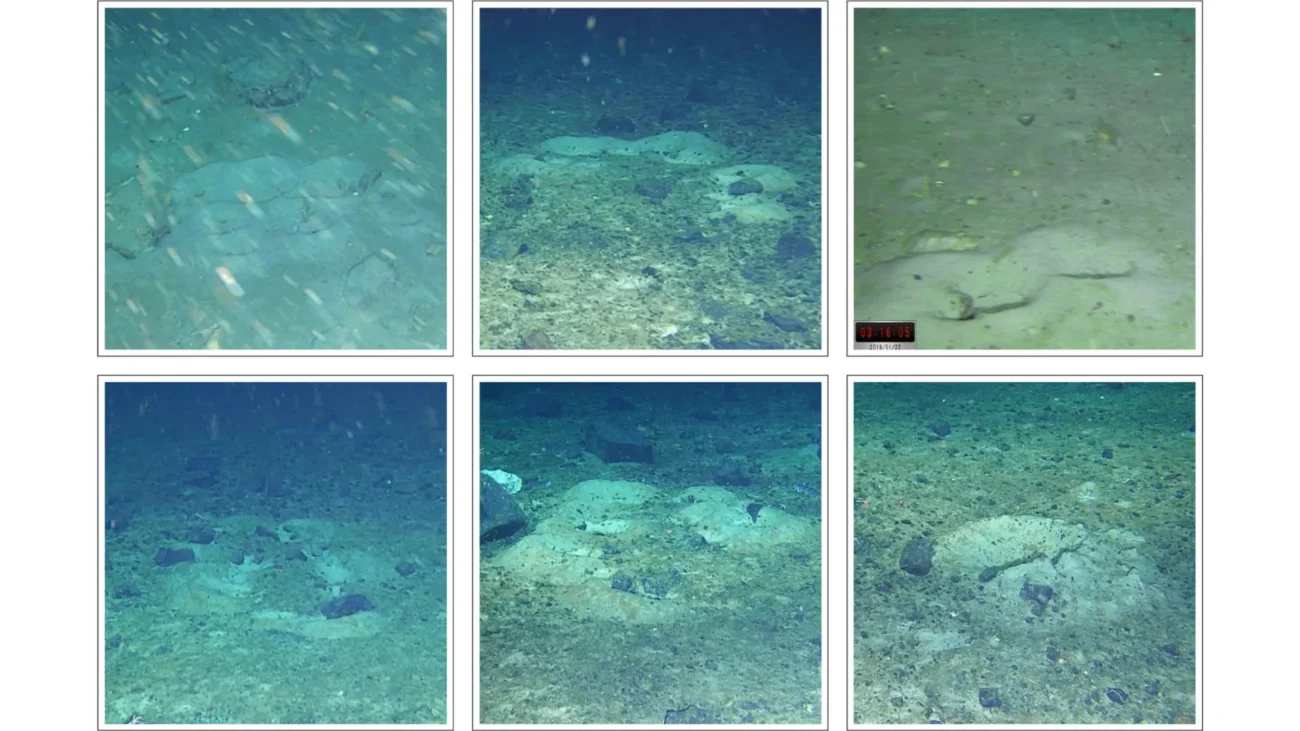
It was during this expedition, while deploying the ROV to survey the newly exposed seabed, that the scientists stumbled upon the extraordinary fish nests. The ROV, equipped with high-definition cameras and sophisticated lighting systems, transmitted back astonishing images of the ocean floor. Instead of a uniform expanse of sediment, researchers observed more than a thousand perfectly circular depressions, arranged in strikingly organized patterns. These depressions, meticulously swept clean of the plankton debris that blanketed the surrounding seafloor, stood out as islands of geometric order in the otherwise murky depths.
The visual contrast was stark and compelling. The images captured by the ROV clearly depicted these sand depressions as deliberately created and maintained. Some nests were found scattered individually across the seabed, particularly in the lower right sections of the surveyed area. Others formed elegant, curved lines in the central portions, while still others clustered together in dense formations in the upper left quadrants. The absence of the pervasive layer of phytoplankton detritus, which coated the adjacent seabed, was a clear indicator of active intervention. This organized landscape, a testament to unseen biological activity, was unlike anything previously documented in such deep Antarctic waters.
Identifying the Architects: The Yellowfin Notie
Subsequent analysis and identification efforts revealed the architects of these remarkable structures to be a species of Antarctic rockcod, specifically the yellowfin notie, scientifically known as Lindbergichthys nudifrons. These small to medium-sized fish, typically found in cold waters, have now been shown to engage in sophisticated collective nesting behaviors. Each circular nest, researchers theorize, was likely created and actively tended by a parent fish, diligently guarding its precious cargo of eggs from potential predators.
The density and arrangement of these nests provide compelling evidence of a complex survival strategy. Scientists propose that the dense groupings illustrate the "selfish herd" concept, a principle in evolutionary biology where individuals position themselves within a group to minimize their personal risk of predation. By forming tight clusters, the fish in the center of the colony are afforded a degree of protection by the individuals on the periphery. Those fish situated on the edges, potentially larger or stronger, appear to defend their individual territories, creating a balanced ecosystem of cooperation and competition. This dynamic interplay between solitary defense and communal protection significantly enhances the overall survival rate of the entire colony, ensuring the continuation of the species in a challenging environment.
Scientific Significance: A Vulnerable Marine Ecosystem
The discovery of these extensive fish nesting colonies holds profound implications for our understanding of Antarctic marine ecosystems and the broader impacts of climate change. This finding provides robust evidence that the region in question represents a Vulnerable Marine Ecosystem (VME). VMEs are defined as marine habitats that are structurally complex, slow-growing, and subject to severe degradation from human activities or environmental changes, such as deep-sea trawling or climate-induced warming. The organized nesting grounds of the yellowfin notie are precisely such a habitat, supporting not only the reproductive success of this species but also contributing to the intricate Antarctic food web, providing sustenance for other marine life, including the iconic penguins and seals that inhabit the region.
This discovery corroborates and expands upon earlier scientific research. Notably, studies such as the one by Purser et al. (2022), which identified one of the world’s largest fish breeding colonies in the Weddell Sea, have highlighted the ecological significance of this particular area. The presence of multiple large breeding colonies, in addition to the newly discovered organized nesting grounds, paints a picture of a highly productive and vital marine environment that has been hidden from scientific view for an extended period.
Broader Implications: The Case for Marine Protected Areas
The implications of this discovery extend beyond purely scientific curiosity. It significantly strengthens the argument for the designation of the Weddell Sea as a Marine Protected Area (MPA). MPAs are geographically defined areas of the ocean that have been reserved for conservation purposes. Their establishment is a critical tool in safeguarding biodiversity, preserving marine habitats, and ensuring the long-term health of ocean ecosystems.
The findings in the Weddell Sea underscore the urgent need to protect these fragile yet vital environments from potential threats. As Antarctica’s ice shelves continue to thin and break apart due to global warming, the unique ecosystems they shield are becoming increasingly vulnerable. Safeguarding the Weddell Sea as an MPA would not only protect its charismatic megafauna, such as whales, seals, and penguins, but also, crucially, preserve the hidden nurseries and breeding grounds that form the foundation of the entire Antarctic food web. This protection would be vital in maintaining the ecological balance of the Southern Ocean, which plays a significant role in global climate regulation.
The Role of Ice Shelves: Guardians of the Continent
The Weddell Sea Expedition’s focus on the role of Antarctica’s floating ice shelves as crucial barriers slowing the flow of glaciers from the continent’s interior provides essential context for the recent discoveries. These massive ice formations act as natural dams, holding back vast quantities of land ice. When ice shelves thin or disintegrate, this stabilizing effect diminishes, allowing glaciers to accelerate their movement into the ocean. This process directly contributes to rising global sea levels, a critical concern for coastal communities worldwide. The calving of iceberg A68, while offering a scientific boon, also serves as a stark reminder of the ongoing impacts of climate change on the Antarctic continent.
A Legacy of Exploration: The Endurance Expedition
The quest for Shackleton’s Endurance serves as a poignant parallel to the scientific exploration currently unfolding. Shackleton’s Imperial Trans-Antarctic Expedition of 1914-1917 aimed to be the first to traverse the Antarctic continent. However, the ship was trapped and crushed by sea ice in the Weddell Sea in 1915. The subsequent survival story of Shackleton and his crew, who eventually abandoned their ship and made an epic journey to safety, is one of the greatest tales of human endurance in polar exploration. The fact that the Weddell Sea continues to present formidable challenges to modern expeditions, even with advanced technology, highlights the enduring power and unforgiving nature of this environment.
The successful discovery of the Endurance wreck in March 2022, by the Endurance22 expedition, resting remarkably preserved at a depth of 3,008 meters, was a triumph of modern exploration and a testament to the scientific advancements pioneered by missions like the 2019 Weddell Sea Expedition. This discovery, while separate from the fish nest findings, underscores the ongoing scientific and historical importance of the Weddell Sea.
A Future of Conservation
The remarkable discovery of the organized fish nesting colonies in the Weddell Sea serves as a powerful testament to the tenacity of life. It demonstrates that even in the planet’s most remote and seemingly inhospitable environments, complex and organized life forms can thrive, adapt, and evolve intricate survival strategies. This finding reinforces the critical need for continued scientific research and, more importantly, for robust conservation efforts to protect these unique and vulnerable ecosystems. As the climate continues to change, understanding and safeguarding these hidden worlds becomes not just an academic pursuit, but an imperative for the health of our planet. The Weddell Sea, once a realm of perpetual ice, is now revealing its secrets, urging humanity to act as stewards of its extraordinary biodiversity.
