

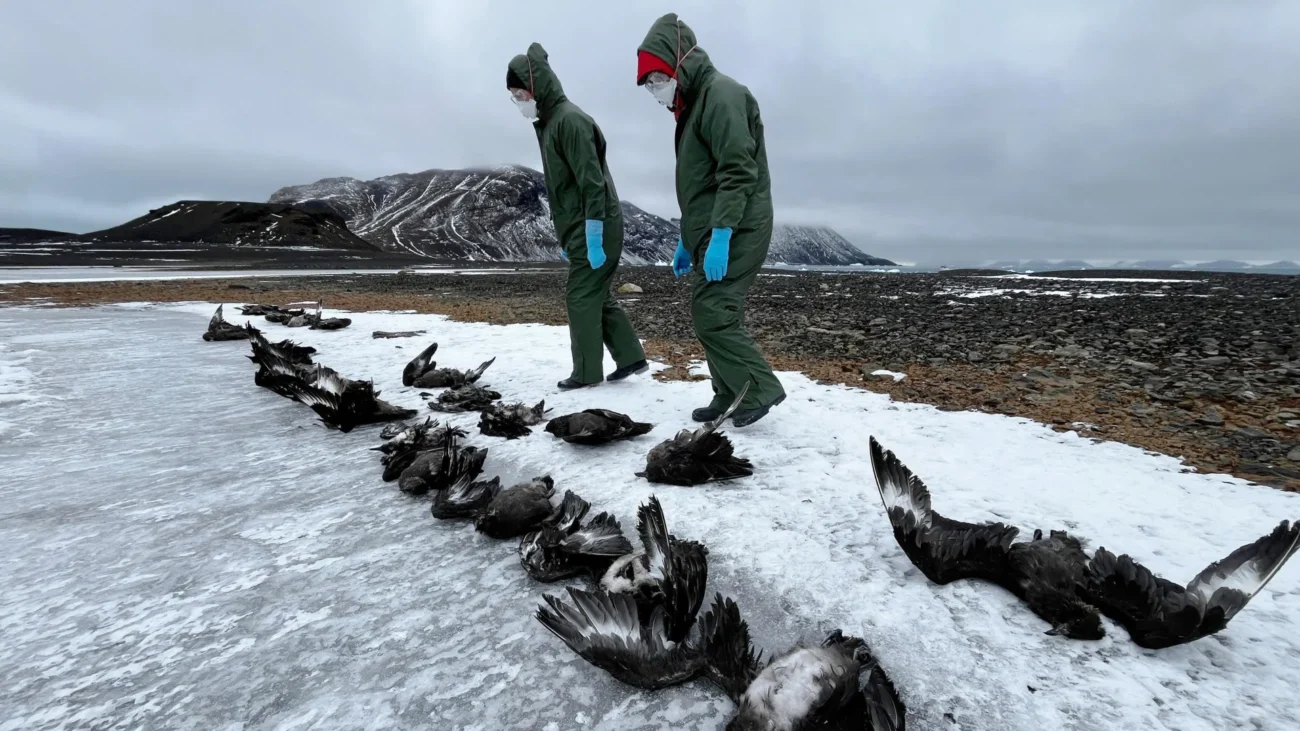
The pristine Antarctic continent, long considered a sanctuary for unique wildlife, has witnessed its first confirmed wildlife die-off due to the highly pathogenic avian influenza virus H5N1. Over the summers of 2023 and 2024, more than 50 skuas, large predatory seabirds crucial to the Antarctic ecosystem, succumbed to the virulent strain of the virus. This grim discovery, detailed in a recent study published in the journal Scientific Reports, is the culmination of research led by a collaborative effort between Erasmus MC in The Netherlands and the University of California, Davis. The findings raise significant concerns about the potential impact of H5N1 on the fragile Antarctic environment and its inhabitants.
The Scavenger’s Dilemma: How Skuas Became Vulnerable
Skuas, scientifically known as members of the Stercorariidae family, are robust, brown seabirds closely related to gulls. They are apex predators and opportunistic scavengers, playing a vital role in the Antarctic food web by consuming carcasses and waste. This ecological niche, however, appears to have inadvertently placed them at increased risk of contracting and disseminating the H5N1 virus. Researchers posit that their scavenging behavior, which involves interacting with dead animals, may have facilitated the initial transmission and subsequent spread of the virus among skua populations across the continent.
The presence of H5N1 in Antarctica was initially detected earlier in 2024. Scientists identified the virus in a kelp gull and two skuas found deceased in January and February. However, definitive proof linking these deaths to the viral infection remained elusive until the comprehensive study was conducted.
"We knew there were animals with the infection, but this is the first study to show they died of the viral infection," stated co-senior author Ralph Vanstreels, a wildlife veterinarian affiliated with the UC Davis One Health Institute within the Weill School of Veterinary Medicine. "It’s an important distinction in the early days of an outbreak." This clarification underscores the critical difference between simply detecting a pathogen and confirming it as the direct cause of mortality, a crucial step in understanding the epidemiology of emerging diseases.
Antarctic Expedition Uncovers Devastating Impact
In March 2024, a dedicated research team embarked on an expedition to Antarctica, strategically timing their arrival shortly after the conclusion of the breeding season for skuas and penguins. Their mission was to investigate the burgeoning concerns surrounding potential disease outbreaks among the continent’s wildlife. The expedition spanned ten distinct sites, encompassing the South Shetland Islands, the northern Weddell Sea, and the Antarctic Peninsula – regions known for their rich biodiversity and sensitive ecological balances.
During their extensive fieldwork, scientists meticulously examined wildlife encountered, prioritizing those exhibiting signs of illness or found deceased. They systematically collected tissue and environmental samples, and conducted necropsies to ascertain the precise cause of death. While the remains of gentoo penguins (Pygoscelis papua), Adélie penguins (Pygoscelis adeliae), and Antarctic fur seals (Arctocephalus gazella) were examined, H5N1 was not identified as the causative agent in these species.
However, as the expedition progressed, a grim pattern began to emerge, focusing the researchers’ attention on the skua populations. "As the expedition progressed, it became obvious quickly that skuas were a major victim," Vanstreels recounted, highlighting the growing concern for this particular species.
The H5N1 virus was ultimately detected in skuas at three key locations: Hope Bay, Devil Island, and Beak Island. Beak Island, in particular, experienced a significant and devastating die-off among its south polar skua (Stercorarius maccormicki) population.
"We diagnosed high pathogenicity avian influenza as the cause of death for nearly all of the dead skuas we found at Beak Island," confirmed first author Matteo Iervolino, a Ph.D. candidate at Erasmus MC in Rotterdam, The Netherlands. His poignant observation, "There, I could really see with my eyes the impact this virus can have on these populations," vividly illustrates the profound and immediate devastation wrought by the outbreak.
Vanstreels further described the harrowing reality faced by infected birds, characterizing the situation as a "crisis in animal suffering." The H5N1 virus is known to target the nervous system, inducing severe neurological symptoms. Affected birds exhibit distressing signs such as twisted necks, unnatural body stretching, compulsive circular movements, disorientation leading to collisions, and even catastrophic falls from the sky. This stark depiction underscores the agonizing nature of the disease and the urgent need for intervention and mitigation strategies.
A Global Scourge: The Pervasive Reach of H5N1
The emergence and subsequent global proliferation of the H5N1 virus represent a significant public health and ecological challenge. The virus was first identified in 1996 on a domestic goose farm in Southeast China. For several years, it circulated largely unchecked within poultry populations, eventually spilling over into wild bird populations. This jump marked a critical turning point, facilitating its rapid dissemination across continents.
From its origins, H5N1 embarked on a relentless journey, spreading through Europe, the Middle East, and Africa. Subsequently, it reached North and South America, and by early 2024, its trajectory had tragically extended to the isolated and seemingly untouched continent of Antarctica.
The same strain of H5N1 currently impacting Antarctic skuas had previously inflicted substantial mortality among marine mammals in Argentina, leading to massive losses of elephant seals and sea lions. Beyond wildlife, the virus has caused widespread devastation in the global poultry industry, resulting in the deaths of over 400 million birds. Furthermore, its adaptability has been alarmingly demonstrated by its ability to infect a diverse array of mammals, including dairy cows, mink, foxes, bears, otters, and numerous other wild bird species.
The implications for human health are also profound. While less common, H5N1 can infect humans, and of the approximately 1,000 reported human cases globally, a staggering half have proven fatal. This highlights the zoonotic potential of the virus and the ongoing risk it poses to public health.
"We let the virus slip out through our fingers when it first emerged in the poultry industry," lamented corresponding senior author Thijs Kuiken, a professor at Erasmus MC. "Once it got into wild bird populations, we lost ability to control this virus. Now it’s established in wild bird populations in all the continental regions of the world except Oceania." This statement underscores a critical failure in early pandemic preparedness and the immense difficulty in containing a highly adaptable virus once it establishes itself in wild animal reservoirs.
Mounting Pressures on Antarctic Ecosystems
The arrival of avian influenza in Antarctica adds a formidable new threat to an environment already grappling with a complex web of anthropogenic pressures. Antarctic wildlife already faces significant challenges, including the pervasive impacts of climate change, the escalating volume of tourism, the introduction of invasive species, the depletion of fish stocks due to overfishing, and the persistent scourge of pollution. The addition of H5N1 to this list of stressors creates a synergistic effect, potentially exacerbating the vulnerability of these unique ecosystems.
The study strongly emphasizes the urgent need for enhanced surveillance and monitoring programs across Antarctica. Such initiatives are crucial for early detection of disease outbreaks, rapid response, and ultimately, for mitigating the risk of further spread and minimizing ecological damage.
A significant complication in assessing the true impact of the H5N1 outbreak is the scarcity of recent population data for key Antarctic species. The last comprehensive census of Antarctic skuas was conducted in the 1980s, at which time researchers estimated approximately 800 breeding pairs. Without updated population figures, it remains challenging to accurately quantify the significance of the loss of over 50 birds in the broader context of population dynamics. This data gap hinders effective conservation planning and the accurate assessment of disease-related mortality.
"Everything points toward this virus spreading further," Kuiken cautioned, expressing concern about the future trajectory of the outbreak. "If nobody is watching, we won’t know what is happening." This stark warning highlights the critical importance of sustained scientific observation and robust data collection in understanding and responding to emerging threats in remote and ecologically sensitive regions like Antarctica.
The HPAI Australis Expedition, instrumental in uncovering these findings, was generously funded by the International Association of Antarctica Tour Operators (IAATO) and Ocean Expeditions. The subsequent research was further supported by grants from the European Union, Consejo Superior de Investigaciones Científicas (CSIC), and PTI Global Health, underscoring the international collaboration and commitment to understanding this critical environmental health issue. The findings from this study are expected to inform future conservation strategies and public health policies related to avian influenza in polar regions.
