


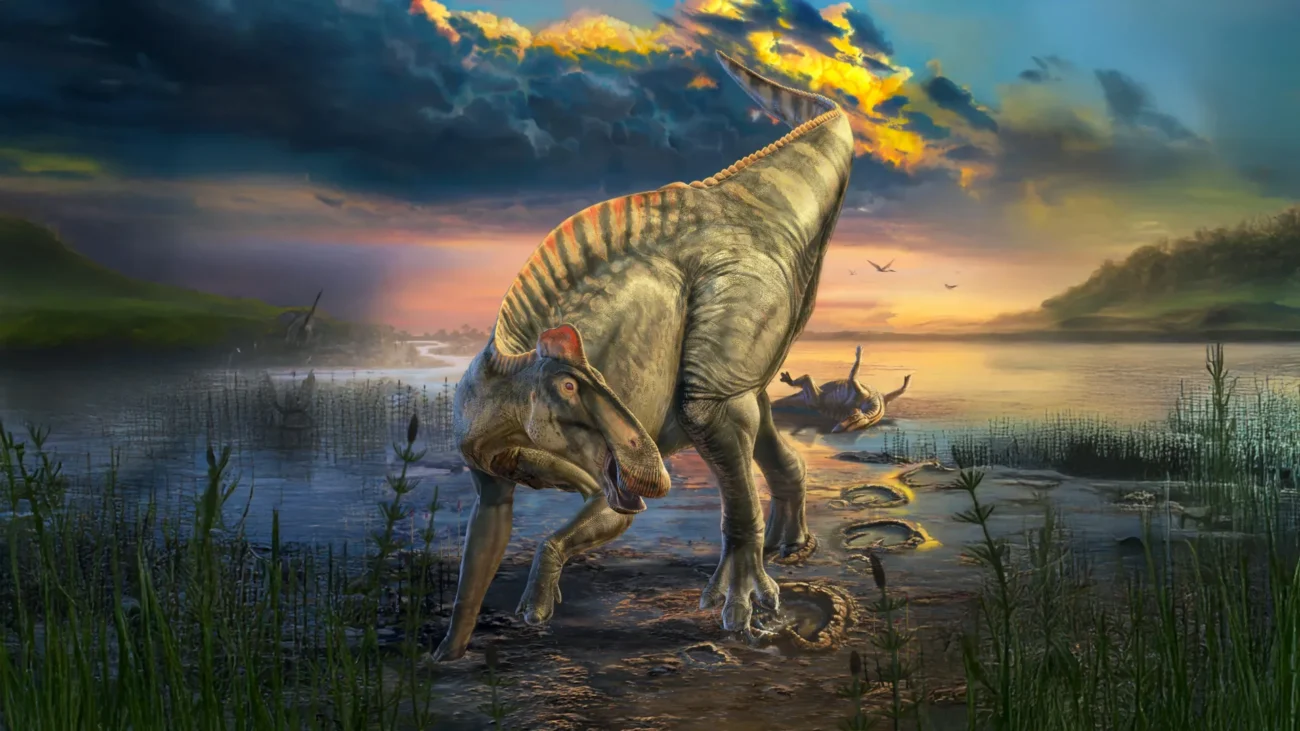
In a groundbreaking study published in the prestigious journal Science, researchers from the University of Chicago have unveiled a remarkable new understanding of dinosaur preservation, detailing how the soft tissues of the duck-billed dinosaur Edmontosaurus annectens were transformed into exquisitely preserved "mummies" around 66 million years ago. This novel process, which the scientists have termed "clay templating," has allowed for an unprecedented glimpse into the intricate details of dinosaur skin, scales, and even hooves, providing a level of anatomical clarity long sought by paleontologists.
The exceptional preservation is attributed to a delicate clay coating that settled over the dinosaur’s skeleton shortly after burial. This thin, less than 1/100th of an inch thick, layer acted as a precise mold, capturing the minute textures of the animal’s outer surface. By employing a sophisticated array of advanced imaging techniques, the research team was able to digitally reconstruct the dinosaur’s appearance in life, revealing features previously only hypothesized. These reconstructions depict a striking crest running along the neck and torso, a distinctive row of spikes adorning the tail, and surprisingly, hooves encasing the toes. When integrated with fossilized footprints found in the same geological strata, these findings offer the clearest and most detailed portrait yet of this iconic duck-billed dinosaur, a creature whose appearance has been a subject of intense speculation for decades.
Rediscovering Wyoming’s "Mummy Zone"
The genesis of this discovery lies in the serendipitous rediscovery of a unique fossiliferous region in east-central Wyoming. Senior author Paul Sereno, PhD, a Professor of Organismal Biology and Anatomy at the University of Chicago, and his team embarked on a meticulous process of retracing the historical footsteps of early paleontological expeditions. Utilizing vintage field photographs and detailed historical records, they pinpointed the exact locations where several seminal dinosaur "mummy" specimens had been unearthed in the early 20th century. This detective work led them to identify a concentrated area, which they have designated a "mummy zone," characterized by specific rock layers representing ancient river sands.
Within this historically significant zone, the University of Chicago team successfully excavated two new Edmontosaurus annectens mummies. One specimen represented a younger individual, while the other was somewhat older. Both of these specimens exhibited large, continuous expanses of preserved external skin surface, providing invaluable data that was crucial for constructing a comprehensive, fleshed-out profile of the animal.
Professor Sereno emphasized a critical distinction between these dinosaur mummies and those of human origin, such as those found in Egyptian tombs. "These are not true mummies in the sense of preserved organic material," he explained. "What we are seeing, in both the newly described specimens and earlier examples labeled as mummies, is not original tissue but an extremely thin clay coating. This coating formed on the exterior of the carcass shortly after burial, preserving the fine details." He described this layer as a "mask, a template, a clay layer so thin you could blow it away," a remarkable preservation event that occurred by chance.
The Science Behind Clay Templating
The formation of these extraordinary fossils is the result of a specific and rare sequence of geological and biological events, meticulously unraveled by the research team through a combination of advanced imaging and analytical methods. These included hospital-grade CT scans, micro-CT scans for finer detail, thin-section analysis of the fossilized tissues, X-ray spectroscopy to determine elemental composition, and detailed clay mineralogical analyses. Crucially, they also undertook a thorough examination of the geological context – the rock layers in which the fossils were found.
The proposed model, termed "clay templating," suggests that after death, the Edmontosaurus carcasses would have been exposed to the sun, leading to desiccation of the outer tissues. Subsequently, rapid burial by sudden flash floods would have occurred. A key factor in the preservation process appears to be a microbial film present on the outer surface of the carcass. This film possessed electrostatic properties that attracted clay particles from the surrounding wet sediment. This attraction resulted in the formation of an exceptionally thin clay template that precisely replicated the animal’s three-dimensional outer form. Over vast geological timescales, the original soft tissues would have decayed, leaving behind the fossilized skeleton and the delicate, mineralized clay impression of its exterior.
Meticulous Preparation and Digital Reconstruction
The fragility of the paper-thin clay layers presented significant challenges during the excavation and preparation phases. Tyler Keillor, the Fossil Lab manager at the University of Chicago and a co-author on the study, spearheaded the painstaking work of uncovering these crucial surfaces without causing irreparable damage. This involved hours of meticulous preparation, employing specialized tools and techniques to expose the delicate impressions.
Following the physical preparation, a separate team, led by postdoctoral scholar Evan Saitta, utilized state-of-the-art 3D surface imaging and CT scans. This advanced imaging data was then cross-referenced with a comprehensive database of fossilized footprints from the same geological period. By carefully aligning the preserved soft tissue impressions with the detailed morphology of fossilized footprints, the researchers were able to definitively match the dinosaur’s hooves to their trackways. This integration of anatomical data with track evidence provided irrefutable confirmation of the foot structure and gait of the Edmontosaurus.
Digital artists then collaborated closely with the scientific team, translating the meticulously gathered data into lifelike reconstructions. These visualizations depict the duck-billed dinosaur as it moved across the muddy landscapes near the close of the Cretaceous period, offering a dynamic and scientifically grounded representation of its appearance and locomotion.
Revealing a Detailed Anatomy: Crests, Spikes, Scales, and Thin Skin
The two newly described Edmontosaurus mummies proved to be remarkably complementary, allowing researchers to assemble a comprehensive and continuous "fleshed-out" outline of Edmontosaurus annectens. "The two specimens complemented each other beautifully," stated Professor Sereno. "For the first time, we could see the whole profile rather than scattered patches."
One of the most significant revelations from these specimens is the discovery of a continuous feature running along the dorsal midline of the animal. This structure began as a fleshy crest extending over the neck and torso. As it transitioned towards the posterior, over the hips, it transformed into a distinct row of spikes that ran along the length of the tail. Each spike was precisely aligned with an underlying vertebra, showcasing a remarkable degree of anatomical integration.
The research also provided unprecedented detail regarding the dinosaur’s scale patterns. The largest polygonal scales were observed along the lower body and tail. In stark contrast, the majority of the animal’s body was covered in exceptionally small, pebble-like scales, measuring only 1 to 4 millimeters across. These tiny scales are particularly surprising given the immense size of Edmontosaurus, which could reach lengths exceeding 40 feet. Furthermore, the presence of fine wrinkles preserved over the ribcage strongly suggests that the skin of this duck-billed dinosaur was relatively thin.
The Unexpected Discovery of Hooves and Heel Pads
Perhaps the most astonishing discovery emerged from the hind feet of the larger mummy: the presence of hooves. Each of the three hind toes was encased in a wedge-shaped hoof with a flat underside, bearing a striking resemblance to the hooves of modern horses. This finding marks a significant evolutionary revelation, pushing back the documented timeline for the presence of hooves in terrestrial vertebrates.
To precisely reconstruct the appearance of these feet in life, the researchers integrated high-resolution CT scans of the mummified feet with detailed 3D surface scans of the most well-preserved duckbill footprint from the same geological period. By meticulously aligning the skeletal and soft-tissue data with the footprint impression, they generated a highly accurate reconstruction of the hind foot. This reconstruction revealed that, unlike the forefeet which contacted the ground primarily through their hooves, the hind feet also possessed a fleshy heel pad located behind the hooves.
"There are so many amazing ‘firsts’ preserved in these duck-billed mummies," Professor Sereno remarked. "We have documented the earliest hooves in a land vertebrate, confirmed the existence of a hooved reptile, and identified the first hooved four-legged animal with distinct forelimb and hindlimb postures."
A New Paradigm for Dinosaur Soft-Tissue Research
Beyond the spectacular anatomical discoveries, this research establishes a robust and practical framework for future investigations into dinosaur soft tissue preservation. The authors have outlined novel preparation techniques, proposed a standardized terminology for describing soft structures and scale types, and detailed a clear imaging pathway from raw fossil specimen to a fully fleshed-out digital model. They have also provided a scientifically grounded explanation for how dinosaur mummies can form under natural geological conditions.
This study proposes a generalized model for dinosaur mummification, centered on the process of clay templating, which can now be applied and tested on other fossil specimens that may have formed under similar circumstances. The implications extend beyond paleontology, offering insights into the complex interplay of biological decay, sedimentary processes, and mineral precipitation that can lead to exceptional fossilization.
The research team has identified several key areas for future investigation. These include targeted searches for additional specimens exhibiting similar preservation characteristics within the same Wyoming rock formations and in other regions globally. Biomechanical studies will now benefit from accurate external body outlines, enabling more precise analyses of locomotion and physiology. Furthermore, complementary geochemical and sedimentological analyses are planned to better understand the specific environmental conditions and geological factors that favor clay templating.
"This may be the single best paper I have released," Professor Sereno concluded, reflecting on the comprehensive nature of the study. "From field discovery to laboratory analysis, 3D reconstructions, and the definition of a suite of essential scientific terms, it’s a tour de force. It tells a coherent and compelling story about how these remarkable fossils come to be and the profound insights they offer into the ancient world." The findings not only enrich our understanding of dinosaur anatomy and evolution but also provide a powerful new tool for paleontologists seeking to unlock the secrets preserved within the fossil record.
