


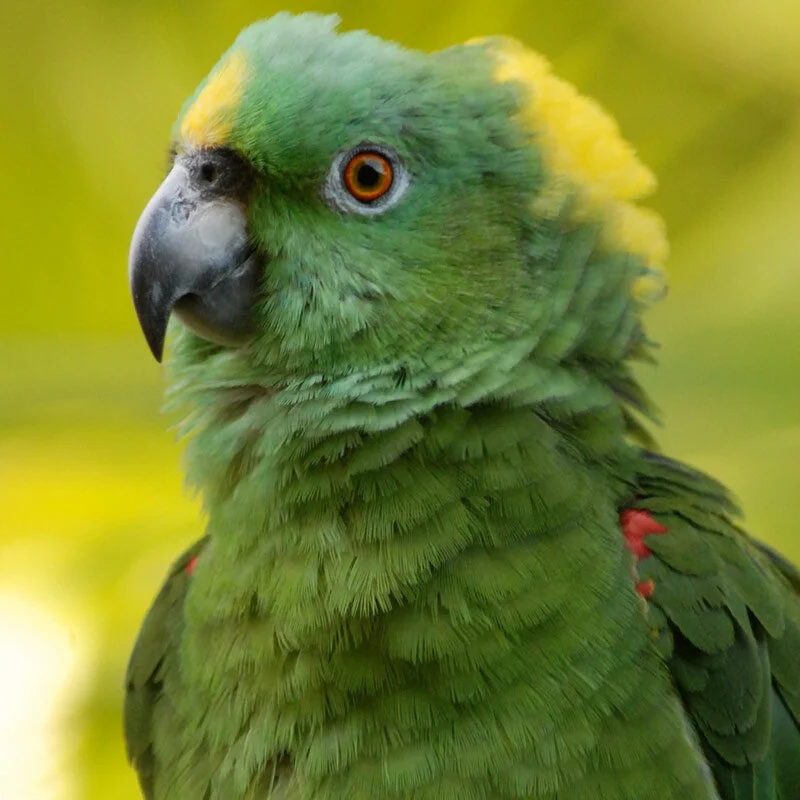
A groundbreaking study published on February 12, 2026, in a leading scientific journal has unveiled the sophisticated vocal communication system of yellow-naped Amazon parrots, revealing intricate, rule-governed duets that challenge previous understandings of animal language. Researchers, led by Dr. Christine R. Dahlin, a professor of biology at the University of Pittsburgh, along with five esteemed colleagues, have demonstrated that mated pairs of these vibrant birds engage in complex "warble" duets composed of no fewer than 36 distinct call types, arranged in patterned sequences strikingly similar to human linguistic structures. This discovery adds significant weight to the burgeoning evidence that parrots, long admired for their mimicry, possess their own highly structured and learned communication systems, potentially offering profound insights into the evolution of language itself.
Unraveling the Mystery of Avian Communication
For centuries, the ability of parrots to imitate human speech has captivated observers, suggesting a unique cognitive capacity within the avian world. However, this new research moves beyond mere mimicry, delving into the intrinsic communication methods these birds employ among themselves. The study’s findings indicate that yellow-naped Amazon parrots (scientific name: Amazona auropalliata) utilize a learned system of vocalizations that may function much like human language, characterized by a structured grammar or syntax. This implies that their calls are not merely random expressions but rather components of a coherent system where the arrangement of sounds carries specific meanings, much as words form sentences in human discourse.
Dr. Dahlin and her team meticulously analyzed countless hours of vocal recordings from wild yellow-naped Amazon parrots, focusing specifically on the duets performed by mated pairs. Their rigorous analysis revealed clear structural patterns within these duets, adhering to recognizable "rules" that govern the sequencing of different call types. This adherence to structural rules is a hallmark of complex communication systems, including human language, where the order of elements significantly impacts meaning.
One of the most compelling aspects of the study is the discovery of sex-biased vocalizations. The researchers found that a substantial proportion of calls—between 75% and 99%—were primarily used by either males or females. Even more remarkably, some calls were identified as entirely sex-specific, produced exclusively by one gender. This division of labor in communication suggests specialized roles within the pair’s interaction, potentially related to courtship, territorial defense, or coordinated parental duties. Such specificity points to a highly evolved system where information is not only conveyed through the type of call but also through the identity of the caller, adding another layer of complexity to their communication.
A Deep Dive into Parrot Vocalizations: Primary and Warble Calls
The communication repertoire of yellow-naped Amazon parrots is broadly categorized into two main groups: primary calls and warble calls. Primary calls are the most frequently used and encompass a wide range of vocalizations essential for daily interactions. However, it is the warble call that truly highlights the sophistication of their duets. The study identified the warble call as a distinct, rapid, and highly diverse range of notes, seemingly employed by pairs for specific purposes such as alerting or warning. Its accelerated tempo and broader tonal range distinguish it from primary calls, suggesting an urgency or particular informational content associated with its use.
In total, the researchers successfully identified 36 distinct call types that form the basis of these intricate duets. Beyond these, an additional 11 unique calls were recorded, though only heard once during the study period, hinting at an even broader, potentially context-dependent, vocal lexicon yet to be fully deciphered. The sheer number of distinct call types, combined with their rule-governed arrangement, positions the yellow-naped Amazon parrot’s communication system as one of the most complex observed in the animal kingdom. This complexity is often associated with highly social species, which require sophisticated means to manage intricate group dynamics, coordinate activities, and navigate complex social hierarchies.
Regional Dialects and the Learning Aspect
Further reinforcing the notion of a learned, language-like system, yellow-naped Amazon parrots are known to exhibit regional dialects across their entire range of calls. This phenomenon, where populations in different geographical areas develop distinct variations in their vocalizations, is a strong indicator of cultural transmission and learning rather than purely innate vocalizations. In humans, dialects are a fundamental aspect of language, reflecting social groups and geographical separation. Observing similar patterns in parrots underscores their cognitive flexibility and capacity for vocal learning, a trait shared by only a few select groups of animals, including some songbirds, hummingbirds, cetaceans, bats, and elephants.
The presence of dialects implies that young parrots learn their specific call types and sequences from their parents and other members of their social group, much like human children acquire language. This learning process is crucial for social cohesion and effective communication within their particular community. It also suggests that these vocal traditions can evolve over time, adapting to new environmental pressures or social dynamics, much like human languages adapt and change.
Methodology and Broader Context of Animal Language Research
To achieve these groundbreaking findings, Dr. Dahlin and her team likely employed a rigorous methodology combining extensive field observations with advanced acoustic analysis. This would have involved prolonged periods of observing parrot behavior in their natural habitats, meticulously recording their vocalizations using high-fidelity microphones, and then analyzing these soundscapes with specialized software. Spectrographic analysis would have allowed the researchers to visualize the acoustic properties of each call, identifying distinct features and patterns. Statistical methods would then be applied to discern the "rules" governing the sequencing of these calls, looking for non-random patterns that suggest syntactic organization.
This study builds upon a rich history of research into animal communication, a field that has seen significant advancements in recent decades. Scientists have long sought to understand whether animals possess forms of communication that could be considered "language." Early research often focused on primate communication, while more recent studies have expanded to include cetaceans (dolphins, whales), elephants, and various bird species. The concept of "syntax" – the arrangement of words and phrases to create well-formed sentences – has been a particular focus. While no animal communication system has yet been definitively proven to possess the full generative grammar of human language, discoveries like those by Dr. Dahlin’s team are continually pushing the boundaries of what is considered possible, revealing increasingly sophisticated structures.
For example, studies on prairie dogs have shown they can encode information about predator type, size, and speed into their alarm calls. Certain bird species, like chickadees, use combinatorial calls where different elements, when arranged in specific orders, convey different meanings (e.g., "mobbing" calls vs. "all clear"). These examples, alongside the new parrot research, collectively suggest that the building blocks of complex communication, including rudimentary forms of syntax, may be more widespread in the animal kingdom than previously assumed.
Implications for Conservation and Future Research
Beyond its profound scientific implications for understanding animal cognition and the evolution of language, this study carries significant weight for the conservation of the yellow-naped Amazon parrot. Amazona auropalliata is currently listed as "critically endangered" by the IUCN Red List, facing severe threats primarily due to habitat loss and illegal wildlife trade. Their natural habitats, spanning Central America from southern Mexico to northern Costa Rica, are rapidly diminishing due to deforestation for agriculture, cattle ranching, and human settlement. The pet trade also poses a serious threat, with thousands of individuals illegally captured from the wild each year, decimating populations.
As Dr. Dahlin and her colleagues eloquently state in their paper, "If we hope to eventually break the code of their vocal communication system, it will likely take a sustained mix of conservation efforts, field observations, and playback experimentation." This statement underscores the interconnectedness of scientific discovery and conservation action. A deeper understanding of these parrots’ complex communication not only highlights their intelligence and intrinsic value but also provides crucial information that could inform more effective conservation strategies. For instance, understanding their warning calls could help design better monitoring systems to protect them from poachers. Recognizing their social communication patterns could aid in rehabilitation and reintroduction programs, ensuring that released birds can successfully integrate into wild populations.
The study serves as a powerful reminder that natural pressures shape communication in ways that cannot be replicated in captivity. Therefore, preserving wild populations is paramount not only for the survival of the species but also for the continued study of their natural behaviors and cognitive abilities. Captive environments, while valuable for breeding programs, often cannot replicate the complex social dynamics and environmental challenges that drive the evolution of such sophisticated communication systems in the wild.
Looking ahead, the research opens several avenues for future investigation. Further "playback experimentation," where researchers play back recorded calls to wild parrots to observe their reactions, could help definitively decode the specific meanings of various call types and sequences. Longitudinal studies tracking individual pairs over many years could reveal how their duets evolve, how new calls are learned, and how communication strategies adapt to changes in their social or ecological environment. Comparative studies with other Amazon parrot species, or even other vocal learners, could shed light on the evolutionary pathways that led to such complex communication.
Ultimately, Dr. Dahlin’s work demonstrates the immense value of investing in research into vocal complexity and syntactic organization in wild animal populations. It challenges us to reconsider our anthropocentric views on language and intelligence, suggesting that the natural world holds many more secrets about sophisticated communication than we have yet uncovered. As we stand on the precipice of understanding these magnificent birds, the urgency to protect them from extinction becomes even more profound, for with each lost species, we lose not just a unique life form, but potentially an entire language, a unique perspective on the world, and invaluable keys to understanding our own origins.
