


Thousands of years ago, on the rugged terrain of the Caribbean island of Hispaniola, a dramatic scene unfolded within the cool, dark confines of a cave. A giant barn owl, a formidable nocturnal predator, carried its prey—a hutia, a rodent endemic to the region—back to its den. The meal, likely swift and brutal, concluded with the remains of the unfortunate hutia left scattered. It was a scene of predation common to the natural world, a testament to the cyclical nature of life and death. However, what transpired in the millennia that followed transformed this ancient larder into an extraordinary testament to evolutionary adaptation and the intricate tapestry of life. A burrowing bee, driven by the primal instinct to reproduce, discovered this macabre feast, and in doing so, initiated a chain of events that would leave paleontologists astounded centuries later. Only two of the original three occupants of the cave—the owl, the hutia, and the bee—would ultimately depart. The one that remained was the creature incapable of flight, its very remains becoming a foundation for a new generation.
The narrative of this prehistoric tableau, pieced together through meticulous scientific investigation, paints a vivid picture of ecological succession and the remarkable ingenuity of even the smallest creatures. The cave, known as Cueva de Mono in the southern Dominican Republic, served as a long-term feeding station for generations of giant barn owls. These owls, powerful hunters of the night, repeatedly brought their prey—primarily hutias in this specific instance—to this sheltered location. Over vast stretches of time, the bones and other remnants of these meals accumulated, forming a rich deposit of organic material interspersed with the bedrock of the cave.
The Accidental Architects: Bees Discover a Ready-Made Haven
It was within this ancient accumulation of osseous debris that a solitary burrowing bee, seeking a secure location to establish its nest, made its discovery. Driven by an innate need to provide for its offspring, the bee began excavating into the fine, clay-rich silt that had settled in the darker recesses of the cave. Its efforts, however, were interrupted when it encountered the fossilized remains of a hutia. This seemingly unfortunate encounter proved to be a serendipitous boon for the bee.
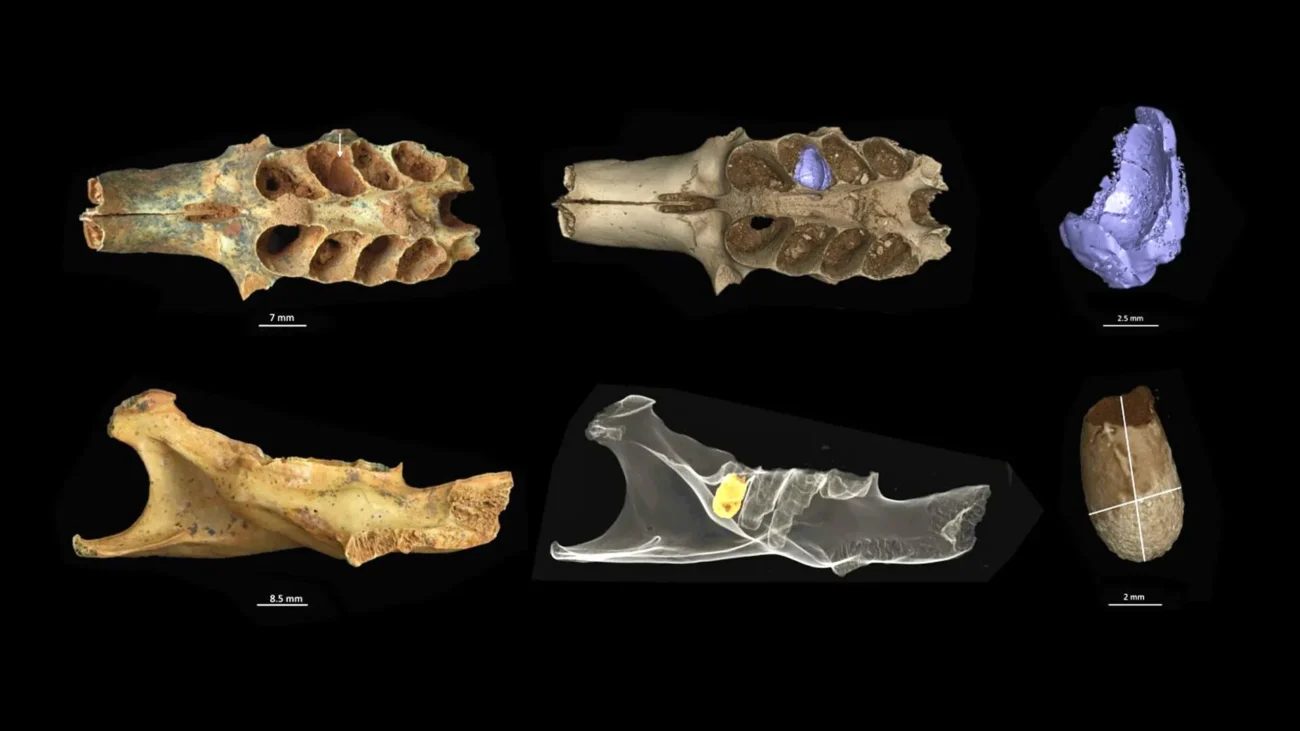
The hutia’s jawbone, a crucial component of its feeding apparatus, contained small sockets known as alveoli, where its teeth had once been firmly anchored. While the teeth themselves had long since decomposed, these hollow spaces remained remarkably intact. Their dimensions, it turned out, were almost perfectly suited to the size requirements for a bee’s nest. Rather than needing to expend precious energy excavating new tunnels in the compacted silt, the bee found a ready-made, structurally sound cavity. It began to utilize these natural, bone-derived chambers as its nursery.
This initial discovery by one bee was just the beginning. The cave’s bounty of pre-existing cavities, a direct consequence of the owls’ consistent predatory activity, provided an ideal environment for a growing population of these resourceful insects. Over time, more bees followed, drawn to the same advantageous nesting sites. They began to line these hollow spaces with a specialized secretion, a waxy substance that served to waterproof and reinforce their nascent homes. Thus, the fossilized remains of the hutia, once a symbol of predator and prey, were transformed into the foundational architecture for a thriving colony of burrowing bees.
A Paleontological Puzzle: Unearthing the Unseen
The story of these ancient bees and their fossilized nurseries remained hidden for millennia, a secret preserved within the geological strata of the cave. The eventual uncovering of this remarkable phenomenon was the result of keen observation and a departure from conventional paleontological practices.
Lazaro Viñola Lopez, a doctoral student at the Florida Museum of Natural History, was instrumental in this discovery. While conducting excavations at Cueva de Mono, he was particularly focused on studying a rare species of hutia found on the island. His work yielded thousands of fossils, all appearing to belong to the same species. This abundance suggested that the cave had indeed served as a long-term feeding site for giant barn owls, a hypothesis supported by the sheer volume of prey remains.
Typically, paleontologists meticulously clean fossils, removing all extraneous sediment, including any material that might be lodged within bone cavities. However, Viñola Lopez, driven by an unusual curiosity, chose a different approach. He meticulously inspected the fossils, paying close attention to the internal surfaces of the bone structures. It was during this careful examination that he noticed something peculiar: one of the alveoli in a hutia jawbone possessed an unusually smooth inner surface, a stark contrast to the rough, porous texture of the surrounding bone.
From Wasp Nests to Bee Colonies: A Scientific Correction
Initially, Viñola Lopez hypothesized that these smooth-walled cavities might be evidence of ancient wasp nests. He recalled a similar discovery he had made in Montana in 2014, where he had found wasp cocoons embedded within fossilized dinosaur material. He entertained the idea of publishing a brief report on this presumed occurrence of wasp nests within hutia mandibles.
He shared his preliminary findings with his colleague, Mitchell Riegler, another doctoral student at the museum. Riegler, initially preoccupied with other research, was not immediately enthusiastic about pursuing what he perceived as a niche project. However, the idea lingered, eventually resurfacing when Riegler accepted a challenge from a former advisor to write a scientific paper within a week. This collaborative endeavor, a friendly competition to produce a paper on a chosen topic, provided the impetus to revisit the peculiar fossilized cavities.
As the two students delved deeper into the research, comparing their findings with existing literature on ichnofossils—traces of past biological activity such as footprints, burrows, or nests—they began to realize their initial identification was likely incorrect. The defining characteristic that led to their scientific re-evaluation was the internal texture of the cavities. Wasp nests are typically constructed from chewed plant material and saliva, resulting in rough, irregular walls. In contrast, the structures within the hutia fossils were uniformly smooth. This smooth, almost polished appearance is a hallmark of nests built by certain species of bees, which often coat their brood cells with a waterproof, waxy secretion. The correction was profound: they were not documenting wasp nests, but rather the remarkably preserved evidence of ancient bee colonies.
A Behavior of Unprecedented Significance
This revised identification elevated the discovery from an interesting observation to a scientifically significant finding. The use of pre-existing fossilized structures by burrowing bees as nesting sites, without any modification to the natural cavities, represented a behavior that was virtually unprecedented in the scientific record. While there was one other known instance of burrowing bees nesting within a cave environment, and a report of bees drilling into human bones, no previous documentation existed of bees utilizing natural cavities within fossilized remains in such a passive, opportunistic manner.
Recognizing the immense importance of their findings, Viñola Lopez and Riegler broadened their research. They engaged with experts specializing in modern bee behavior and conducted an extensive review of scientific literature. Viñola Lopez also returned to the Cueva de Mono to conduct further geological analysis, aiming to better understand the environmental conditions that might have facilitated such unusual nesting behavior.
The research team faced a race against time during their expanded investigations. The land surrounding the cave was slated for development, with plans to convert the cave into a septic tank. Fortunately, conservation efforts successfully halted this destructive proposal. However, in the interim, the paleontological team had to conduct a rapid "rescue mission" to recover as many fossils as possible before any irreversible damage could occur. This urgent effort ensured the preservation of a wealth of material that would further illuminate the cave’s rich history.
Beyond the Jawbone: Diverse Fossil Niches
The final, comprehensive study, published in the Proceedings of the Royal Society B, revealed that the bees’ nesting habits were not confined solely to the jawbones of the hutias. The research team discovered evidence of bee nests within a variety of fossilized remains from the cave. In one striking instance, a nest was found meticulously constructed within the pulp cavity of a sloth tooth. Tree sloths, once native to the Caribbean, had long since vanished from the region, making this discovery a poignant link to a lost era. Another nest was identified within a hutia vertebra, occupying the space that once housed the animal’s spinal cord.
Advanced imaging techniques, such as CT scans, provided further astonishing details. These scans revealed that some cavities had been repurposed multiple times. Instead of excavating new tunnels, certain bee species demonstrated a remarkable adaptability by reusing existing empty cavities. In one remarkable example, a single hutia alveolus contained an astonishing six individual bee nests, one nested inside another, reminiscent of the iconic Russian nesting dolls. This layered arrangement suggested a long history of successful nesting and reuse within these fossilized structures.
Karstic Landscapes and the Genesis of an Adaptation
The researchers also proposed a compelling explanation for why these bees were drawn to such an unusual nesting environment. The geological landscape of Hispaniola, particularly the region where Cueva de Mono is located, is characterized by karst topography. Karst terrain is composed of soluble bedrock, primarily limestone, which is eroded by rainwater, leading to the formation of caves, sinkholes, and sharp, jagged rock formations. This type of terrain is often deficient in stable soil.
Mitchell Riegler elaborated on this environmental challenge: "The area we were collecting in is karst, so it’s made of sharp, edgy limestone, and it’s lost all of its natural soils. I actually fell on it at one point, so I can tell you all about it." In such environments, any soil that does accumulate on the surface is frequently washed away by rainfall, often draining into the subterranean cave systems. Within these caves, the washed-in sediment can settle, creating localized pockets of suitable material—material that might be the only viable option for burrowing bees seeking to construct their nests. The ancient cave, therefore, filled with the detritus of past predation, inadvertently offered a stable and protected refuge for these resourceful insects, providing a critical nesting substrate in an otherwise inhospitable landscape.
A Legacy of Discovery in the Depths of Time
The ongoing research at Cueva de Mono promises to yield further insights into the island’s rich paleontological and ecological history. The team continues to analyze other fossils recovered from the cave, with additional publications anticipated in the future. This remarkable discovery, born from a chance encounter between a predator’s larder and an insect’s instinct, serves as a powerful illustration of life’s persistent adaptability. It underscores how even the most seemingly insignificant creatures can exploit unexpected opportunities, leaving behind indelible traces of their existence that continue to inform and inspire scientific understanding centuries later. The cave, once a silent repository of ancient meals, has become a vibrant narrative of survival, adaptation, and the enduring legacy of life’s intricate interconnections.
