

A minuscule parasitic worm, no larger than a speck of dust, possesses an astonishing ability: it can launch itself into the air up to 25 times its own body length. New research has unveiled the ingenious mechanism behind this acrobatic feat, revealing that the nematode Steinernema carpocapsae utilizes static electricity to latch onto unsuspecting flying insects. This groundbreaking discovery, published in the prestigious journal Proceedings of the National Academy of Sciences (PNAS), is the result of a collaborative effort between scientists at Emory University and the University of California, Berkeley, shedding new light on the intricate adaptations of the natural world.
The Electrostatic Advantage: A Tiny Hunter’s Secret Weapon
The research meticulously details how Steinernema carpocapsae exploits electrostatic forces to achieve its predatory success. "We’ve identified the electrostatic mechanism this worm uses to hit its target, and we’ve shown the importance of this mechanism for the worm’s survival," stated co-author Justin Burton, a professor of physics at Emory University whose lab spearheaded the mathematical analyses of the experimental data. "Higher voltage, combined with a tiny breath of wind, greatly boosts the odds of a jumping worm connecting to a flying insect."
Victor Ortega-Jiménez, an assistant professor of biomechanics at the University of California, Berkeley, and co-lead author of the study, emphasized the significance of studying small organisms. "You might expect to find big discoveries in big animals, but the tiny ones also hold a lot of interesting secrets," he remarked. Ortega-Jiménez led the experimental work, employing high-speed microscopy to capture high-resolution footage of the needle-tip-sized worms as they launched themselves toward electrically charged fruit flies.
The scientists discovered that as insect wings move through the air, they generate an electric field measuring several hundred volts. This ambient charge induces an opposing charge in the nematode, creating an electrostatic attraction that acts as an invisible tether, drawing the worm towards its aerial prey. Through rigorous experimentation, the team confirmed that this remarkable interaction is powered by electrostatic induction, a fundamental principle of physics.
Ranjiangshang Ran, a postdoctoral fellow in Burton’s lab and co-lead author, highlighted the interdisciplinary nature of the research. "Using physics we learned something new and interesting about an adaptive strategy in an organism," Ran explained. "We’re helping to pioneer the emerging field of electrostatic ecology."
The study also benefited from the contributions of other researchers, including Saad Bhamla and Sunny Kumar from the Georgia Institute of Technology, who specialize in biomechanics across various species and conducted crucial preliminary trials. Adler Dillman, a nematode biologist at the University of California, Riverside, provided essential expertise on the organism itself.
The Shocking Lives of Tiny Creatures: A Broader Ecological Context
The phenomenon of static electricity, familiar to most as the spark felt when touching a doorknob or the cling of a freshly dried sweater, occurs when there is an imbalance of electric charges on a surface. While often a minor inconvenience for humans, scientists are increasingly recognizing its profound impact on the survival and behavior of many small organisms.
This current research builds upon a growing body of evidence that suggests static electricity plays a vital, yet often overlooked, role in ecological interactions. In 2013, Ortega-Jiménez himself made a significant discovery regarding spider webs. His research indicated that these intricate silk structures can harness the electrical charge of nearby insects, drawing them in and facilitating their entrapment. Further studies have revealed that static forces aid bees in collecting pollen, allow flower mites to cling to hummingbirds, and enable ballooning spiders to drift across vast distances using charged silk.
Burton and Ortega-Jiménez have also collaborated on a recent commentary for Trends in Parasitology, exploring the electrostatic interactions of ticks. "Ticks can get sucked up from the ground by fluffy animals, purely through the static electricity in the animal’s fur," Burton elaborated. Experiments designed to test this phenomenon led Ortega-Jiménez to develop a precise method for controlling the electric charge of a tethered tick, a technological advancement that proved instrumental in enabling the current nematode research.
As the Jumping Worm Turns: The Mechanics of an Aerial Ambush
The primary objective of the current study was to investigate how electrostatic forces, in conjunction with aerodynamic principles, influence the success rate of S. carpocapsae in connecting with flying insects.
Steinernema carpocapsae is an unsegmented roundworm, commonly known as a nematode. These microscopic predators are highly effective biological pest control agents, owing to their symbiotic relationship with specific bacteria. The worm kills insects by introducing these bacteria into their bodies, leading to death within 48 hours. The worm then feeds on the multiplying bacteria and the decaying host tissue, subsequently laying eggs. Multiple generations can complete their life cycle within the insect cadaver before juvenile worms emerge to seek new hosts. This life cycle makes them a valuable natural pesticide, and researchers worldwide are actively investigating ways to enhance their efficacy.
When S. carpocapsae detects an insect above, it adopts a coiled posture before launching itself skyward. This remarkable leap can propel the worm to heights of up to 25 times its own body length – an astonishing feat equivalent to a human jumping over a 10-story building. "I believe these nematodes are some of the smallest, best jumpers in the world," Ortega-Jiménez remarked. He further noted that during these dizzying, acrobatic leaps, the worms can rotate at an astounding rate of 1,000 times per second.
Painstaking Experiments: Unraveling the Physics of the Leap
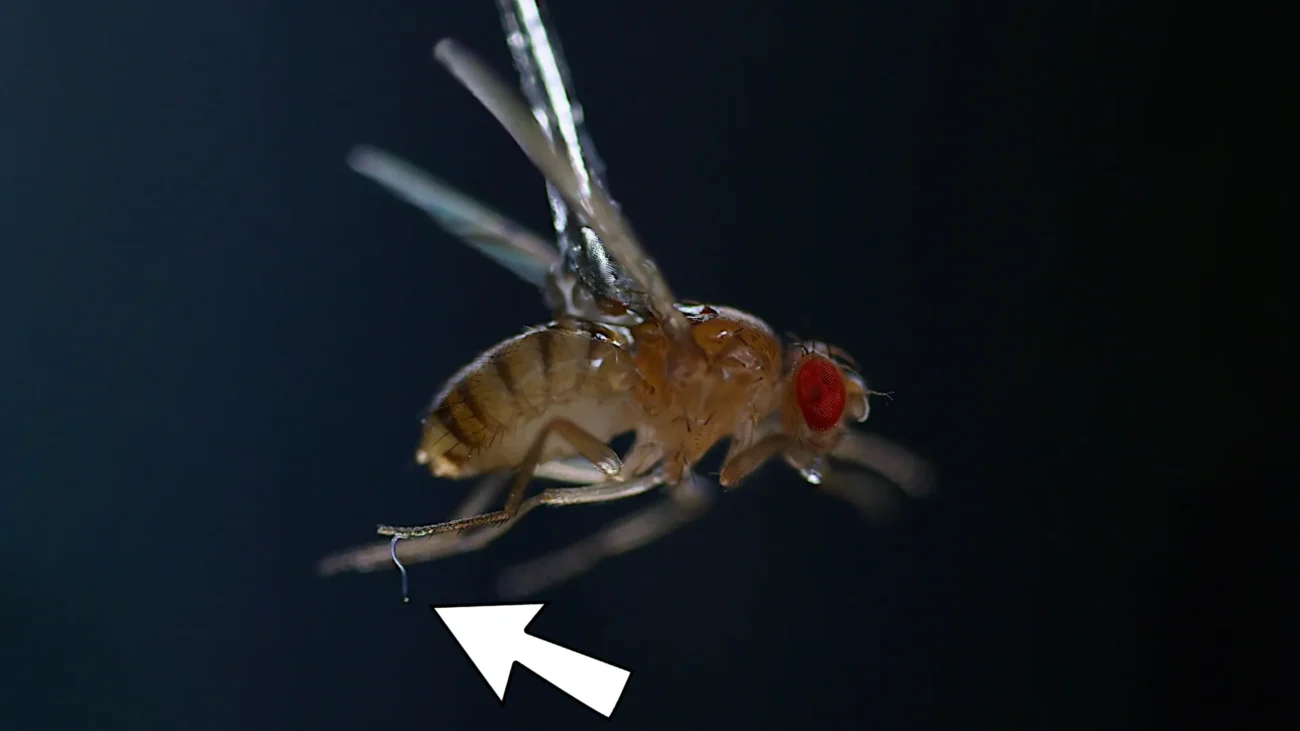
The researchers meticulously designed experiments to dissect the physics underlying the worm’s remarkable ability to intercept aerial targets. In natural environments, the rapid movement of insect wings through the air, interacting with atmospheric ions, can generate electric fields of several hundred volts. To accurately replicate these conditions, the physicists needed to quantify the precise electric charge of the fruit flies used in their experimental setup. This necessitated a delicate procedure developed by Ortega-Jiménez: attaching a minuscule wire, connected to a high-voltage power supply, to the back of each fruit fly to precisely control its voltage.
"It’s very difficult to glue a wire to a fruit fly," Ortega-Jiménez confessed, recounting that this painstaking process often took him between half an hour and an hour per fly.
Another significant challenge involved identifying the optimal conditions to induce the worms to jump in a controlled laboratory setting. Ortega-Jiménez discovered that a substrate of moistened paper, neither too wet nor too dry, was crucial. Furthermore, the worms required a subtle stimulus, such as a gentle puff of air or a minor mechanical disturbance, to initiate their launch towards a suspended fruit fly.
Ortega-Jiménez conducted dozens of these intricate experiments, meticulously recording each event with a specialized high-speed camera. This camera, capable of capturing images at an astonishing 10,000 frames per second, was essential for tracking the midair trajectories of the submillimeter worms, which are virtually invisible to the naked eye. For some experiments, he ingeniously constructed a miniature wind tunnel, allowing the physicists to systematically analyze the impact of ambient breeze on the worm’s target acquisition success rate.
Digitizing the Data: Statistical Analysis and Probabilistic Outcomes
The next crucial phase involved transforming the raw experimental footage into quantifiable data. Ran utilized computer software to digitize the trajectories of the worms from approximately 60 experimental videos. This process, though time-consuming, was essential for statistical analysis. In instances where a worm moved out of the camera’s focal plane, blurring its image, Ran had to manually record its position frame by frame.
To analyze the digitized data, Ran employed a sophisticated computer algorithm known as Markov chain Monte Carlo (MCMC). This method, named after the mathematician Andrey Markov and inspired by the probabilistic nature of Monte Carlo casinos, allows researchers to explore a vast number of possibilities and estimate the probability of a particular outcome.
Ran applied the MCMC algorithm to identify a set of 50,000 plausible parameter values for each worm’s trajectory. These parameters included variables such as the voltage of the insect, the physical dimensions of the worm, and its launching velocity. By systematically testing these values, Ran could determine the probability that a specific charge on the worm would enable it to successfully strike its target.
The results were compelling. In the absence of any electrostatic charge, only one out of 19 worm trajectories successfully reached the target. However, when the model incorporated the electrostatic forces, the findings revealed a dramatic increase in success rates. A charge of a few hundred volts, a magnitude commonly generated by flying insects, induced an opposing charge in the jumping worm, significantly boosting its chances of making contact. With an insect charge of just 100 volts, the probability of hitting the target dropped to less than 10%. Conversely, an insect charge of 800 volts elevated the probability of success to an impressive 80%.
These findings underscore the critical importance of electrostatic interactions for the survival strategy of S. carpocapsae. Launching into the air expends a considerable amount of energy for the worm, leaving it vulnerable to predation and desiccation. "Our findings suggest that, without electrostatics, it would make no sense for this jumping predatory behavior to have evolved in these worms," Ran concluded, highlighting the evolutionary significance of this adaptation.
Science Past and Future: Echoes of Maxwell and a New Frontier
The researchers had initially hypothesized that electrostatic induction was the primary mechanism driving the interaction between the worm and its prey. Their investigation into existing scientific literature led them to the foundational work of Scottish physicist James Clerk Maxwell, a towering figure in the history of science. "Maxwell, one of the most prolific physicists of all time, had a wild imagination, similar to Einstein," Ran noted. "It turns out that our model for the worm-charging mechanism agreed with a prediction for electrostatic induction that Maxwell made in 1870. There are many buried treasures in scientific history. Sometimes being a scientist is like being an archeologist."
The study also meticulously accounted for drag force, a critical factor for objects as small as the nematode. The researchers used the analogy of a bowling ball versus a floating feather to illustrate the profound impact of air resistance on tiny bodies. While a bowling ball’s trajectory is minimally affected by drag, a feather’s movement is almost entirely dictated by it.
Drawing from the experimental data, Ran simulated the combined effects of electrostatic charge and various wind speeds. The results indicated that even the faintest breeze, as low as 0.2 meters per second, when combined with higher electrostatic voltages, further amplified the likelihood of the worm successfully intercepting its target.
This comprehensive study establishes a novel framework for future investigations into the pervasive role of electrostatics in ecological systems. "We live in an electrical world, electricity is all around us, but the electrostatics of small organisms remains mostly an enigma," Ortega-Jiménez stated. "We are developing the tools to investigate many more valuable questions surrounding this mystery." The research was generously supported by a grant from the W.M. Keck Foundation and the Tarbutton Postdoctoral Fellowship of Emory College of Arts and Sciences, underscoring the significance of this pioneering work.
