

The landscape of animal ownership and aviculture in the United States is currently navigating a complex period of shifting legal frameworks, where the distinction between pet ownership and prohibited activity is increasingly defined by local, state, and federal legislative maneuvers. As advocacy groups intensify their efforts to reshape the legal status of animals, the American Federation of Aviculture (AFA) has identified a critical need for bird owners, breeders, and exhibitors to maintain a vigilant watch over legislative developments. The process of monitoring legislation is no longer a secondary concern for hobbyists; it has become a fundamental necessity for the survival of bird keeping as a recognized and legal practice. By understanding the mechanics of bill drafting, the influence of lobbying organizations, and the nuances of regulatory changes, the avicultural community can better protect its interests against restrictive ordinances that often begin with seemingly unrelated objectives.
The Mechanics of Modern Legislation and the Role of Lobbying
In its historical context, legislation refers to the formal proposal and enactment of laws. However, in the modern political arena, the majority of legislative action begins as a "Bill"—a document that represents the specific intent of its drafter. While these bills are introduced by elected representatives, they frequently originate within the offices of powerful lobbying organizations. This is particularly prevalent in the realm of animal law, where organizations focused on animal rights and animal welfare draft comprehensive language and present it to sympathetic legislators for introduction into the local, state, or federal systems.
A critical distinction exists between animal welfare and animal rights agendas, though the two are often conflated in public discourse. Animal welfare typically focuses on the humane treatment and responsible care of animals within the context of human-animal interactions. Conversely, many animal rights organizations pursue an abolitionist agenda, seeking to end the human use or ownership of animals entirely. Because these organizations have significant funding and dedicated legal teams, the bills they draft are often sophisticated and designed to achieve long-term strategic goals. For bird owners, this means that a bill ostensibly designed to prevent cruelty may contain definitions or restrictions that effectively outlaw the breeding or exhibition of exotic birds.
The Anatomy of Local Ordinances and the "Slippery Slope" Effect
The AFA has raised significant concerns regarding the negative impacts of bills on pet birds, breeding stock, and exhibit animals. One of the primary challenges for the average bird owner is recognizing how a proposed law might affect them when the initial language seems focused on other species. A common example involves local "ordinances," which are laws enacted at the city or county level. These often begin as measures to address concerns regarding the overpopulation of dogs and cats or the mitigation of public nuisances.
Consider a scenario where a city council proposes an ordinance to limit the number of dogs or cats in a single household to six. On the surface, this may appear to be a reasonable measure for urban management. However, these ordinances frequently utilize broad language or are subject to future amendments. If the definition of "pet" or "animal" in such an ordinance is expanded to include birds, a canary breeder with six breeding pairs—totaling twelve birds—would suddenly find themselves in violation of the law.
Furthermore, ordinances are typically civil rather than criminal matters. While this means an owner may not face immediate arrest, it subjects them to a cycle of fines and administrative hearings. If an owner fails to comply or pay the assessments, a judge can eventually hold them in contempt of court, leading to more severe legal repercussions. The AFA emphasizes that these local changes are often the "front lines" of legislative shifts, where small adjustments to definitions can have catastrophic consequences for aviculturists.
Chronology of Legislative and Regulatory Evolution
The path from a proposed idea to an enforceable rule follows a specific chronology that stakeholders must understand to intervene effectively.
- Drafting and Introduction: A bill is drafted, often by a lobbying group, and introduced by a legislator. At this stage, the bill is assigned a number and referred to a committee. This is the most effective time for advocacy groups like the AFA to provide input or seek amendments.
- Committee Review and Public Comment: Committees hold hearings to discuss the bill’s merits. This stage involves expert testimony and public feedback. If a bill is misleadingly summarized, it may pass this stage without the affected community realizing its implications.
- Voting and Enactment: If the bill passes through committees, it moves to the full chamber (City Council, State Assembly, or Congress) for a vote. Once signed by an executive (Mayor, Governor, or President), it becomes law.
- Administrative Rulemaking and Regulations: Once a law is enacted, the relevant government agency (such as the USDA or USFWS) creates "regulations"—the specific rules on how the law is enforced. Unlike the law itself, regulations can sometimes be changed through an administrative process rather than a legislative vote, though this still requires a period of public notice and comment under the Administrative Procedure Act.
A prime example of this process is the inclusion of species under the Endangered Species Act (ESA) by the U.S. Fish and Wildlife Service (USFWS). While the ESA is a federal law, the specific list of birds protected under it can be modified by agency officials based on biological data and public petitions, significantly impacting the interstate trade and movement of those species.
Supporting Data: The Rising Tide of Animal-Related Bills
The volume of anti-animal use legislation has seen a marked increase over the last decade. According to legislative tracking data, hundreds of bills related to animal "rights" or "protection" are introduced annually across the 50 states. Many of these bills focus on "exotic animal bans" or "prohibitions on animal performances."
In many instances, these bills use "inclusive language" that defines "wild or exotic animals" so broadly that it encompasses common pet birds like parrots, finches, and even certain types of poultry. For instance, a local act intended to prohibit circuses from using elephants might be written with a definition of "exotic animal" that includes all non-native avian species. Without specific exemptions for aviculture, the law could inadvertently—or intentionally—criminalize the display of birds at educational events or bird shows.
The AFA Legislative Committee, working in tandem with other animal-interest organizations, monitors these developments closely. Their experience shows that once a restrictive law is passed in one jurisdiction, it serves as a "model" for other states and cities. This "domino effect" makes it easier for activists to propose similar restrictions elsewhere, citing the previous law as a successful precedent.
Official Responses and the Strategy of Avicultural Advocacy
The AFA’s stance is that proactive education and early intervention are the only ways to prevent the erosion of bird-keeping rights. The organization’s Legislative Committee emphasizes that bird owners must look beyond the "introductory summary" of a bill, which is often written in a way that sounds universally positive. Statements from the AFA suggest that while a bill may claim to be "eliminating inhumane treatment," the actual legal mechanisms within the text may be designed to make bird ownership prohibitively expensive or legally risky.
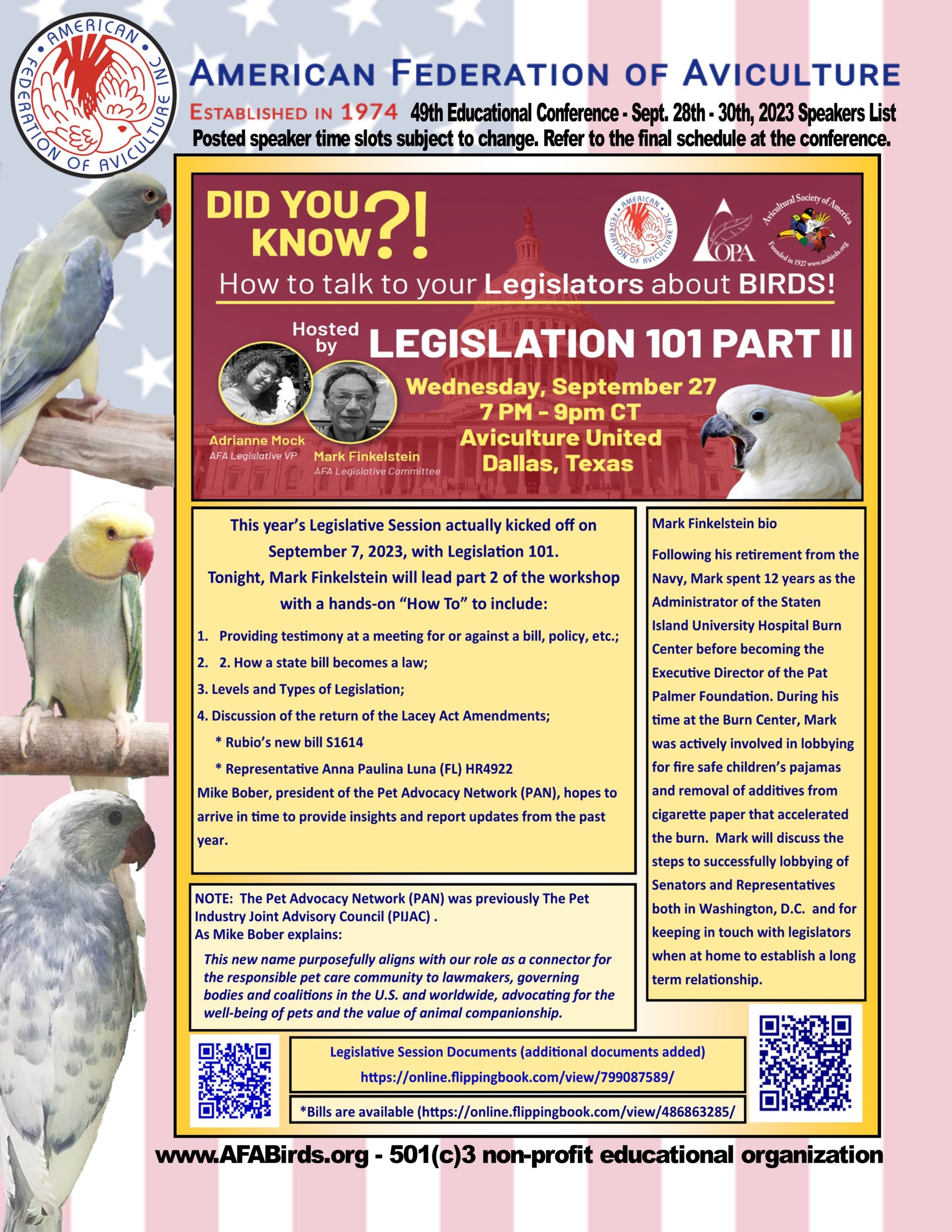
To combat this, the AFA encourages its members to enroll in programs like the "Legislation 101: Training Course." This educational initiative is designed to teach bird owners how to read bill text, identify "trigger words" that could affect aviculture, and communicate effectively with their elected officials. The goal is to move the community from a reactive posture—where they only respond after a law is passed—to a proactive one where they are involved in the drafting and vetting process.
Broader Impact and Long-term Implications for the Avicultural Community
The implications of failing to monitor legislation extend far beyond the individual hobbyist. The avicultural industry contributes significantly to the economy through the sale of feed, cages, veterinary services, and specialized equipment. Restrictive laws that stifle breeding and ownership could lead to a decline in these secondary industries, impacting thousands of jobs.
Furthermore, there is a conservation concern. Many bird species are currently thriving in captivity through the efforts of dedicated breeders, even as their wild populations dwindle due to habitat loss. If domestic breeding is regulated out of existence, the "safety net" provided by aviculture for these species could disappear.
The AFA warns that the ultimate goal of certain radical lobbying groups is the total elimination of birds from human lives, whether as pets or in business. If the community does not stay informed through resources like the "Current Legislative Issues" portal, they risk a future where the birds they care for are legally categorized as "nuisances" or "illegal contraband."
In conclusion, the monitoring of legislation is an essential pillar of modern bird keeping. It requires a sophisticated understanding of the legal system, a skeptical eye toward bill summaries, and a commitment to collective action. By staying informed on the activities of the USDA, USFWS, and local city councils, aviculturists can ensure that the joy of bird ownership remains a protected right for future generations. The AFA remains dedicated to this mission, providing the tools and oversight necessary to navigate an increasingly complex legislative environment.
