


The Evolution of Mobile Manual Control
The mobile photography landscape has shifted dramatically over the last decade. While Apple’s native Camera app has become increasingly adept at computational photography—using artificial intelligence to balance shadows and highlights automatically—many professional creators find these "black box" algorithms restrictive. The demand for "Pro" camera apps has grown as users seek to regain manual control over ISO, shutter speed, white balance, and focus. Reeflex has positioned itself within this niche, focusing on a "photography-first" philosophy that prioritizes manual precision over automated processing.
Version 3.0 represents the culmination of user feedback and technical advancement. The update focuses on three primary pillars: advanced capture modes, a rebuilt high-performance engine, and a streamlined workflow that minimizes the friction between the photographer’s vision and the final image. As smartphone sensors, particularly the 48-megapixel units found in recent iPhone Pro models, continue to improve in physical size and resolution, the software driving them must evolve to leverage that raw potential.
Advanced Bracketing: Focus and Exposure Precision
At the heart of the Reeflex Pro Camera 3.0 update are the new Focus and Exposure Bracketing modes. These techniques are staples in professional landscape, architectural, and macro photography, but they have historically been difficult to execute on mobile devices without significant third-party post-processing.
Focus Bracketing is a specialized tool designed to overcome the physical limitations of small sensors and lenses. In macro photography, the depth of field is often so shallow that only a tiny sliver of the subject remains in focus. By utilizing the Focus Bracketing tool in Reeflex 3.0, photographers can capture a sequence of frames across a defined focus range. When these frames are later stacked, the result is an image with edge-to-edge sharpness that would be impossible to achieve in a single shot. This feature is equally valuable for landscape photographers who want to maintain sharp detail from the immediate foreground to the distant horizon.
Exposure Bracketing addresses the challenge of high-contrast scenes. While Apple’s built-in Smart HDR does a commendable job for casual users, professional editors often prefer to have the individual bracketed RAW files to blend manually. Reeflex 3.0 allows users to capture multiple exposures of the same scene—one for the shadows, one for the mid-tones, and one for the highlights. This ensures that no data is lost to "clipping" in bright skies or "crushing" in dark shadows, providing a much higher dynamic range for post-production in software like Adobe Lightroom or Capture One.
Rebuilt Capture Engine and Burst Mode Enhancements
To support these advanced features, Reeflex has completely overhauled its internal capture engine. One of the most common complaints regarding third-party camera apps is "shutter lag"—the delay between pressing the button and the image being recorded. The new engine in version 3.0 is designed to eliminate this lag, providing a near-instantaneous response that is critical for street photography and action shots.
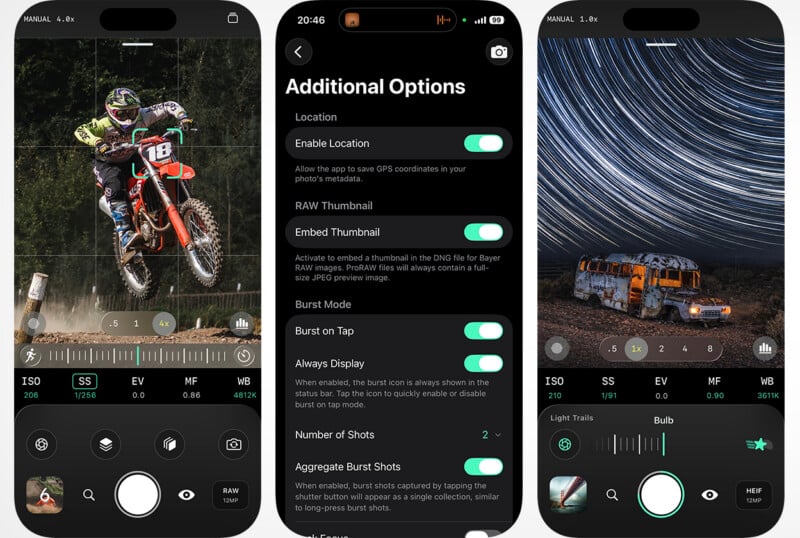
The upgraded Burst Mode is a direct beneficiary of this engine overhaul. Integrated directly into the shutter experience, users can now trigger rapid sequences by simply holding the shutter button. The app provides granular control over the burst experience, including settings for shot count, focus locking during the sequence, and the ability to group burst shots within the gallery to prevent clutter. This responsiveness ensures that photographers can capture the "decisive moment" in fast-moving environments, such as sports or wildlife photography, with the same confidence they would have when using a traditional camera.
Streamlined Interface and Professional Monitoring Tools
A professional tool is only as good as its usability. Reeflex Pro Camera 3.0 introduces a redesigned interface that aims to reduce "menu diving" and keep the photographer’s eye on the subject. The new layout brings camera selection—switching between the ultra-wide, wide, and telephoto lenses—directly into the viewfinder area for quicker access.
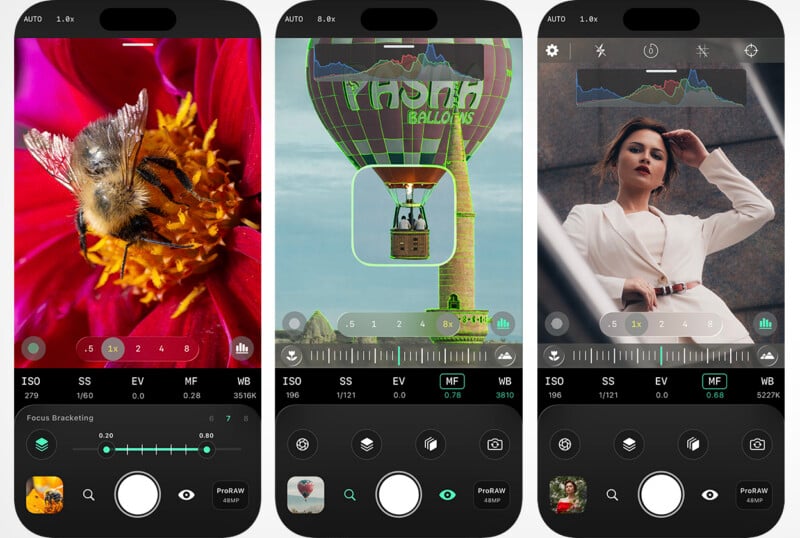
Furthermore, the update enhances the app’s monitoring capabilities. For exposure management, the app features real-time histograms and "zebra stripes." Histograms provide a graphical representation of the tonal distribution in an image, allowing photographers to see if an image is overexposed or underexposed before they hit the shutter. Zebra stripes act as a visual overlay that highlights overexposed areas of the frame in real-time, serving as a warning to adjust the shutter speed or ISO.
For manual focusing, Reeflex 3.0 introduces a Focus Magnifier that works in tandem with Focus Peaking. Focus Peaking highlights the edges of objects that are in sharp focus with a colored overlay. The Focus Magnifier takes this a step further by enlarging a portion of the frame, allowing the user to verify the exact point of focus with pinpoint accuracy. These tools are essential for users who prefer manual focus to ensure the AI doesn’t accidentally lock onto the wrong subject.
Expanded Format Support and Gallery Management
Reeflex Pro Camera 3.0 offers a wide array of file formats to suit different needs. For quick sharing, users can shoot in JPG or HEIF. For those who require maximum editing flexibility, the app supports standard RAW and Apple’s ProRAW format. On compatible devices, such as the iPhone 14 Pro and later, the app fully supports 48-megapixel capture, allowing for significant cropping and large-scale printing.
The internal gallery has also been modernized to handle the influx of data that comes with professional shooting. New features include:
- RAW and JPG Tagging: Clearly identifies which files contain the most data for editing.
- Burst Grouping: Automatically stacks rapid-fire sequences to keep the gallery organized.
- Enhanced Metadata: Provides a deep dive into the EXIF data, including specific lens information, exposure settings, and GPS coordinates for location tracking.
Long Exposure and Creative Flexibility
Long exposure photography remains a standout feature in the Reeflex ecosystem. The app’s slow shutter modes, which include "Motion Blur" and "Light Trails," allow users to create artistic effects without the need for physical Neutral Density (ND) filters. By using computational stacking, Reeflex can simulate the effect of a long exposure, smoothing out moving water, blurring clouds, or turning car headlights into flowing streams of light.
The app supports capture durations ranging from half a second to two hours. For specialized night photography, an unlimited "Bulb" mode is available, giving the photographer total control over the exposure time. Uniquely, these long exposures can be previewed in real-time as they develop on the screen, allowing the user to stop the exposure the moment the desired effect is achieved.

Industry Impact and Future Roadmap
The recognition of Reeflex by the Apple App Store as "App of the Day" and its inclusion in the "Apps We Love" category underscores its growing influence in the mobile photography community. Industry analysts suggest that the continued success of apps like Reeflex, Halide, and ProCamera indicates a maturing market where the smartphone is no longer seen as a "toy" but as a legitimate tool in a professional’s kit.
Looking forward, Reeflex has announced an ambitious roadmap. The company plans to introduce in-app stacking for both focus and exposure bracketing. This would allow users to complete the entire creative process—from capture to final composite—without ever leaving their iPhone. Additionally, the company is developing native support for its "G-Series" add-on lenses. This integration will allow the app to automatically detect the attached hardware and apply specific optical corrections or optimizations, further enhancing image quality.
Pricing, Availability, and Technical Requirements
Reeflex Pro Camera 3.0 is currently available on the Apple App Store for a one-time purchase price of $14.99. This pricing model stands in contrast to the increasing trend of subscription-based software, making it an attractive option for photographers who prefer perpetual licenses.

The app requires a device running iOS 15 or later. While the core manual controls are available on all compatible iPhones, advanced features such as ProRAW and 48-megapixel capture are limited to the iPhone 12 Pro, 13 Pro, 14 Pro, 15 Pro, and 16 Pro series. For new users, Reeflex provides a suite of educational resources, including in-app tutorials and a comprehensive FAQ section on their official website, to help them master the complexities of manual mobile photography.
By prioritizing technical depth and user experience, Reeflex Pro Camera 3.0 sets a new standard for what is possible in the palm of a hand, offering a robust alternative for those who find the default smartphone experience lacking in professional rigor.
