


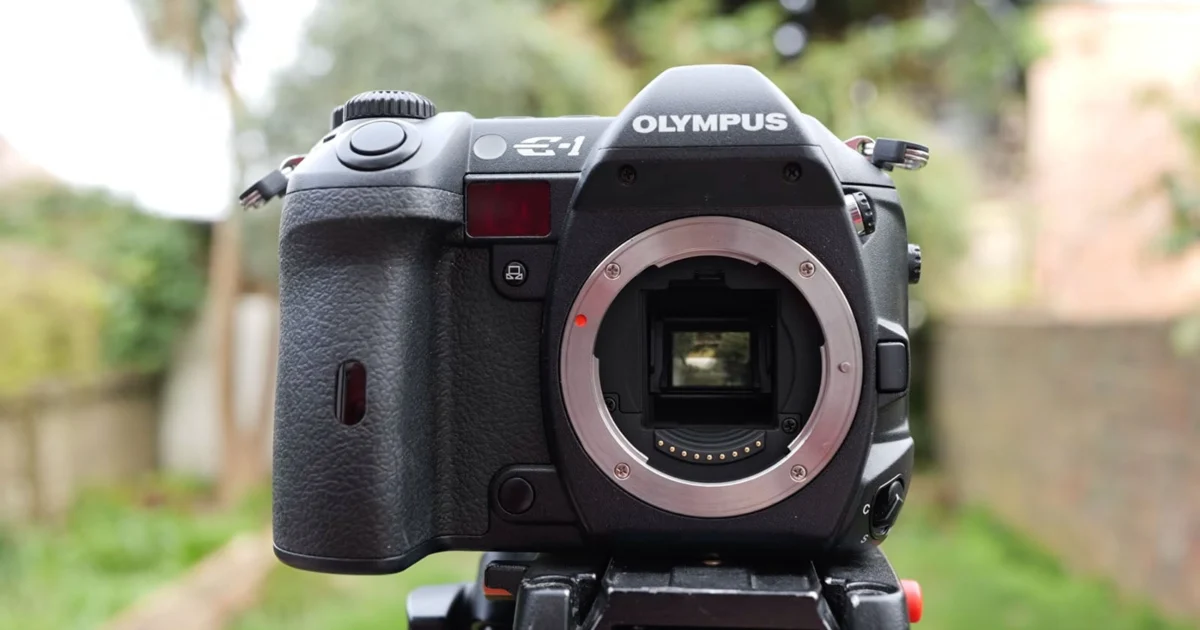
The Olympus E-1, released in late 2003, represents a pivotal moment in the history of digital photography as the first interchangeable-lens camera designed from the ground up for a digital sensor. While contemporary digital single-lens reflex (DSLR) cameras from industry titans Canon and Nikon were built upon the foundations of existing 35mm film mounts, the Olympus E-1 debuted the Four Thirds System. This joint venture between Olympus and Eastman Kodak sought to redefine the relationship between the lens and the sensor, prioritizing a "digital-only" architecture that would eventually pave the way for the modern mirrorless revolution. More than two decades after its introduction, Gordon Laing of Cameralabs has revisited this pioneering device through his "Dino Bytes" series, highlighting the enduring build quality and unique color science of a camera that challenged the status quo of the early 2000s.
The Genesis of the Four Thirds System
In the early 2000s, the transition from film to digital was fraught with engineering compromises. Manufacturers were largely repurposing film camera bodies and lens mounts for digital use. This presented a significant technical challenge: film is relatively indifferent to the angle at which light strikes it, but digital sensors are not. Because digital pixels sit at the bottom of microscopic "wells" or microlenses, light hitting the sensor at an oblique angle—common with lenses designed for film—often resulted in vignetting, chromatic aberration, and reduced sharpness at the edges of the frame.
To solve this, Olympus and Kodak developed the Four Thirds System. The standard was announced in 2001 and officially launched with the E-1 in 2003. The core philosophy was "telecentricity." By designing a new mount with a larger diameter relative to the sensor size, engineers could ensure that light rays hit the sensor as close to perpendicular as possible across the entire surface. This required an entirely new catalog of lenses, known as the Zuiko Digital range, which were optimized specifically for the 18 x 13.5mm sensor size.
The sensor itself featured a 4:3 aspect ratio, reminiscent of medium format photography and traditional television screens, rather than the 3:2 ratio derived from 35mm film. This gave the system its name and established a unique visual footprint that persists today in the Micro Four Thirds (MFT) ecosystem.
Technical Specifications and the Kodak CCD Sensor
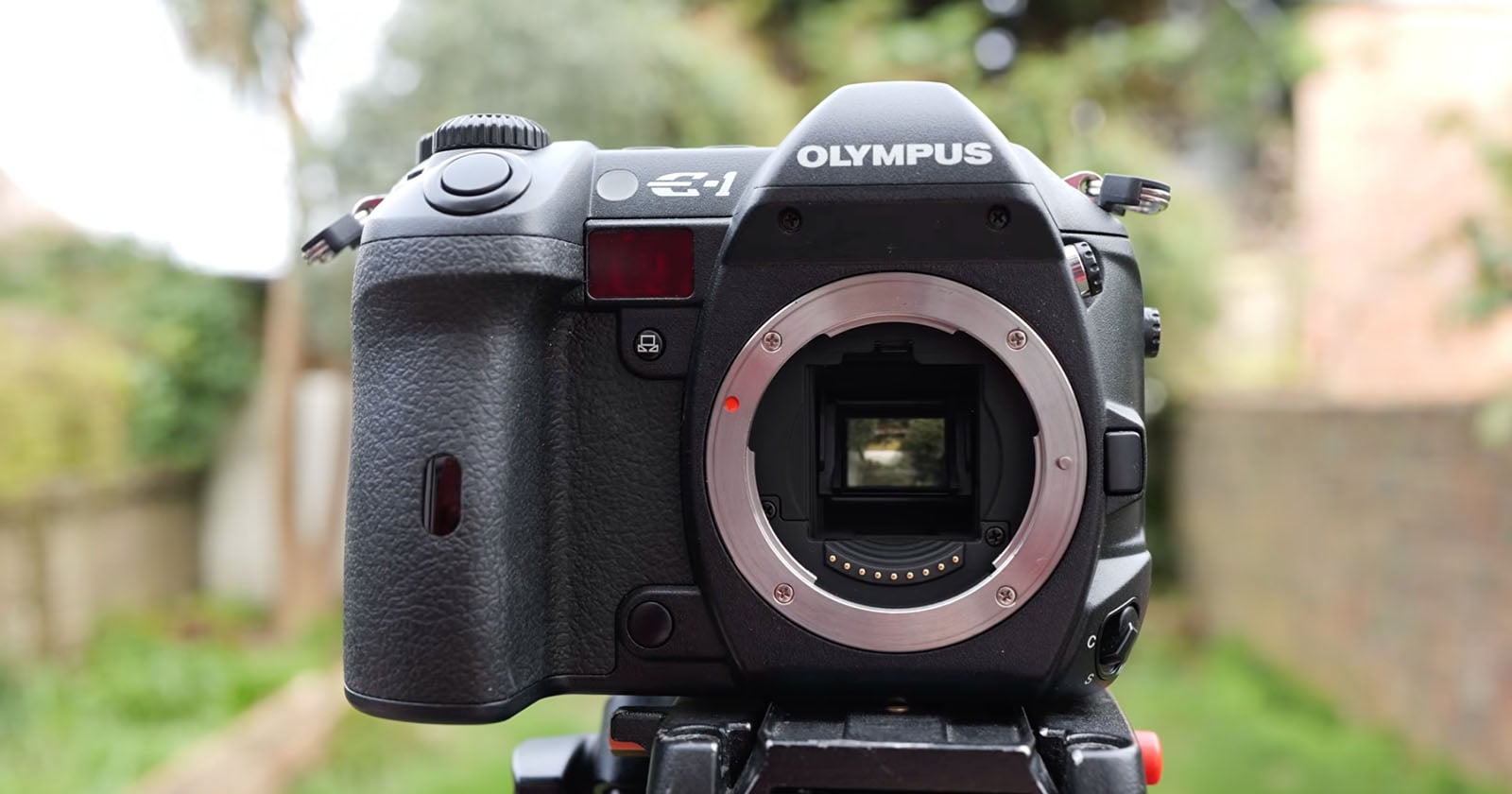
At its heart, the Olympus E-1 utilized a 5.1-megapixel Full Frame Transfer CCD sensor manufactured by Kodak. While 5 megapixels may seem meager by modern standards, in 2003, it was a professional-grade resolution, competing with the Nikon D1 series and the Canon EOS-1D. The CCD (Charge-Coupled Device) technology used in the E-1 is often cited by enthusiasts for its "film-like" color reproduction and high dynamic range at base ISO, characteristics that many modern CMOS (Complementary Metal-Oxide-Semiconductor) sensors are said to lack.
The E-1 was also the first camera to feature an active dust-reduction system. The Supersonic Wave Filter (SSWF) used ultrasonic vibrations to shake dust off the sensor every time the camera was powered on. This innovation was revolutionary at a time when digital photographers were frequently plagued by "sensor spots" caused by dust entering the chamber during lens changes. This technology was so successful that it was eventually adopted in various forms by every other major manufacturer.
Build Quality and Ergonomics
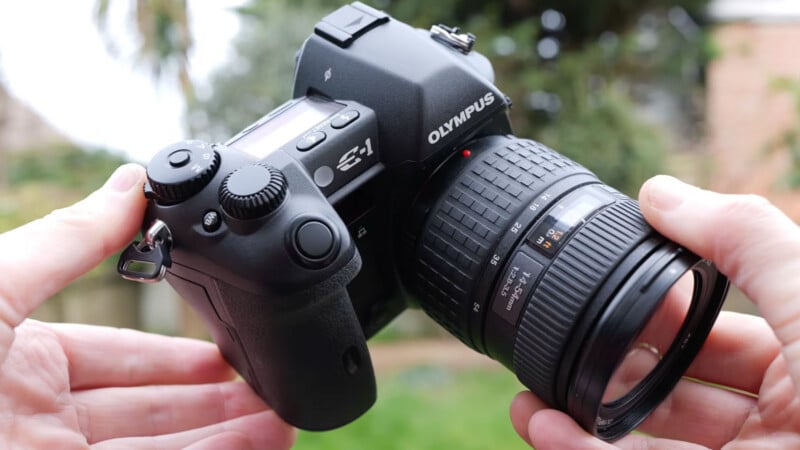
One of the most lauded aspects of the Olympus E-1, and a focal point of Gordon Laing’s retrospective, is its legendary construction. The camera was built like a "tank," featuring a full magnesium alloy chassis and extensive weather sealing. Olympus marketed the E-1 as a professional tool capable of withstanding harsh environments, a claim backed by numerous reports of the camera functioning perfectly in rain, snow, and desert conditions.
The ergonomics of the E-1 were also highly regarded. Unlike the boxy designs of many early DSLRs, the E-1 featured a deep, comfortable grip and an intuitive control layout that prioritized tactile feedback. For modern collectors, this build quality means that many E-1 units found on the used market today remain fully functional, despite twenty years of potential wear and tear. At launch, the E-1 body was priced at approximately $2,000—roughly $3,500 to $4,000 when adjusted for today’s inflation. Today, as Laing notes, a working kit can be acquired for a few hundred dollars, making it an accessible piece of photographic history.
A Chronology of the Four Thirds System
The trajectory of the Four Thirds system was marked by rapid innovation followed by a swift transition to mirrorless technology.
- 2001: Olympus and Kodak announce the Four Thirds System standard.
- 2003: The Olympus E-1 is released as the flagship professional model.
- 2004: Olympus introduces the E-300, featuring a unique "Porro prism" design that eliminated the traditional DSLR "hump," creating a flat-top aesthetic.
- 2005: Panasonic joins the system, eventually releasing the Lumix DMC-L1, which shared components with the Leica Digilux 3.
- 2006: The Olympus E-400 is released. It was the smallest DSLR in the world at the time and the last Olympus DSLR to use a Kodak CCD sensor.
- 2007: The Olympus E-3 is launched, succeeding the E-1 with a 10-megapixel CMOS sensor and world-leading image stabilization and autofocus speeds.
- 2008: Olympus and Panasonic announce the Micro Four Thirds (MFT) system, removing the mirror box to allow for even smaller cameras and lenses.
- 2010: The Olympus E-5 is released. It would be the final flagship DSLR for the Four Thirds mount.
- 2017: Olympus officially announces the discontinuation of Four Thirds lens production, fully committing to the Micro Four Thirds mirrorless line.
Market Reception and Competitive Pressures
While the Four Thirds system was technically sophisticated, it faced significant market headwinds. The primary criticism centered on the sensor size. Because the Four Thirds sensor was roughly half the size of a 35mm "full-frame" sensor, it faced inherent disadvantages in low-light performance and the ability to achieve a shallow depth of field.
Canon and Nikon, by sticking to their legacy mounts, allowed photographers to transition from film to digital while keeping their expensive lens investments. Olympus required photographers to start from scratch. Furthermore, as CMOS technology improved, the gap in noise performance between the smaller Four Thirds sensors and the larger APS-C and Full Frame sensors became a significant marketing hurdle.
Despite these challenges, the system found a dedicated niche among nature and macro photographers. The "2x crop factor" meant that a 300mm lens on a Four Thirds camera provided the same field of view as a 600mm lens on a full-frame camera, but in a significantly smaller and lighter package. This advantage remains a cornerstone of the Micro Four Thirds system today.
Analysis of Implications and Legacy
The Olympus E-1 was not just a camera; it was a proof of concept for the idea that digital photography deserved its own dedicated hardware standards. The failure of the Four Thirds DSLR system to achieve dominant market share did not mean the philosophy was flawed. On the contrary, the lessons learned from the E-1 and its successors directly informed the creation of Micro Four Thirds.
Micro Four Thirds became the first commercially successful mirrorless system, proving that photographers were willing to trade sensor size for portability and electronic innovation. The "digital-first" lens design pioneered by the E-1 is now the industry standard; modern Sony, Canon, and Nikon mirrorless lenses (E, RF, and Z mounts) all follow the telecentric principles first championed by Olympus in 2003.
Gordon Laing’s look back at the E-1 serves as a reminder of a period of intense experimentation in the industry. The E-1’s 5-megapixel CCD may struggle with the dynamic range and high ISO demands of 2024, and its three-point autofocus system feels archaic compared to modern AI-driven subject tracking. However, the "soul" of the images—characterized by the Kodak color science—and the physical satisfaction of using a rugged, purpose-built machine continue to attract digital lo-fi enthusiasts and camera historians alike.
Conclusion
The Olympus E-1 stands as a monument to a bold, if ultimately transitional, era of imaging technology. It challenged the industry to stop looking at digital sensors as a replacement for film and to start looking at them as the center of a new optical universe. While the Four Thirds DSLR mount has been relegated to the annals of history, its DNA lives on in every mirrorless camera currently on the market. For those who own an E-1 today, it is more than a "dino byte"; it is a functional piece of art that captures images with a specific character that modern, hyper-optimized sensors often struggle to replicate. As the photography world continues to move toward ever-higher resolutions and computational processing, the tactile, CCD-driven experience of the Olympus E-1 remains a refreshing touchstone of the digital revolution’s dawn.
