


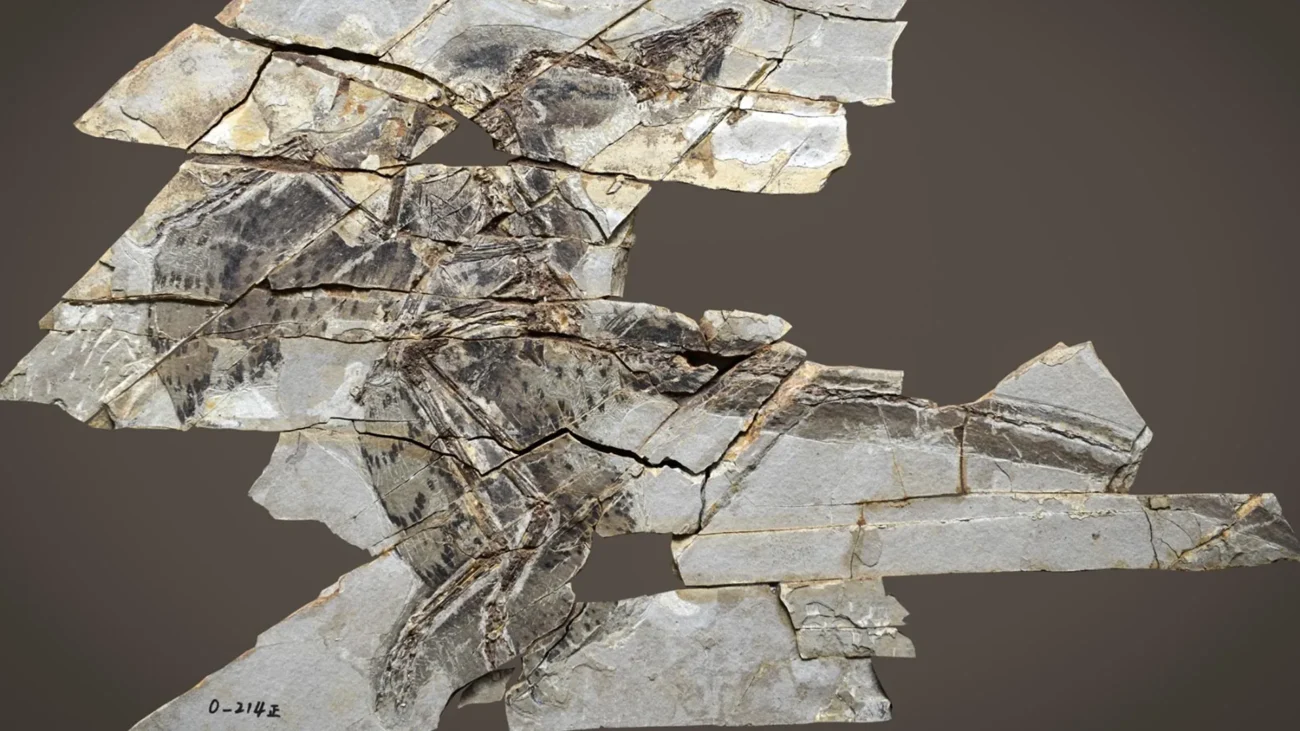
A groundbreaking study of exceptionally preserved dinosaur fossils has unearthed compelling evidence suggesting that some feathered dinosaurs, despite possessing intricate plumage, had already lost the capacity for flight millions of years before the emergence of modern birds. This discovery, led by researchers from Tel Aviv University in collaboration with international scientists, is reshaping our understanding of how flight evolved, revealing a far more complex and dynamic evolutionary trajectory than previously theorized. The findings, published in the esteemed journal Communications Biology by Nature Portfolio, hinge on the meticulous analysis of feather molting patterns preserved in the fossilized remains of Anchiornis, a four-winged feathered dinosaur that roamed the Earth approximately 160 million years ago.
Unraveling the Mystery of Flightless Feathered Dinosaurs
For decades, the prevailing scientific consensus has linked the development of feathers in dinosaurs primarily to the eventual evolution of avian flight. The discovery of feathered dinosaurs, particularly those with wing-like appendages, has often been interpreted as direct precursors to birds and their aerial prowess. However, the recent research challenges this linear progression. By examining the molting patterns—the natural process by which animals shed and regrow their feathers—in nine exceptionally preserved Anchiornis specimens from eastern China, the team has identified clear indicators of flightlessness.
Dr. Yosef Kiat, an ornithologist at Tel Aviv University’s School of Zoology and the Steinhardt Museum of Natural History, spearheaded the study. His expertise in feather development and function in modern birds provided the crucial lens through which to interpret the ancient evidence. "Feather molting seems like a small technical detail," Dr. Kiat explained in a statement, "but when examined in fossils, it can change everything we thought about the origins of flight, highlighting how complex and diverse wing evolution truly was."
The study’s implications are profound, suggesting that the evolutionary path to flight was not a simple, unidirectional journey. Instead, it appears that some dinosaur lineages may have developed rudimentary flight capabilities, only to lose them later in their evolutionary history, a phenomenon observed in various modern bird species.
A Glimpse into the Mesozoic Era: The Age of Anchiornis
The Mesozoic Era, often referred to as the "Age of Reptiles," spanned from roughly 252 to 66 million years ago. This period witnessed the rise and fall of the dinosaurs, and it was during its Jurassic and Cretaceous periods that many dinosaur groups developed feathers. Dinosaurs themselves diverged from other reptiles approximately 240 million years ago. Shortly thereafter, in evolutionary terms, feathers began to appear. These structures, composed of lightweight protein, served multiple purposes, including insulation, display, and, for some, the nascent stages of flight.
Around 175 million years ago, a significant group of feathered dinosaurs known as Pennaraptora emerged. This lineage is considered a crucial branch in the evolutionary tree leading to modern birds. Indeed, Pennaraptora represents the only dinosaur lineage to survive the catastrophic mass extinction event at the end of the Mesozoic Era, which wiped out all non-avian dinosaurs. While it was long assumed that feathers in Pennaraptora were primarily for flight, the Anchiornis fossils paint a more nuanced picture.
The Remarkable Preservation of Anchiornis Fossils
The nine Anchiornis specimens analyzed in this study are exceptionally rare due to the extraordinary conditions of their fossilization in eastern China. These fossils not only preserved the delicate structure of the feathers but also their original coloration. This remarkable preservation allows researchers to study aspects of these ancient creatures that are typically lost to time, such as pigmentation and feather microstructure.
The Anchiornis fossils revealed a striking pattern: their wing feathers were predominantly white with a distinct black spot at the tip. This consistent coloration across multiple specimens provided a unique opportunity to examine the growth and arrangement of these feathers in unprecedented detail, offering insights into their function and the animal’s lifestyle.
Molting Patterns: The Key to Unlocking Flight Ability
The core of the study lies in the interpretation of feather molting. Dr. Kiat explained the biological process: "Feathers grow for two to three weeks. Reaching their final size, they detach from the blood vessels that fed them during growth and become dead material. Worn over time, they are shed and replaced by new feathers—in a process called molting, which tells an important story."
Crucially, the way an animal molts is directly related to its ability to fly. Birds that rely on flight for survival, such as eagles or swallows, undergo a gradual and symmetrical molting process. This orderly shedding and regrowth ensure that their wings maintain aerodynamic integrity, allowing them to fly even during the molt. In contrast, flightless birds, like ostriches and penguins, exhibit a more random and irregular molting pattern. Their feathers are shed and replaced less systematically, as they do not depend on continuous aerial locomotion.
Analyzing Anchiornis‘s Molt: Evidence of Flightlessness
By meticulously examining the fossilized wing feathers of Anchiornis, the researchers identified a continuous line of black spots along the edges of the wings. More importantly, they observed developing feathers where the black spots were out of alignment, indicating that these new feathers were still in the process of growing. This observation, combined with the overall distribution and appearance of the molting feathers, pointed towards an irregular and asymmetrical pattern.
"Based on my familiarity with modern birds, I identified a molting pattern indicating that these dinosaurs were probably flightless," Dr. Kiat stated. This conclusion is significant because it moves beyond inferences based solely on skeletal morphology, which can sometimes be ambiguous. The preserved coloration of the feathers provided a tangible clue to a functional trait—how the animal managed its primary means of locomotion.
The irregular molting pattern observed in Anchiornis suggests that it did not need to maintain the precise symmetry required for powered flight. Instead, its feather replacement was likely more haphazard, similar to that of extant flightless birds. This suggests that while Anchiornis possessed well-developed feathers and wing-like structures, these were potentially used for other purposes, such as display, thermoregulation, or perhaps gliding, rather than sustained, powered flight.
Broader Implications for the Evolution of Flight
The finding that Anchiornis, a member of the Pennaraptora lineage, was likely flightless has far-reaching implications for our understanding of avian evolution. It underscores that the evolution of feathers and the evolution of flight were not always directly intertwined in a linear fashion.
- Diversification of Feather Function: The study supports the hypothesis that feathers initially evolved for purposes other than flight, such as insulation or visual signaling, and were later co-opted for aerial locomotion by certain dinosaur groups. The presence of feathers in flightless dinosaurs like Anchiornis demonstrates their diverse early functions.
- Evolutionary Reversals: The possibility of flight loss in feathered dinosaurs mirrors the phenomenon seen in numerous bird species today. Flightlessness has evolved independently multiple times in birds, often in environments with fewer predators or limited open spaces. This suggests that evolutionary pathways are not always progressive; reversals and adaptations to new niches are common.
- Complexity of Wing Evolution: The research highlights the intricate and multifaceted nature of wing evolution. It was not a singular event but a complex process involving the development of feathers, changes in skeletal structure, and the refinement of musculature, with some lineages potentially experimenting with and then abandoning flight capabilities.
Expert Reactions and Future Research
The findings have garnered significant interest from paleontologists and evolutionary biologists worldwide. Dr. Evelyn Reed, a paleontologist not involved in the study, commented, "This is a truly remarkable piece of research. The ability to infer functional traits like flight capability from preserved coloration and molting patterns in fossils is a significant advancement. It forces us to re-evaluate our assumptions about the evolutionary pressures driving the development of feathers and flight."
The study opens new avenues for research. Future investigations could focus on other feathered dinosaur fossils, particularly those from the Pennaraptora group, to see if similar patterns of flightlessness emerge. Advanced imaging techniques and computational biomechanics could further refine our understanding of the aerodynamic capabilities, or lack thereof, of these ancient creatures.
"Anchiornis now joins the list of dinosaurs that were covered in feathers but not capable of flight," Dr. Kiat concluded. "This highlights how complex and diverse wing evolution truly was. The story of flight is far richer and more convoluted than we ever imagined." This research serves as a potent reminder that the fossil record, when interpreted with innovative methodologies, continues to unveil surprising chapters in the grand narrative of life on Earth.

