


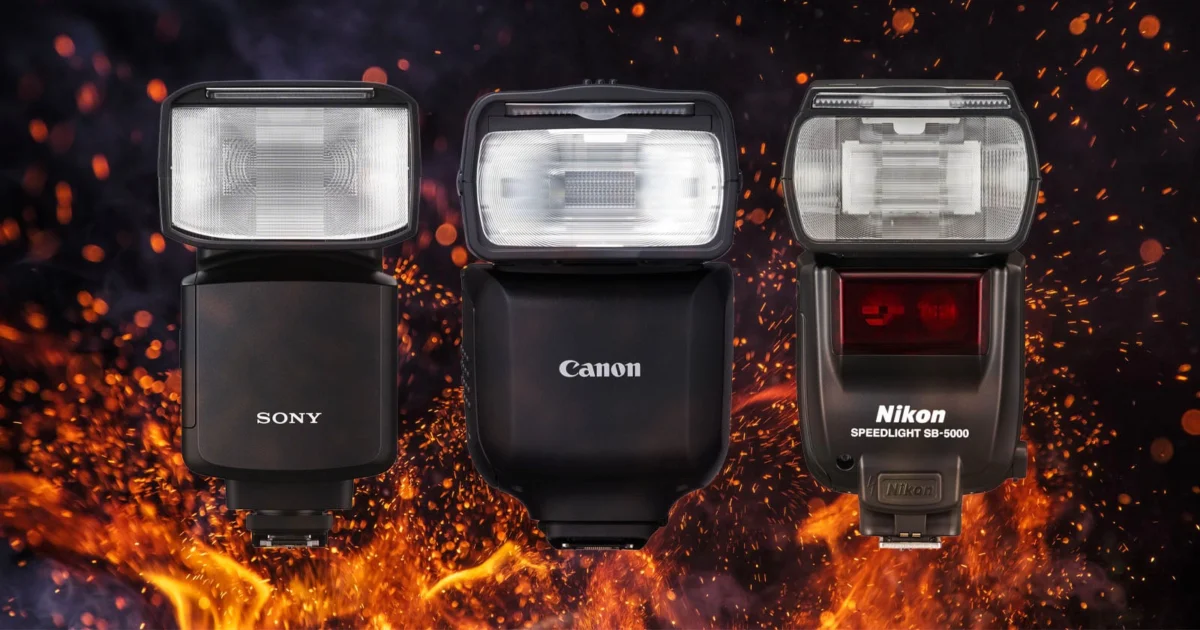
Canon USA has issued a comprehensive Service Notice across its official platforms, urgently advising photographers and videographers to cease the use of lithium and lithium-ion batteries in a wide array of its portable lighting products. The warning, which covers Speedlites, macro twin lights, and external battery packs, has sent ripples through the professional photography community, as many users have long relied on the high energy density and long shelf life of lithium cells. However, a deeper investigation into manufacturer documentation reveals that this is not a new restriction, but rather a critical safety and performance update that many in the industry have overlooked for years.
The updated notice identifies a significant risk of "extremely high temperature" when certain lithium-type batteries are used in high-drain flash units. While the convenience of picking up a pack of disposable lithium AAs at a local retailer is undeniable, the internal chemistry and discharge characteristics of these batteries are increasingly at odds with the thermal management systems of modern, compact flash units.
The Scope of the Canon Service Notice
The advisory is classified by Canon as an "update," suggesting that while the core warning has existed in various forms, the company has expanded the list of affected hardware to reflect its current product lineup. The list is extensive, encompassing 21 different Speedlite models—Canon’s proprietary term for shoe-mount flashes—alongside four macro twin light strobes and four compact battery packs designed to provide external power for faster recycling.
Among the specific products mentioned are modern staples of the Canon ecosystem, such as the EL-10 and the EL-100. For these models, the instruction manuals are explicit, stating: "Do not use AA/R6 lithium batteries." The notice clarifies that the restriction applies to "lithium batteries and lithium-ion batteries… in general" when they are in the AA or R6 form factor. The primary concern cited by Canon engineers is the generation of heat. When a flash unit fires, it draws a massive amount of current from the batteries in a very short burst to recharge its internal capacitor. Lithium batteries, known for their ability to sustain high discharge rates, can become dangerously hot during this process, potentially damaging the flash’s internal circuitry or, in extreme cases, posing a fire hazard.
A Cross-Industry Consensus on Battery Safety
While Canon’s notice has garnered recent headlines, a survey of other major camera manufacturers reveals a broad, though sometimes varied, consensus against the use of lithium AA batteries in portable strobes.
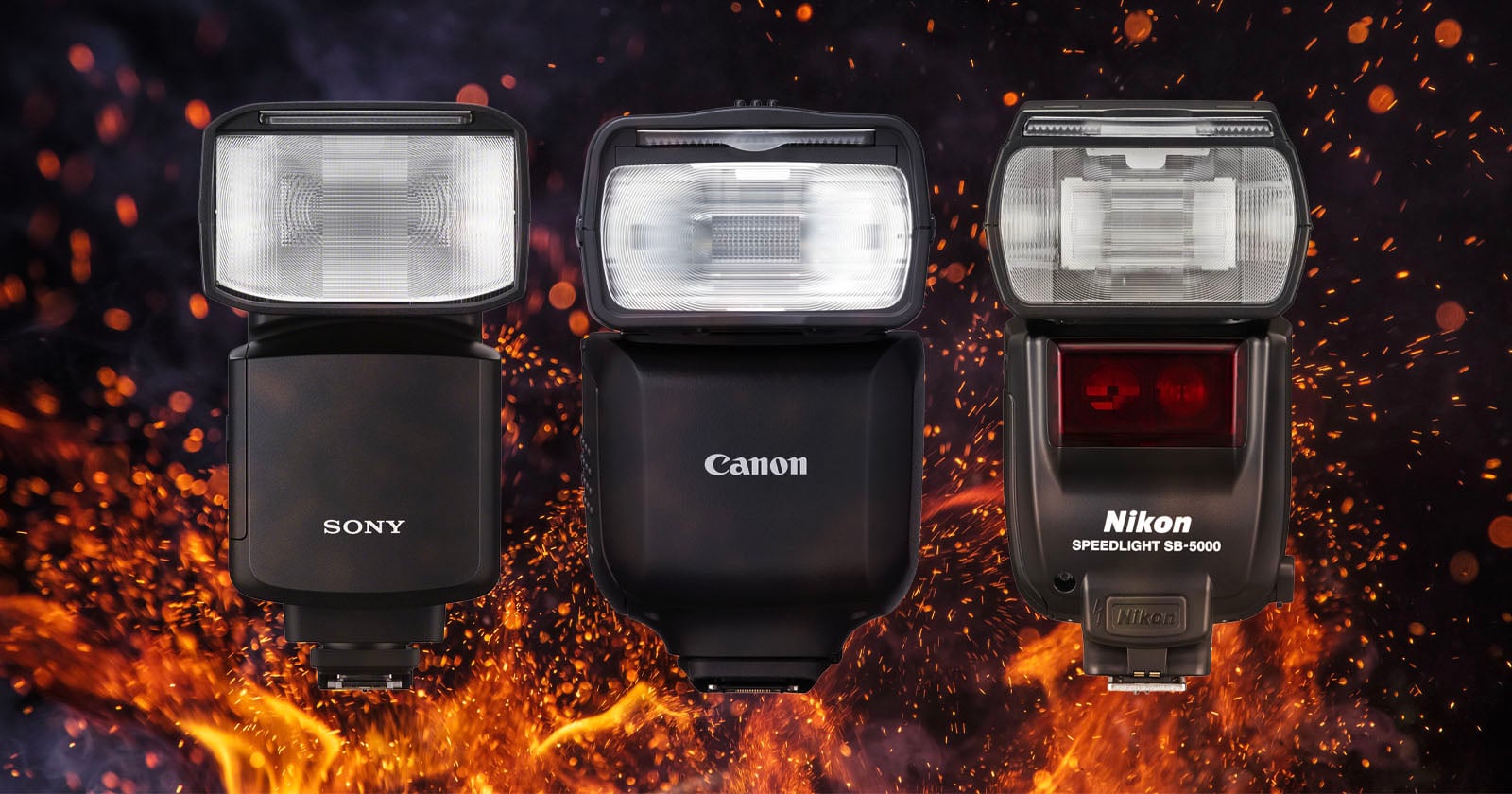
Sony, a leader in the mirrorless camera market, provides similar warnings in the documentation for its HVL series flashes, including the HVL-F28RM, HVL-F60RM2, and HVL-F46RM. Sony’s rationale, however, focuses more on performance than immediate physical danger. Their manuals state that lithium-ion batteries may "prevent the flash unit from delivering full performance." This likely refers to the voltage curves of lithium cells, which differ from the alkaline or Nickel-Metal Hydride (Ni-MH) batteries the units were designed to utilize.
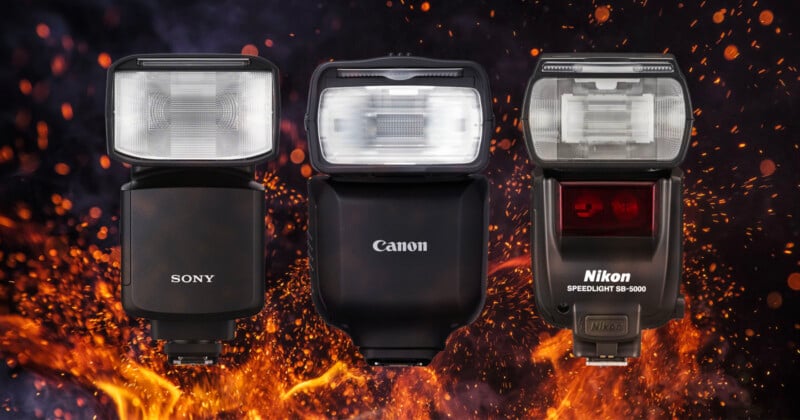
OM System (formerly Olympus) takes a stance closer to Canon’s. In the manual for the FL-700WR speedlight, the company explicitly tells users to avoid AA lithium batteries because they "may become extremely hot during use." This reinforces the theory that the issue is primarily one of thermal management within the confined space of a battery compartment.
Panasonic Lumix and Nikon present a more nuanced, though still cautious, perspective. Panasonic’s DMW-FL360L manual recommends only alkaline or rechargeable Ni-MH batteries, notably excluding lithium from the "approved" list while specifically forbidding manganese dry batteries. Nikon, historically, has been the most permissive. Their discontinued SB-900 speedlight—once the flagship of their lighting line—actually listed lithium batteries as an approved power source. However, in more recent models like the SB-5000, Nikon has moved toward recommending only alkaline or Ni-MH, following the industry trend of steering users away from lithium AA cells.
Technical Analysis: Why Lithium Fails in High-Drain Strobes
To understand why lithium batteries are being phased out of flash applications, one must look at the physics of battery discharge and flash capacitor charging. A speedlight requires a massive "gulp" of energy every time it recycles.
Internal Resistance and Heat
Lithium batteries (specifically disposable Lithium-Iron Disulfide, or Li-FeS2) have a very low internal resistance compared to alkaline batteries, which allows them to discharge energy very quickly. While this sounds ideal for a flash, it can lead to "thermal runaway" if the flash is fired repeatedly in a short period. The flash unit acts as a near-short circuit during the recycle phase, pulling the maximum current the battery can provide. Without the natural "bottleneck" of higher internal resistance found in other chemistries, the lithium battery can heat up to the point of melting plastic or damaging sensitive electronics.
Voltage Regulation Issues
Modern rechargeable AA-sized lithium-ion batteries are even more complex. A standard Li-ion cell has a native voltage of 3.7V, but an AA battery must output 1.5V to be compatible with standard devices. To achieve this, these batteries contain a small DC-to-DC buck converter circuit inside the battery casing. When a flash unit demands a massive surge of current, these tiny internal circuits can fail, overheat, or introduce electrical noise that interferes with the flash’s digital communication with the camera.
The Recycle Time Paradox
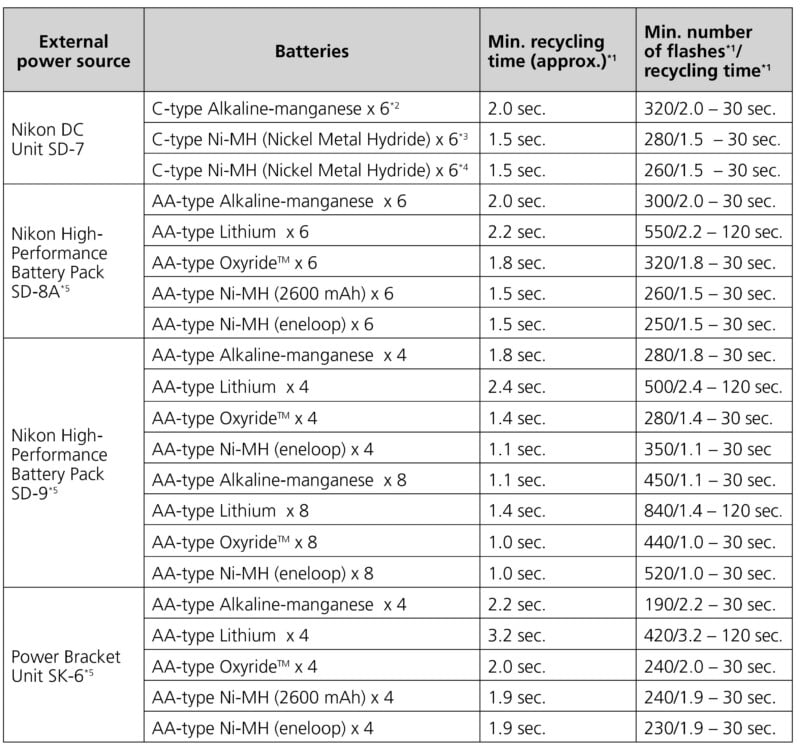
Data published by Nikon in earlier manuals provides a fascinating look at the performance trade-offs of lithium. In a comparative test of the SB-900, Nikon found that lithium batteries actually produced the slowest recycle times among all tested types. While a Ni-MH rechargeable battery could recycle the flash in roughly 2.3 seconds, a lithium battery took upwards of 4.5 seconds.
While lithium batteries offer a higher total number of flashes over their lifespan (the "capacity"), the "speed" at which they deliver that energy is inferior to Ni-MH in a high-drain environment. For professional wedding or event photographers, a two-second delay in recycle time can mean the difference between capturing a once-in-a-lifetime moment and missing it entirely.
Chronology of Battery Compatibility in Photography
The transition away from lithium in portable lighting has been a slow evolution rather than a sudden shift.
- The 1990s – Early 2000s: Alkaline batteries were the standard. They were safe but slow and prone to leaking.
- The Mid-2000s: High-capacity Ni-MH rechargeables became the professional standard. They offered the fastest recycle times but had high self-discharge rates (they would go dead if left in a bag for a week).
- 2008: Nikon releases the SB-900, which includes lithium as an approved source, marking the peak of lithium AA acceptance.
- 2010s: The "Low Self-Discharge" (LSD) Ni-MH revolution, led by Sanyo (and later Panasonic) with the Eneloop brand, changed the landscape. These batteries combined the speed of Ni-MH with the shelf life of alkaline.
- 2020-Present: As flash units become smaller and more powerful, thermal constraints have tightened. Manufacturers like Canon and Sony begin explicitly updating service notices and manuals to exclude lithium to prevent hardware damage and liability.
Defining the Terms: What Batteries Are Actually Prohibited?
There is often confusion among consumers regarding what constitutes a "lithium" battery in this context. The warnings issued by Canon and others specifically target AA-shaped (R6) batteries. This includes:
- Disposable Lithium (Li-FeS2): Commonly sold as "Energizer Ultimate Lithium." These are popular for their 20-year shelf life and performance in cold weather.
- Rechargeable Li-ion AAs: These are 3.7V cells stepped down to 1.5V via internal circuitry, often charged via a USB port on the battery itself.
Crucially, these warnings do not apply to the proprietary lithium-ion battery packs provided by manufacturers for high-end strobes. For example, the Canon Speedlite EL-1 uses the LP-EL lithium-ion battery pack. These are purpose-built for the device, featuring sophisticated thermal sensors and communication pins that allow the flash to throttle its performance if the battery gets too hot. The danger lies only in "dumb" AA lithium cells that cannot communicate with the device’s thermal management system.
Broader Implications for the Photography Industry
The move to restrict battery types has significant implications for both manufacturers and end-users. For manufacturers, these service notices serve as a legal safeguard. If a user’s flash unit melts or catches fire due to the use of a forbidden battery type, the manufacturer is shielded from liability.
For photographers, it necessitates a shift in kit management. The industry-wide recommendation is gravitating toward high-quality Ni-MH rechargeables, with Panasonic’s Eneloop Pro line being the most frequently cited "gold standard." These batteries offer a consistent 1.2V output and can handle the high-current demands of a flash capacitor without the extreme heat signatures associated with lithium.
Furthermore, this trend may accelerate the demise of the AA-powered speedlight. We are already seeing a shift toward "V-series" strobes (like the Godox V1 or Canon EL-5) that move away from AA batteries entirely in favor of dedicated, high-capacity lithium-ion blocks. These dedicated packs are more efficient, faster, and safer, as they allow the flash and battery to "talk" to each other regarding temperature and voltage.
Conclusion and Recommendations
The recent Canon Service Notice serves as a vital reminder that even the most common accessories, like AA batteries, can have profound effects on the longevity and safety of expensive photographic equipment. While the "Lithium" label often suggests "premium" or "long-lasting," in the high-stress environment of a portable strobe, it is often the wrong tool for the job.
Photographers are encouraged to audit their gear bags and replace any AA lithium cells in their strobes with high-quality Ni-MH rechargeables. Not only will this adhere to manufacturer safety guidelines and preserve warranty coverage, but it will also likely result in faster recycle times and more reliable performance during critical shoots. As flash technology continues to push the boundaries of power and size, following these "hidden" manual instructions becomes not just a matter of performance, but one of fundamental equipment safety.

