


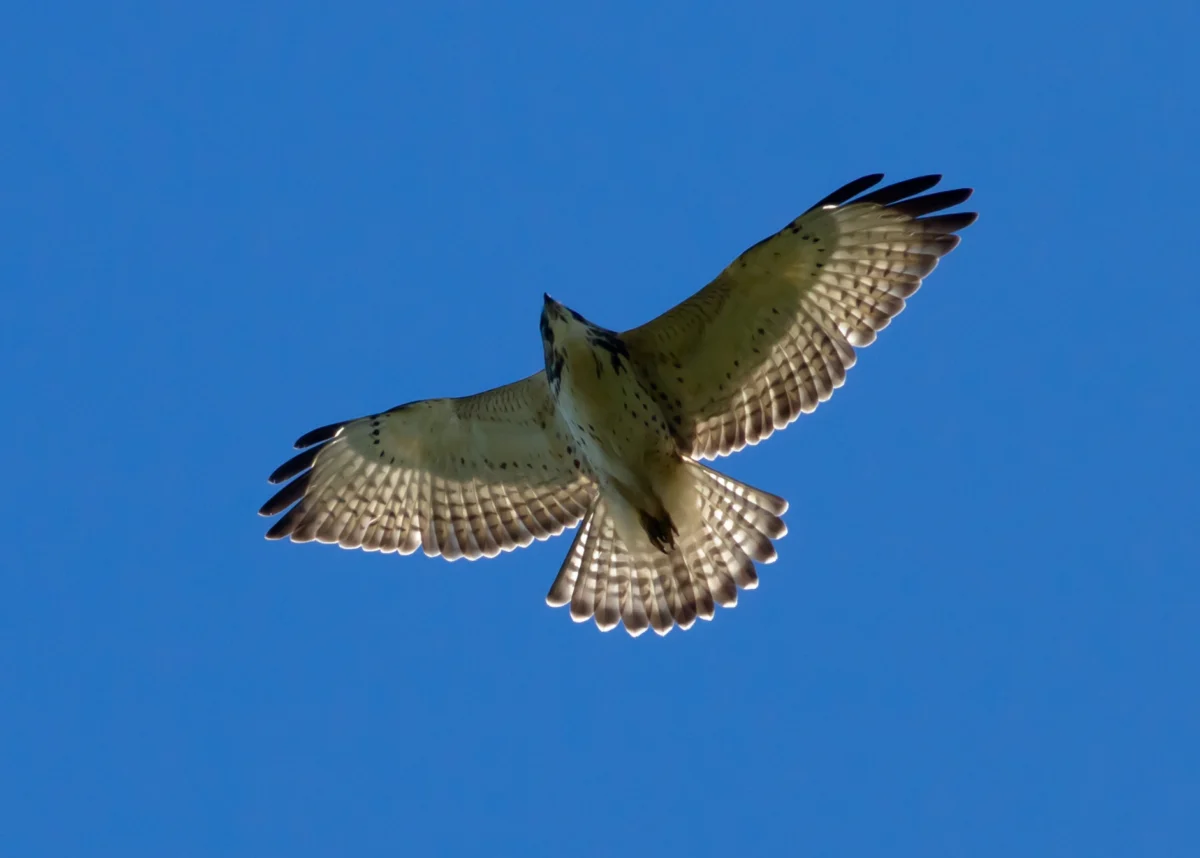
As of July 2021, the Ohio Ornithological Society (OOS) officially recognizes 443 distinct avian species within the Buckeye State. This rich biodiversity offers enthusiasts and visitors alike the opportunity to encounter a remarkable array of birds of prey. From the silent flight of owls to the powerful stoop of falcons, Ohio’s diverse landscapes provide crucial habitats for these magnificent creatures. This article delves into the identification, characteristics, and ecological significance of some of the most commonly observed raptors in Ohio, offering insights for both seasoned birdwatchers and casual observers.
The diverse avian population of Ohio is a testament to the state’s varied ecosystems, ranging from the expansive forests of the Appalachian foothills to the wetlands of Lake Erie and the agricultural plains of the west. This ecological mosaic supports a wide range of predatory birds, each playing a vital role in maintaining the delicate balance of their environments. Understanding these species is not only a matter of natural curiosity but also crucial for appreciating the health of Ohio’s natural heritage and contributing to ongoing conservation efforts.
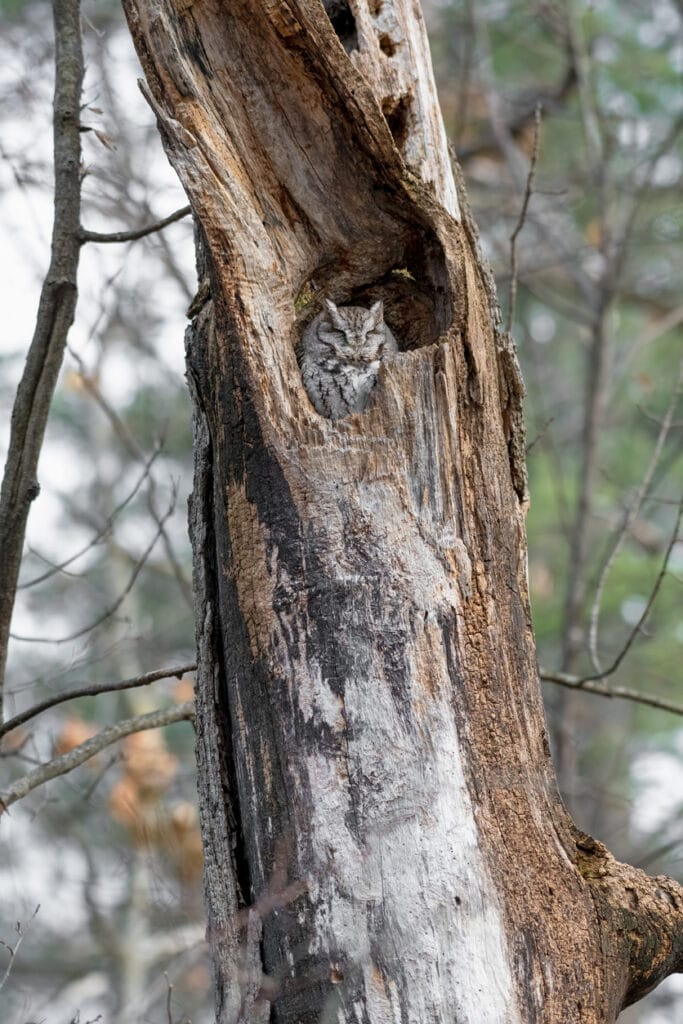
Eastern Screech-Owl (Megascops asio)
The Eastern Screech-Owl, a diminutive yet formidable predator, is a year-round resident of Ohio, often found camouflaged against tree bark. Measuring between 6.3 to 9.8 inches (16 to 25 cm) in length and weighing approximately 4.3 to 8.6 ounces (121 to 244 g), these owls possess a wingspan of 18.9 to 24.0 inches (48 to 61 cm). Their plumage, which can be either gray or reddish-brown, is intricately patterned with stripes and spots, providing exceptional camouflage. A distinctive feature is their relatively large heads, bright yellow eyes, and prominent ear tufts that often give them a perpetually alert or even scowling appearance. Their tails are squared, and their wings are rounded, contributing to their stealthy flight.

As nocturnal hunters, Eastern Screech-Owls are most active after dusk, preying on small mammals, insects, and amphibians. They typically inhabit second-growth forests, particularly at lower elevations, and are adaptable enough to be found in open spaces like swamps and suburban areas. While visually elusive, their presence is often revealed by their distinctive calls, a haunting series of trills and whinnies that are a familiar sound to many Ohioans during the night. Their ability to thrive in proximity to human settlements highlights their adaptability and the importance of preserving wooded areas within developed landscapes.
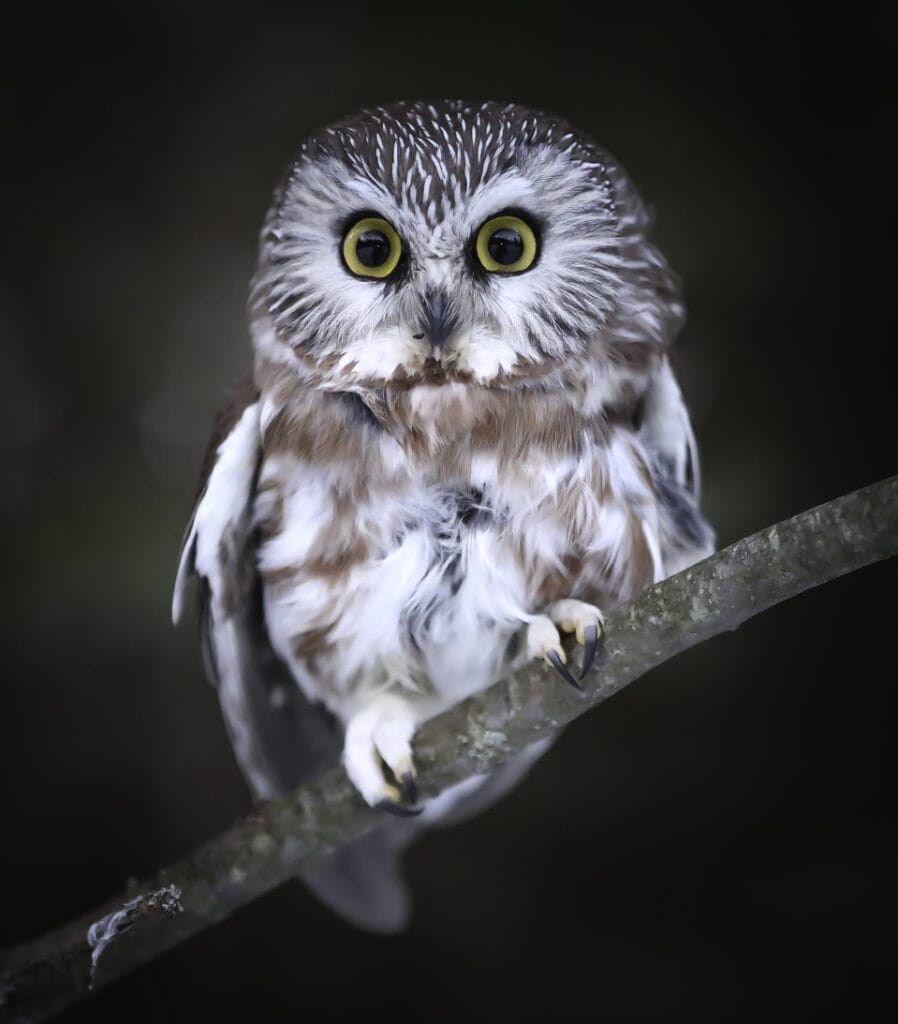
Northern Saw-whet Owl (Aegolius acadicus)
The Northern Saw-whet Owl, scientifically named Aegolius acadicus, is one of Ohio’s smallest owl species, measuring around 7.1 to 8.3 inches (18 to 21 cm) long with a wingspan of 16.5 to 18.9 inches (42 to 48 cm). It weighs between 2.3 to 5.3 ounces (65 to 151 g). This tiny raptor is characterized by its large, rounded head devoid of ear tufts, and its mottled brown body adorned with white spotting, particularly on the head and face. A striking feature is its distinctive white facial disk and piercing bright yellow eyes.
These owls are highly elusive and nocturnal, making them challenging to spot. They favor roosting in dense vegetation and breeding in thick forests, though they can sometimes be found in more open wooded areas. Their diet primarily consists of voles, shrews, and deer mice. The Northern Saw-whet Owl’s presence is often detected by its unique call, a series of sharp, consecutive toots that can be heard during the breeding season. Conservation efforts aimed at preserving mature forests are critical for the continued survival of this species in Ohio.
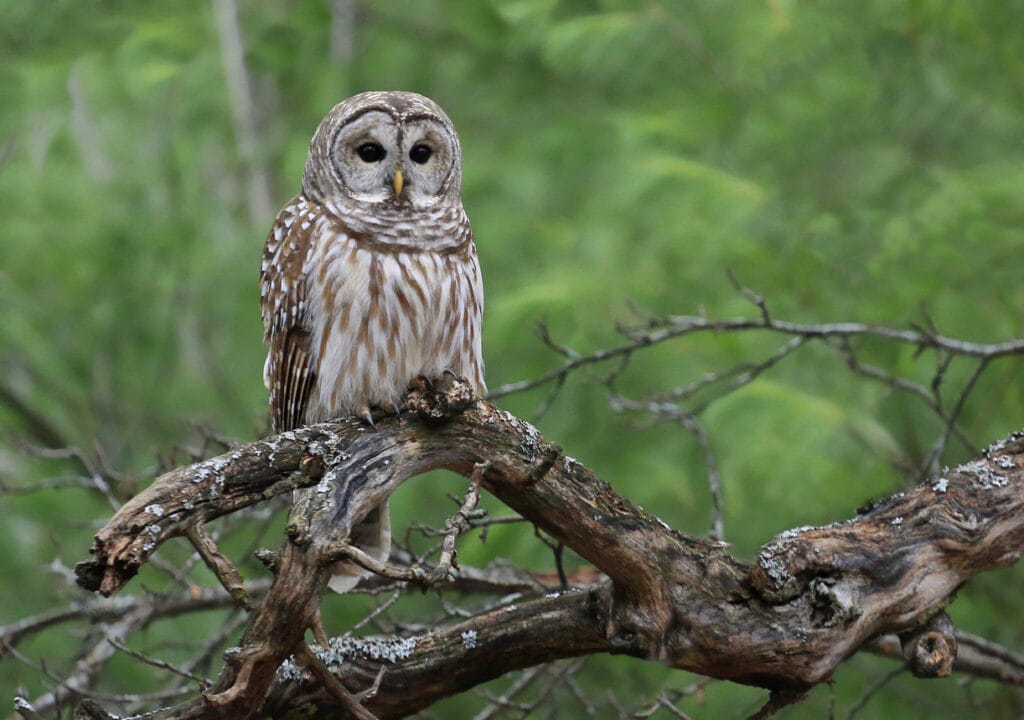
Barred Owl (Strix varia)
The Barred Owl, scientifically known as Strix varia, is a large and robust owl found in Ohio’s mature forests. It measures between 16.9 and 19.7 inches (43 and 50 cm) in length, with an impressive wingspan ranging from 39.0 to 43.3 inches (99 to 110 cm). Its weight typically falls between 16.6 and 37.0 ounces (470 to 1050 g). Barred Owls are recognized by their stocky build, rounded heads and tails, and the absence of ear tufts. Their most striking facial feature is their pitch-black eyes, which stand in stark contrast to their pale faces.
The species earns its name from its plumage, which features alternating horizontal stripes of light and dark brown and white, creating a barred appearance. This pattern extends across their wings, back, and tail, complemented by a bright yellow beak. Barred Owls are known for their distinctive hooting call, often described as sounding like "who cooks for you, who cooks for you all?" This vocalization is a hallmark of the deep, old-growth forests they inhabit, which are characterized by a mix of deciduous and evergreen trees. Protecting these large tracts of mature woodland is paramount for sustaining healthy Barred Owl populations.
Snowy Owl (Bubo scandiacus)
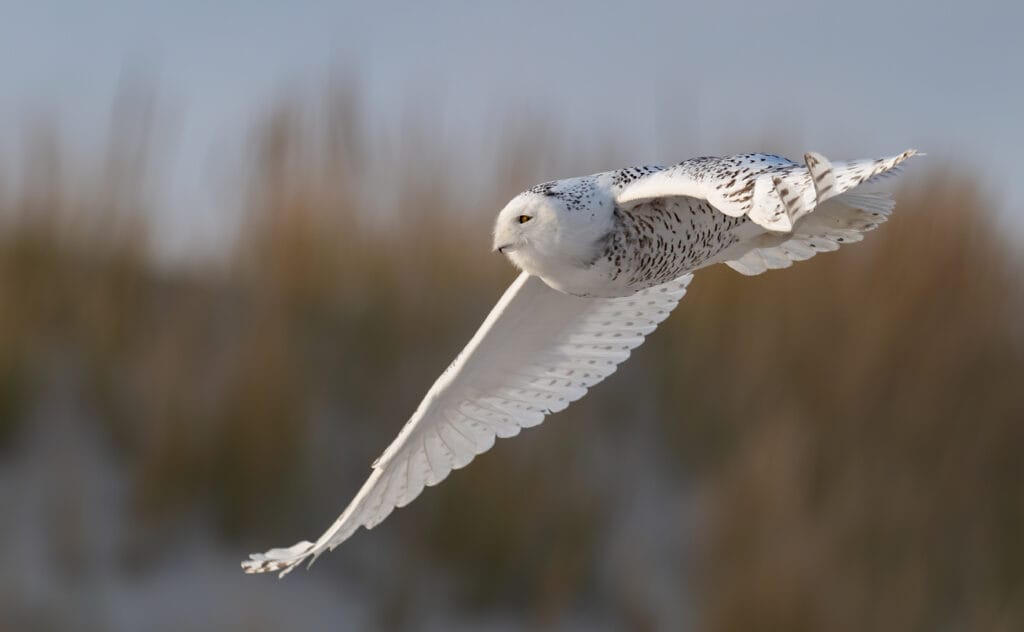
The Snowy Owl, scientifically Bubo scandiacus, is an iconic species, famously known as the inspiration for Hedwig in the Harry Potter series. While primarily associated with the Arctic tundra, Snowy Owls occasionally venture into Ohio, particularly during winter months, often attracted by fluctuating prey populations. These are large owls, measuring between 20.5 and 27.9 inches (52 and 71 cm) in length, with a substantial wingspan of 49.6 to 57.1 inches (126 to 145 cm), and weighing around 56.4 to 104.1 ounces (1600 to 2950 g). They possess smooth, rounded heads without ear tufts and bulky bodies with thick plumage that extends down to their legs, providing insulation against cold climates.
Their name derives from their predominantly white plumage, though variations exist. Females and younger birds often display brown or black spotting, giving them a salt-and-pepper appearance, while adult males are typically the purest white. Snowy Owls are diurnal hunters, preferring open spaces at low altitudes. Their presence in Ohio is usually a temporary phenomenon, linked to irruptions driven by lemming populations in their northern breeding grounds. Their appearance is a celebrated event for birdwatchers, drawing attention to the unpredictable nature of migratory patterns and the interconnectedness of ecosystems across vast distances.
Cooper’s Hawk (Accipiter cooperii)
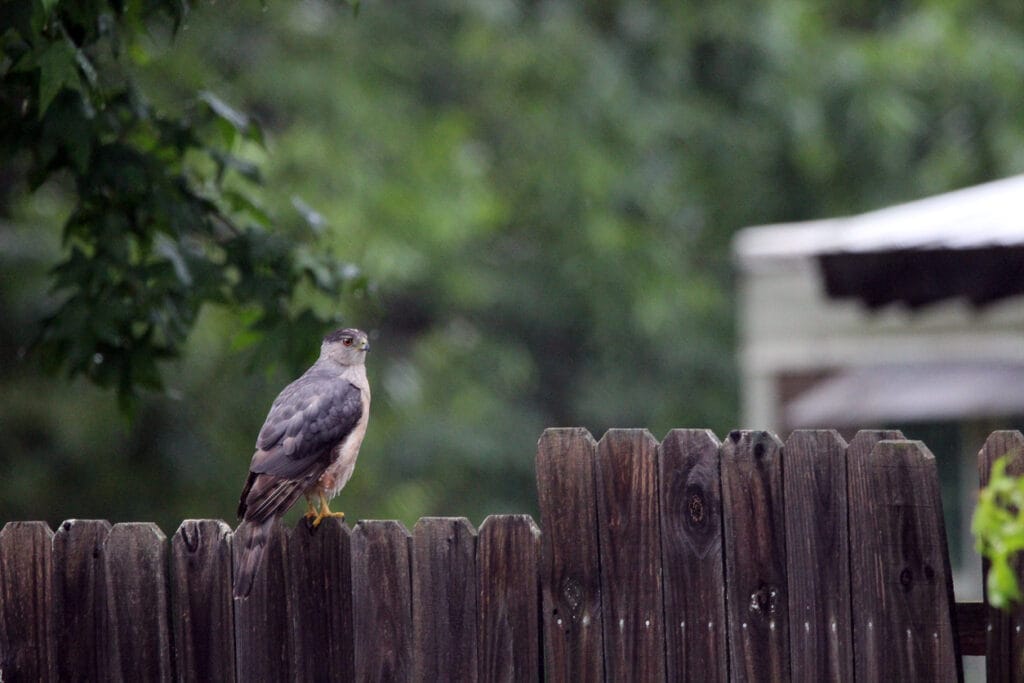
Cooper’s Hawks, scientifically classified as Accipiter cooperii, are medium-sized accipiters frequently observed in Ohio’s wooded areas and even suburban backyards. Males measure approximately 14.6 to 15.3 inches (37 to 39 cm) in length, while females are larger, ranging from 16.5 to 17.7 inches (42 to 45 cm). Their weight varies between 7.8 to 24.0 ounces (220 to 680 g), with a wingspan of 24.4 to 35.4 inches (62 to 90 cm). They are characterized by the classic accipiter build: wide, rounded wings and a long, narrow tail. Their plumage is a steely blue-gray on their upperparts, transitioning to reddish-brown streaks on their undersides, with dark bands adorning their wings and tail.
These agile hunters are known for their distinctive flight pattern, a series of rapid flaps followed by a glide. Cooper’s Hawks are adept at navigating dense woodlands, utilizing their agility to pursue prey, which primarily consists of medium-sized birds. Their increasing presence in urban and suburban environments reflects their adaptability and the availability of food sources such as backyard bird feeders. Monitoring their populations is important for understanding the impact of habitat fragmentation and the health of avian communities in human-dominated landscapes.
Red-tailed Hawk (Buteo jamaicensis)
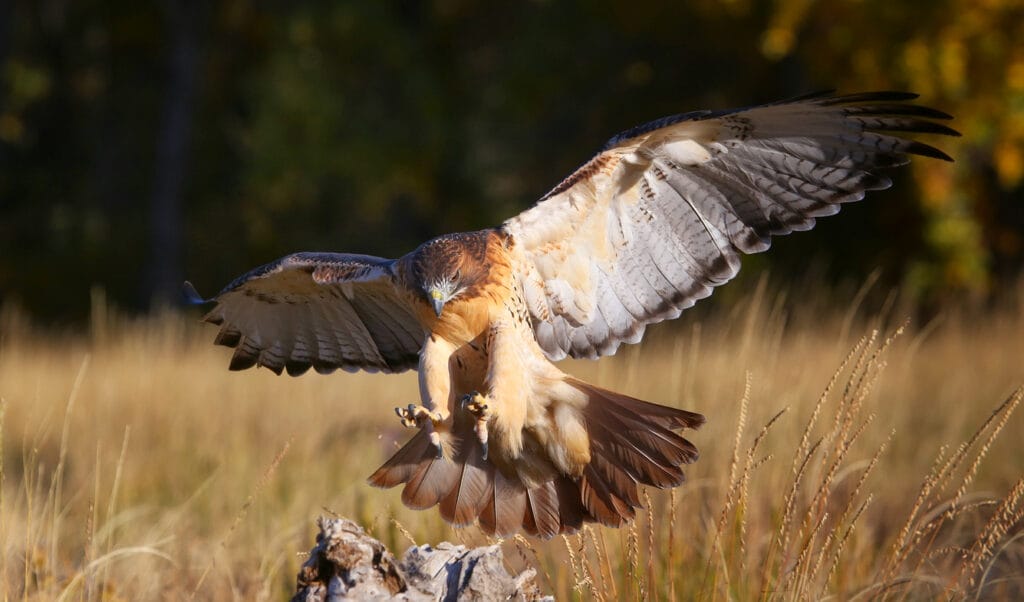
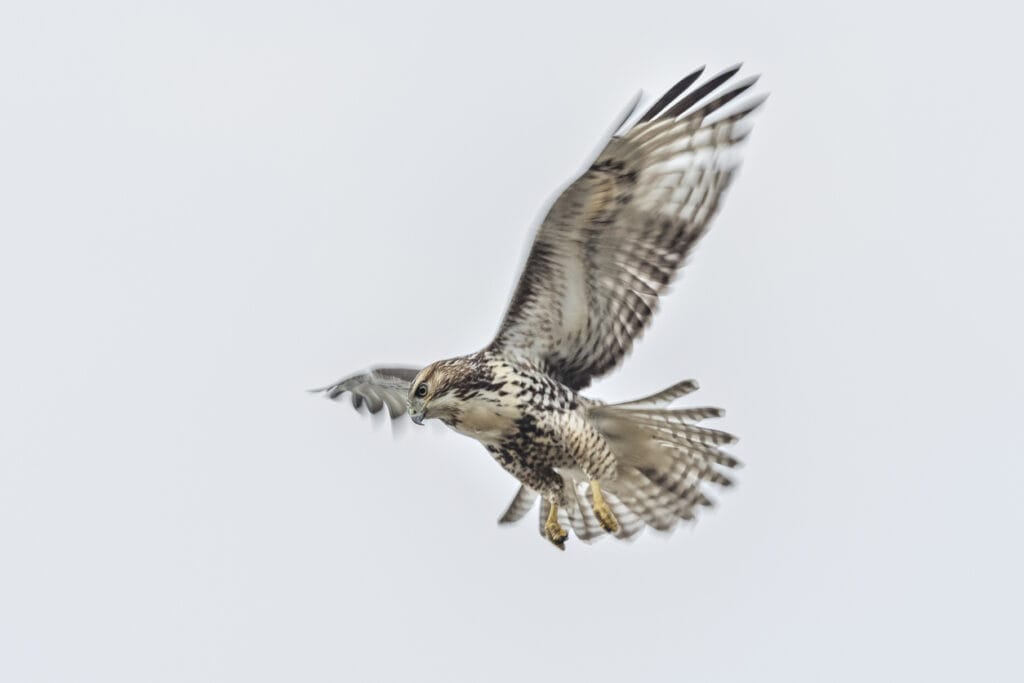
The Red-tailed Hawk, scientifically known as Buteo jamaicensis, is one of the most widespread and recognizable raptors in North America, and a common sight throughout Ohio. These large hawks measure between 17.7 to 25.6 inches (45 to 65 cm) in length, with a substantial wingspan of 44.9 to 52.4 inches (114 to 133 cm), and typically weigh between 24.3 to 51.5 ounces (690 to 1460 g). They are distinguished by their large bodies, broad, rounded wings, and relatively short, wide tails. Adult Red-tailed Hawks are most famously identified by the characteristic cinnamon-red coloration of their tails, which contrasts with their deep brown heads and backs and pale undersides, often featuring streaked bellies.
As the second-largest hawk in the Buteo genus in North America, they are apex predators in many ecosystems. Their diet is varied, with a strong preference for rodents, but they will also consume small mammals, birds, and reptiles. Red-tailed Hawks are frequently observed perched along highways, scanning the landscape for prey, or soaring over open fields and suburban areas. Their adaptability to human-modified landscapes makes them a visible indicator of the ecological health of agricultural and developed regions. Their presence underscores the importance of maintaining open spaces and providing perching opportunities within these environments.
Red-shouldered Hawk (Buteo lineatus)
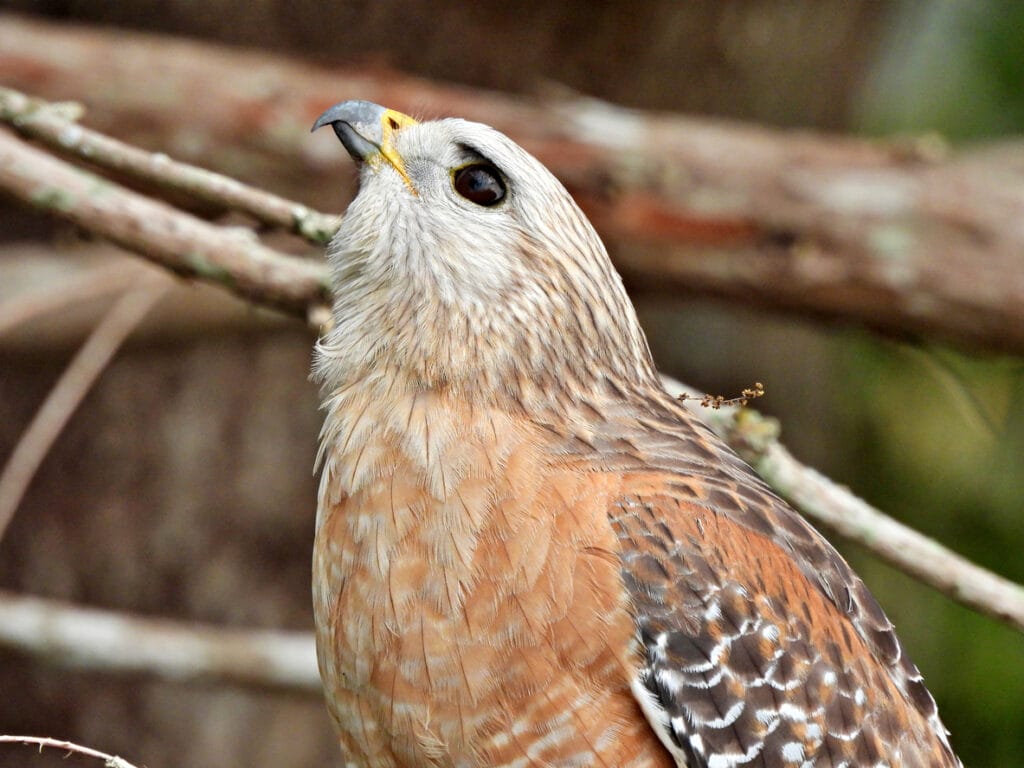
The Red-shouldered Hawk, scientifically Buteo lineatus, is a medium-sized hawk found in Ohio, typically inhabiting deciduous woodlands, especially those near swamps and rivers. They are smaller than Red-tailed Hawks but larger than Broad-winged Hawks, measuring between 16.9 to 24.0 inches (43 to 61 cm) in length with a wingspan of 37.0 to 43.7 inches (94 to 111 cm). Their weight ranges from 17.1 to 27.3 ounces (486 to 774 g). Distinctive features include black and white checkered wings and striking copper-red patches on their shoulders, along with reddish barring on their undersides.
Red-shouldered Hawks exhibit a characteristic "reaching" posture in flight and produce a unique, high-pitched "kee-rah" whistled call. Their diet consists of small mammals, reptiles, and amphibians, which they often hunt from perches within their woodland habitat. Their preference for riparian and swampy areas makes them sensitive to changes in wetland ecosystems. Conservation efforts focused on preserving these specific habitats are crucial for the long-term survival of this species in Ohio.
Broad-winged Hawk (Buteo platypterus)
The Broad-winged Hawk, scientifically Buteo platypterus, is a small, stocky raptor that inhabits Ohio’s forests. They measure between 13.4 to 17.3 inches (34 to 44 cm) in length, with a wingspan of 31.9 to 39.4 inches (81 to 100 cm), and weigh between 9.3 to 19.8 ounces (265 to 560 g). These hawks are characterized by their big heads, short, squared tails, and reddish-brown heads with barred undersides. Their tails are distinctly streaked in black and white.
Broad-winged Hawks are ambush predators, hunting small animals from perching spots typically found beneath the forest canopy. They are known for their piercing, single-pitch call. During migration, they often gather in large numbers, forming "kettles" that circle in the sky. Their reliance on dense forest cover makes them an indicator species for the health of these ecosystems. Protecting large, contiguous forest tracts is essential for supporting their populations and ensuring their migratory success.
Rough-legged Hawk (Buteo lagopus)
The Rough-legged Hawk, scientifically Buteo lagopus, is a visitor to Ohio, primarily observed during the winter months when they migrate south from their Arctic breeding grounds. These are relatively large buteos, measuring 18.5 to 20.5 inches (47 to 52 cm) in length, with a wingspan of 52.0 to 54.3 inches (132 to 138 cm), and weighing between 25.2 to 49.4 ounces (715 to 1400 g). They are characterized by long, wide wings and slightly swept-back wingtips, giving them an M-shaped appearance in flight. Their plumage varies, with light morphs displaying pale underwings marked by dark patches, while dark morphs have light trailing borders on their underwings.
Rough-legged Hawks prefer open areas such as prairies, fields, and deserts for foraging. Their diet consists mainly of small mammals, particularly lemmings and voles in their northern habitats, and they adapt their prey selection to available resources during their wintering period in Ohio. Their presence in Ohio during winter highlights the interconnectedness of Arctic and temperate ecosystems and the importance of providing suitable foraging grounds during their non-breeding season.
Osprey (Pandion haliaetus)
While not technically a hawk or eagle, the Osprey (Pandion haliaetus) is a prominent fish-eating bird of prey often found near large bodies of water in Ohio. Belonging to its own family, Pandionidae, Ospreys are smaller than Bald Eagles but larger and longer than Red-tailed Hawks, measuring between 21.3 to 22.8 inches (54 to 58 cm) in length. They have a considerable wingspan of 59.1 to 70.9 inches (150 to 180 cm) and weigh around 49.4 to 70.5 ounces (1400 to 2000 g).
Often called "sea hawks" or "fish hawks," their diet consists almost exclusively of fish, which they catch with remarkable precision by diving feet-first into the water. They also occasionally prey on small mammals, reptiles, crustaceans, and amphibians. Ospreys are found statewide in Ohio, with concentrations in areas with abundant water resources, particularly in central and northeastern regions. Their recovery in Ohio, following a period of decline due to environmental factors like pesticide contamination, is a significant conservation success story, demonstrating the positive impact of habitat restoration and reduced pollutant levels.
Turkey Vulture (Cathartes aura)
The Turkey Vulture, scientifically Cathartes aura, is one of the most common vulture species found across the United States, including Ohio, often referred to as the "Turkey Buzzard." These large birds are bigger than Red-tailed Hawks but smaller than eagles, measuring 25.2 to 31.9 inches (64 to 81 cm) in length, with a wingspan of 66.9 to 70.1 inches (170 to 178 cm), and weighing approximately 70.5 ounces (2000 g). They are characterized by their black bodies and featherless, red-colored heads, a feature that aids in hygiene as they feed on carrion.
Turkey Vultures possess a distinctive flight style, soaring at low altitudes with their wings held in a V-shape, a posture known as a dihedral. Their primary food source is decaying animal flesh, which they locate using an exceptional sense of smell. Their role as scavengers is vital for ecosystem health, as they help to remove carcasses and prevent the spread of disease. Their widespread presence indicates their adaptability to various environments, from rural to suburban areas.
Peregrine Falcon (Falco peregrinus)
The Peregrine Falcon, Falco peregrinus, holds the distinction of being one of the fastest creatures on Earth, capable of reaching astonishing speeds of 180 to 200 mph during its hunting stoop. These powerful falcons measure around 14.2 to 19.3 inches (36 to 49 cm) in length, with a wingspan of 39.4 to 43.3 inches (100 to 110 cm), and weigh between 18.7 to 56.4 ounces (530 to 1600 g). Adult Peregrine Falcons are easily identified by their blue-gray upperparts, barred undersides, dark heads, and prominent "sideburns."
Their primary prey consists of medium-sized birds, with pigeons and doves being favored targets, though they will also take waterfowl and songbirds. Peregrine Falcons are found in Ohio, often nesting on tall structures like bridges and skyscrapers in urban areas, as well as on cliffs in more natural settings. Their recovery from severe population declines caused by pesticide poisoning, particularly DDT, is another major conservation triumph. The successful reintroduction and breeding programs have brought this magnificent falcon back to prominence in the state.
Golden Eagle (Aquila chrysaetos)
The Golden Eagle, scientifically Aquila chrysaetos, is one of Ohio’s most majestic raptors, although less common than some other species. It is characterized by its golden-brown plumage on the head and nape, contrasting with its overall dark brown body. These powerful birds are known for their formidable legs equipped with long, sharp talons, enabling them to hunt a variety of small animals in flight, including squirrels and rabbits.

Golden Eagles are impressive in size, measuring approximately 27.6 to 33.1 inches (70 to 84 cm) in length, with a substantial wingspan ranging from 72.8 to 86.6 inches (185 to 220 cm). They are heavy birds, weighing between 105.8 to 216.1 ounces (3000 to 6125 g). While their primary breeding grounds are in more mountainous and open terrain, they can be observed in Ohio, particularly during migration or when seeking wintering territories. Their presence is a significant indicator of healthy, extensive wild landscapes.
Northern Harrier (Circus hudsonius)
The Northern Harrier, scientifically Circus hudsonius, is a slender raptor that frequets Ohio’s open fields and wetlands, particularly during spring and fall migration. Smaller than a Red-tailed Hawk, it measures between 18.1 to 19.7 inches (46 to 50 cm) in length, with a wingspan of 40.2 to 46.5 inches (102 to 118 cm). Females are noticeably heavier than males, with weights ranging from 10.6 to 26.5 ounces (300 to 750 g).
Northern Harriers are distinctive for their low, buoyant flight over open ground, often with their wings held in a shallow V-shape. They possess a characteristic white rump patch, visible in flight. Their diet is diverse, encompassing small mammals, birds, and reptiles, which they hunt by gliding low over grasslands and marshes. Their reliance on these open habitats makes them vulnerable to habitat loss and degradation, emphasizing the importance of conserving grassland ecosystems within Ohio.
Broader Implications and Conservation Efforts
The presence of such a diverse array of raptors in Ohio underscores the state’s ecological richness and the importance of ongoing conservation initiatives. Species like the Osprey and Peregrine Falcon have seen remarkable recoveries thanks to dedicated conservation programs that address pollution and habitat restoration. The continued health of populations like the Barred Owl and Broad-winged Hawk depends on the preservation of large, intact forest ecosystems.
Understanding the habits, habitats, and needs of these birds of prey is crucial for fostering a harmonious coexistence between humans and wildlife. By appreciating their ecological roles, from pest control by falcons and hawks to nutrient cycling by vultures, Ohioans can better support the natural heritage of the Buckeye State. Continued monitoring, habitat protection, and public awareness are essential for ensuring that these magnificent predators continue to grace Ohio’s skies for generations to come. The Ohio Department of Natural Resources, along with various ornithological societies and conservation groups, plays a vital role in these efforts, providing data, implementing management strategies, and educating the public about the importance of raptor conservation.

