


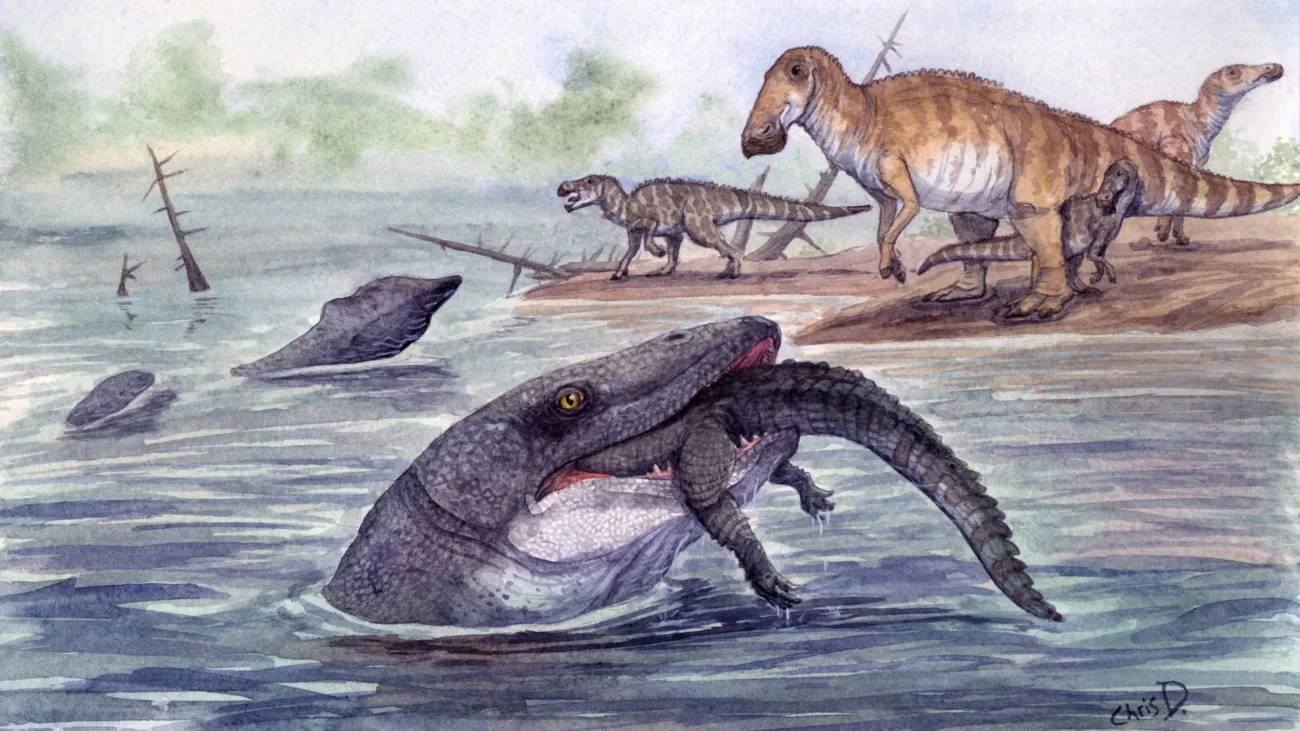
New research unearthed from the fossil-rich landscapes of North Dakota is rewriting our understanding of mosasaurs, the colossal marine reptiles that dominated the oceans for millions of years before the asteroid impact that ended the age of dinosaurs. Contrary to long-held beliefs that these apex predators were exclusively ocean dwellers, a groundbreaking analysis of a mosasaur tooth has revealed compelling evidence that some species ventured into freshwater river systems during the twilight of their reign, approximately 66 million years ago. This discovery, led by an international team of scientists, suggests a remarkable adaptive flexibility in these formidable creatures in the final million years of their existence.
The remarkable specimen at the heart of this revelation was discovered in 2022 within a river deposit in North Dakota. Its presence in this context was immediately perplexing. The tooth was found in close proximity to the fossilized remains of a Tyrannosaurus rex tooth and a crocodylian jawbone, alongside other fossils typical of the region, such as those of the duck-billed dinosaur Edmontosaurus. This unusual juxtaposition—a marine reptile’s tooth found among terrestrial and freshwater inhabitants—sparked immediate curiosity among the researchers. If mosasaurs were solely creatures of the open sea, how did one of their teeth become preserved in an ancient riverbed?
The Isotopic Key to an Ancient Puzzle
To unravel this prehistoric mystery, a collaborative effort involving scientists from the United States, Sweden, and the Netherlands was initiated. The core of their investigation focused on the chemical composition of the mosasaur tooth’s enamel, employing sophisticated isotope analysis. By examining the ratios of different isotopes—variants of the same element with different numbers of neutrons—scientists can glean invaluable information about an organism’s diet, environment, and physiology.
The fortuitous co-occurrence of the mosasaur tooth with the Tyrannosaurus rex tooth and crocodylian jawbone, all dating to roughly 66 million years ago, provided a unique opportunity for direct comparison. The research, conducted at the Vrije Universiteit (VU) in Amsterdam, meticulously analyzed isotopes of oxygen, strontium, and carbon. The results were striking. The mosasaur tooth exhibited unusually high concentrations of the lighter oxygen isotope, $^16$O. This isotopic signature is a strong indicator of freshwater environments, in stark contrast to the signatures typically found in marine settings. Furthermore, strontium isotope ratios corroborated these findings, pointing towards a freshwater habitat for the mosasaur.
Dr. Melanie During, one of the study’s corresponding authors and a researcher at Uppsala University, elaborated on the significance of these findings. "Carbon isotopes in teeth generally reflect what the animal ate," she explained. "Many mosasaurs have low $^13$C values because they dive deep. The mosasaur tooth found with the T. rex tooth, on the other hand, has a higher $^13$C value than all known mosasaurs, dinosaurs, and crocodiles, suggesting that it did not dive deep and may sometimes have fed on drowned dinosaurs." This dietary implication suggests a shift in foraging behavior, potentially exploiting resources available in a riverine environment that were less accessible to purely marine predators.
The isotope signatures, according to Dr. During, provided the definitive answer to the initial puzzle. "The isotope signatures indicated that this mosasaur had inhabited this freshwater riverine environment. When we looked at two additional mosasaur teeth found at nearby, slightly older, sites in North Dakota, we saw similar freshwater signatures. These analyses show that mosasaurs lived in riverine environments in the final million years before going extinct." This extension of the analysis to multiple specimens from the same region strengthens the conclusion that this freshwater adaptation was not an isolated incident but rather a regional phenomenon.
A Shifting Landscape: From Seas to Streams
The implications of this discovery extend beyond individual species’ behavior to encompass significant environmental changes occurring in North America during the Late Cretaceous period. The researchers posit that the transition of some mosasaurs to freshwater systems was facilitated by a dramatic transformation of a vast inland sea. The Western Interior Seaway, a massive body of water that once stretched north to south across what is now central North America, effectively bisecting the continent, underwent a significant hydrological shift.
Over time, an increasing influx of freshwater, likely from extensive river systems and meltwater, began to dilute the seaway’s salinity. This gradual process transformed the once-saline waters into brackish conditions, and eventually, into predominantly freshwater environments, particularly in its shallower and more inland reaches. The researchers draw a parallel to modern environments like the Gulf of Bothnia, where layers of freshwater and saltwater coexist.
This stratification, known as a halocline, would have created distinct ecological niches. The research team suggests that mosasaurs, adapted to breathe air, likely exploited the upper, less saline freshwater layers. This hypothesis is supported by the isotopic data gathered from other fossilized marine animals found in the same geological formations.
"For comparison with the mosasaur teeth, we also measured fossils from other marine animals and found a clear difference," stated Professor Per Ahlberg, a co-author of the study and Dr. During’s doctoral advisor at Uppsala University. "All gill-breathing animals had isotope signatures linking them to brackish or salty water, while all lung-breathing animals lacked such signatures. This shows that mosasaurs, which needed to come to the surface to breathe, inhabited the upper freshwater layer and not the lower layer where the water was more saline." This distinction between air-breathing and gill-breathing animals is crucial, highlighting how the mosasaurs’ physiological needs aligned with the changing environmental conditions.
Evolutionary Adaptability in a Dynamic World
The findings underscore the remarkable adaptive capacity of these ancient reptiles. The researchers argue that the mosasaurs whose teeth were analyzed had clearly evolved to thrive in these altered freshwater conditions. The shift from a purely marine existence to incorporating riverine habitats is not unprecedented in evolutionary history.
Dr. During noted, "Unlike the complex adaptation required to move from freshwater to marine habitats, the reverse adaptation is generally simpler." This suggests that creatures already accustomed to aquatic life might find it more straightforward to adjust to environments with lower salinity than to transition from freshwater to the high salt concentrations of the open ocean.
This flexibility is echoed in modern fauna. River dolphins, for instance, are entirely freshwater inhabitants today, despite their evolutionary ancestors having been marine. Similarly, the formidable estuarine crocodile, widely known as the saltwater crocodile, demonstrates remarkable adaptability by seamlessly moving between freshwater rivers and the open ocean, preying on available resources in both environments. These contemporary examples provide a tangible link to the potential ecological plasticity of ancient creatures like mosasaurs.
A Bus-Sized Predator in Unexpected Territories
The discovery of mosasaur fossils in North Dakota is particularly noteworthy. While mosasaur remains are relatively common in marine deposits across North America, Europe, and Africa, dating back from approximately 98 to 66 million years ago, their presence in the inland river systems of North Dakota during this period is rare. This scarcity makes the find exceptionally significant, offering a rare glimpse into a previously underappreciated aspect of their ecological niche.
The size of the discovered tooth suggests an animal of considerable magnitude, estimated to be up to 11 meters (approximately 36 feet) in length—comparable to the length of a modern-day bus. This estimate is supported by earlier discoveries of mosasaur bones at a nearby site, which also pointed to the presence of large individuals. While the exact genus of the mosasaur cannot be definitively identified from a single tooth, its characteristics suggest it likely belonged to a prognathodontine mosasaur. This group is known for its massive skulls, powerful jaws, and robust teeth, indicating they were opportunistic predators capable of tackling large prey.
Professor Ahlberg emphasized the awe-inspiring nature of such a predator in a riverine setting. "The size means that the animal would rival the largest killer whales, making it an extraordinary predator to encounter in riverine environments not previously associated with such giant marine reptiles." The implications for the prehistoric ecosystems of these North Dakota rivers are profound, suggesting a top predator that could have significantly influenced the food web and the behavior of other inhabitants.
Broader Implications and Future Research
This research has far-reaching implications for paleontology and our understanding of evolutionary adaptation. It challenges the established narrative of mosasaurs as exclusively oceanic giants and opens new avenues for exploring their ecological diversity. The findings suggest that as environmental conditions shifted towards the end of the Cretaceous, some mosasaur populations were able to adapt and exploit new ecological opportunities in freshwater systems. This adaptability may have played a role in their survival during the tumultuous final million years before the K-Pg extinction event.
The study also highlights the power of interdisciplinary scientific collaboration. The combined expertise of paleontologists, geochemists, and geologists, along with the international cooperation between institutions like Uppsala University, Eastern West Virginia Community and Technical College, Vrije Universiteit Amsterdam, and the North Dakota Geological Survey, was instrumental in piecing together this complex puzzle. The research also draws from Dr. During’s doctoral thesis, successfully defended at Uppsala University in November 2024, underscoring the ongoing contributions of doctoral research to scientific advancement.
Future research will likely focus on identifying more fossil evidence from similar riverine deposits to further delineate the extent of mosasaur freshwater habitation. Investigating other potential dietary adaptations and understanding the specific prey available in these river systems will provide a more complete picture of their behavior. The ongoing discovery and analysis of fossils continue to reveal the intricate tapestry of life that existed millions of years ago, reminding us that even the most well-established scientific narratives can be profoundly enriched by new evidence and innovative research. The era of the mosasaurs, it seems, still holds many surprises.

