


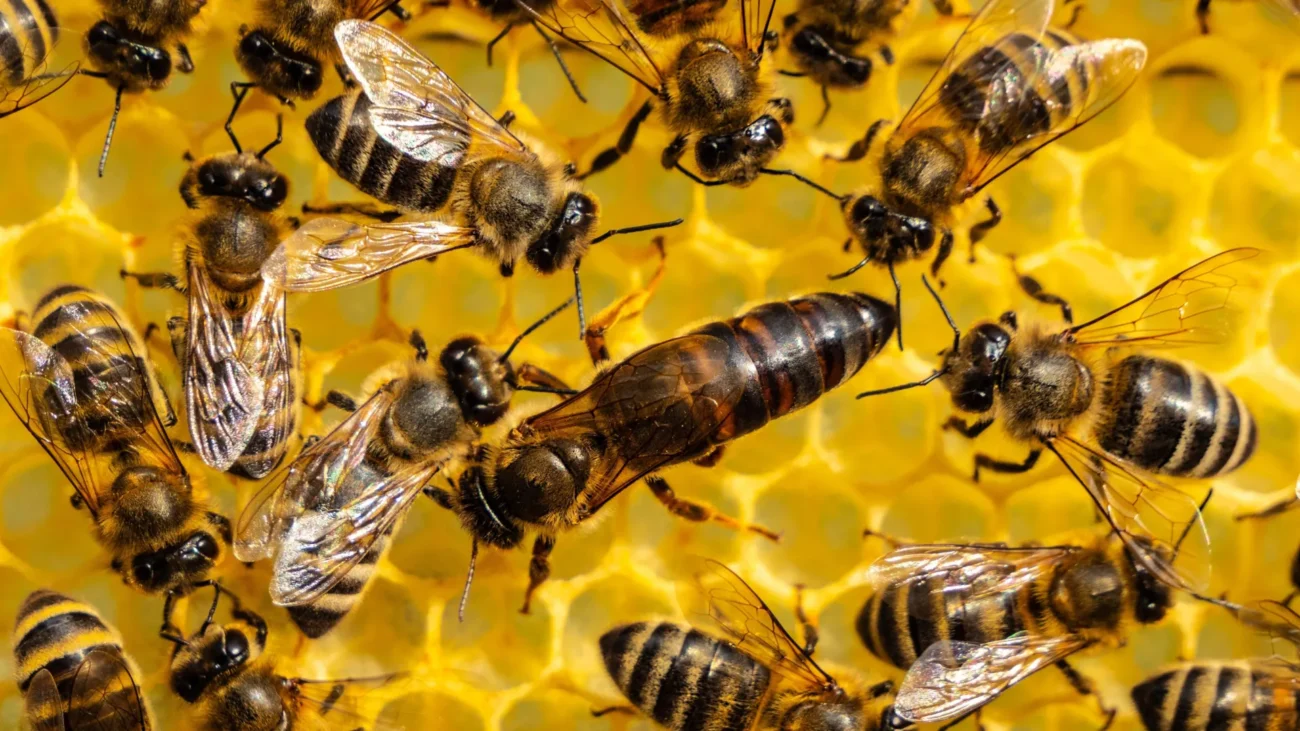
The survival of a honeybee colony has long been understood as a masterclass in collective defense, with worker bees acting as the primary line of protection against environmental toxins. However, groundbreaking new research reveals that when these frontline filtration systems are overwhelmed, honeybee queens resort to a drastic and previously undocumented survival strategy: they transfer accumulated pesticides directly into their own eggs.
Published in the journal Current Biology, the study was led by researchers at the University of California, Davis, in collaboration with the Lawrence Livermore National Laboratory (LLNL) and the U.S. Department of Agriculture’s Agricultural Research Service (USDA-ARS). The findings shed new light on the insidious, cumulative nature of agricultural pesticide exposure and raise critical questions about the long-term viability of managed and wild honeybee populations, which play an irreplaceable role in global agriculture.
The Limits of Worker Bee Protection
For decades, entomologists and toxicologists focused nearly all of their investigative efforts on worker bees, assuming that the caste system of the hive provided a robust buffer for the reproductive heart of the colony—the queen. Worker bees are responsible for foraging, nursing larvae, and feeding the queen a specialized secretion known as royal jelly. Crucially, they also act as biochemical filters, metabolizing or sequestering foreign substances before they can reach the sensitive biological systems of the queen and developing brood.
However, this new research demonstrates that the protective capacity of worker bees is finite and subject to fatigue over time. As Angela Encerrado-Manriquez, the paper’s lead author and a recent Ph.D. graduate from UC Davis, explains, prolonged exposure to environmental chemicals degrades the efficiency of this filtration network.
"In our study, pesticides began to accumulate in queens over time, suggesting that worker filtration capacity can be overwhelmed," Encerrado-Manriquez said. "When this happens, queens have their own defense. Maternal offloading allows them to shunt the toxic burden to their eggs."
This process, termed "maternal offloading," represents the first time scientists have documented honeybee queens actively dumping chemical contaminants into their reproductive output as a means of self-preservation. While this mechanism allows the queen to reduce her own immediate chemical load and maintain her physiological functions, it shifts the toxic burden directly onto the next generation.
Inside the Laboratory: Simulating Hive Dynamics
To observe and measure this complex biochemical transfer, the research team constructed experimental systems dubbed "nanocolonies." These miniaturized enclosures were specifically engineered to replicate the functional dynamics of a full-scale beehive under controlled conditions. Each nanocolony consisted of a conical plastic container featuring a netted bottom, housing a single queen bee alongside a cohort of 60 worker bees.
To track the movement of contaminants through the social structure of the hive, the researchers introduced methyl parathion—an organophosphate insecticide commonly used in agriculture—into the bees’ diet of pollen, water, and food. Critically, the pesticide was tagged with an ultra-low-level radioactive marker, allowing scientists to monitor its exact trajectory through the nanocolonies with pinpoint precision.
The experiment revealed a stark decline in the worker bees’ filtration efficiency over a ten-day period. On the first day of exposure, the worker bees successfully intercepted and filtered out 95% of the administered pesticide, sequestering the majority of it away from the queen and into the comb wax. By the tenth day, however, that filtration rate dropped to 86%. As the workers’ protective barrier degraded, the pesticide began to permeate the queen’s biological tissues, eventually triggering the maternal offloading mechanism.
Cutting-Edge Tracking: The Role of BioAMS
Tracking minute quantities of agricultural chemicals within biological tissues has historically presented a major technological hurdle for toxicologists. To overcome this limitation, the UC Davis team partnered with specialists at the Lawrence Livermore National Laboratory, who utilized a specialized technology known as Accelerator Mass Spectrometry, specifically adapted for biological applications (BioAMS).
Bruce Buchholz, an LLNL scientist and co-author of the study, emphasized the precision offered by the technology. "With BioAMS, we can trace very low levels of a pesticide," Buchholz noted. "The pesticide concentrations we used were not lethal and were environmentally relevant to that seen in nature."
By leveraging BioAMS, researchers were able to quantify chemical accumulation across various compartments of the nanocolonies, tracking the toxicant from the food supply through the worker bees, into the wax, and ultimately accumulating within the queen’s ovaries and newly laid eggs. This high-resolution tracking provided indisputable evidence of the physical pathways contaminants take inside the hive environment.
Agricultural Implications and the "Tipping Point"
The implications of these findings extend far beyond academic toxicology, touching upon commercial beekeeping, agricultural policy, and global food security. Honeybees are responsible for pollinating roughly one-third of the human diet, including a vast array of fruits, vegetables, and nuts. Consequently, any physiological stressor that compromises colony health threatens agricultural productivity on a macro scale.
Sascha Nicklisch, senior author of the paper and an associate professor in the UC Davis Department of Environmental Toxicology, warned that the gradual accumulation of pesticides poses a subtle yet severe threat to colony stability.
"When pesticides accumulate to the extent that the queen bee has eggs that are so loaded they may no longer develop properly, there could be a tipping point," Nicklisch cautioned. "There may be a slow creeping effect of chemical accumulation that will contribute to delayed colony collapse."
Unlike acute pesticide poisonings—which result in massive, sudden die-offs easily noticed by beekeepers—maternal offloading operates as a stealthy stressor. A queen bee can produce between 1,500 and 2,000 eggs daily during peak seasons, serving as the sole biological engine of the hive. If these eggs are systematically compromised by maternally offloaded toxins, hatch rates may decline, larval mortality may spike, and the workforce of the colony may wither away incrementally, leading to unexplained colony failure weeks or months after initial exposure events.
Chronology of the Research Collaboration
The publication in Current Biology represents the culmination of years of multidisciplinary cooperation between academic, federal, and national laboratory institutions.
- Phase 1: Hypothesis and Design: Researchers identified a gap in existing ecotoxicology literature, which had heavily prioritized worker bees while largely ignoring the systemic internal distribution of toxins within the queen and her reproductive tract.
- Phase 2: Nanocolony Construction: Scientists from UC Davis and the USDA-ARS designed the controlled nanocolony system to safely isolate variables while maintaining natural behavioral interactions between queens and worker bees.
- Phase 3: Isotopic Labeling and Exposure: Methyl parathion treated with low-level radioactive isotopes was administered over standardized multi-day periods to map temporal changes in filtration efficiency.
- Phase 4: BioAMS Analysis: Lawrence Livermore National Laboratory processed biological samples using accelerator mass spectrometry to detect non-lethal, environmentally realistic chemical residues.
- Phase 5: Publication and Peer Review: Findings were compiled, peer-reviewed, and published, opening new pathways for agricultural and environmental research.
Future Horizons in Honeybee Toxicology
Despite the clarity brought by the new study, several critical questions remain unanswered. The research team notes that future investigations must determine the long-term developmental outcomes for larvae that hatch from pesticide-laden eggs, whether different classes of agricultural chemicals (such as neonicotinoids or synthetic pyrethroids) trigger similar offloading behaviors, and the precise physiological thresholds that prompt a queen to begin transferring toxins to her reproductive system.
Furthermore, these findings present new challenges for integrated pest management (IPM) planners and agricultural growers. As awareness grows regarding how sub-lethal chemical exposures ripple through the social structures of beneficial insects, regulatory bodies and farming communities may need to reassess application windows and chemical load limits to prevent the gradual degradation of managed and wild pollinator populations.
Support for the research was provided by the USDA’s National Institute of Food and Agriculture, the Non-Assistance Cooperative Agreement program, the PAm-Costco USA Scholarship program, and the University of California National Laboratory Fees Research Program, with work at LLNL conducted under the auspices of the U.S. Department of Energy. Additional contributors to the study include Julia Fine and Eliza Litsey of the USDA-ARS, alongside David Baliu-Rodriguez and Sean Leonard of LLNL.

