


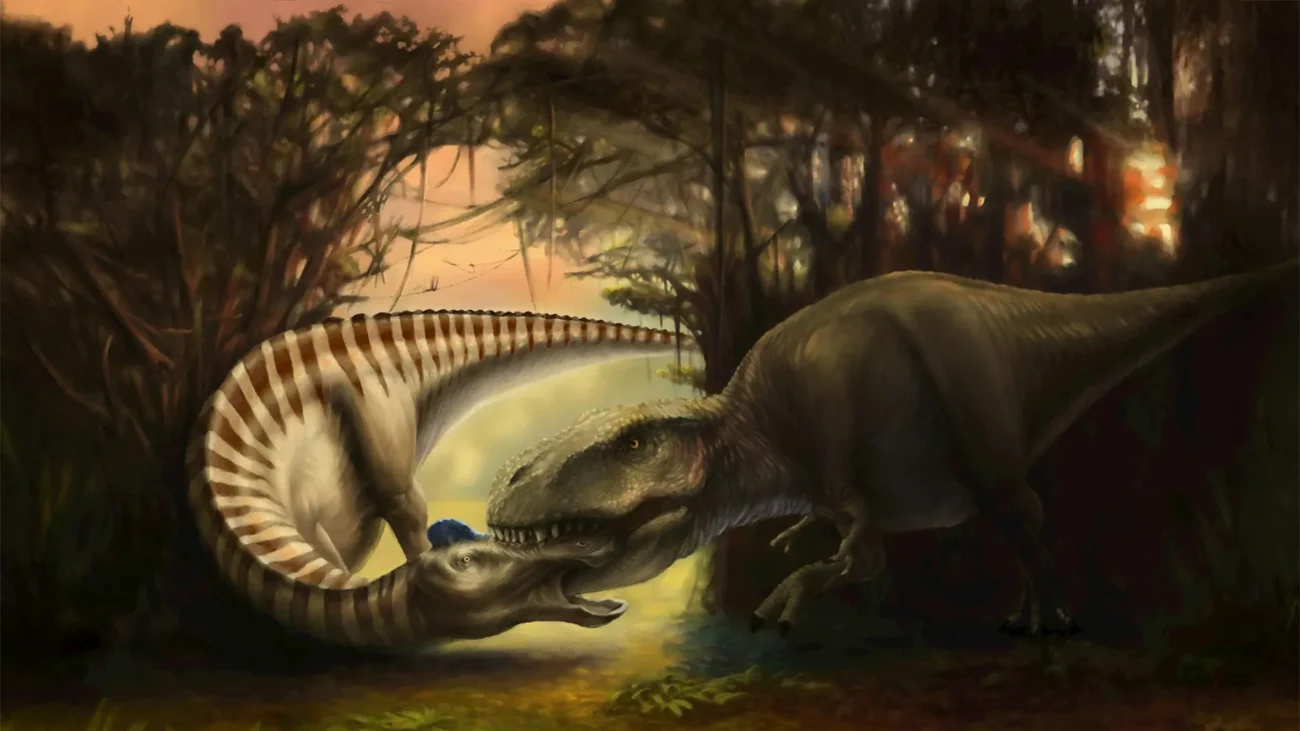
Deep within the rugged, sun-baked badlands of eastern Montana lies the Hell Creek Formation, a geological treasure trove that has long served as a window into the twilight of the Mesozoic Era. It was here, approximately 66 million years ago, that one of the most terrifying apex predators in Earth’s history roamed a lush, subtropical floodplain. Today, a groundbreaking scientific study centered at the Museum of the Rockies is shedding fresh light on the hunting strategies of the undisputed king of these ancient ecosystems: Tyrannosaurus rex. By examining an exceptionally rare fossilized Edmontosaurus skull bearing the physical fragment of its attacker, researchers have unlocked a vivid narrative of prehistoric violence that bridges millions of years of evolutionary history.
The centerpiece of this new research is a nearly complete skull of an Edmontosaurus, a massive, duck-billed herbivorous dinosaur that shared the Late Cretaceous landscape with towering horned ceratopsians like Triceratops and the gargantuan apex predator itself. Unearthed in 2005 on land managed by the federal Bureau of Land Management (BLM), the specimen eventually found a permanent home in the extensive paleontology collections of the Museum of the Rockies in Bozeman, Montana. Recently, the fossil became the subject of an intensive, collaborative investigation led by University of Alberta doctoral student Taia Wyenberg-Henzler and Dr. John Scannella, the Museum of the Rockies’ Curator of Paleontology. Their meticulous findings, which combine classical paleontology with modern medical imaging, were published in the peer-reviewed scientific journal PeerJ.
The geological context of the Hell Creek Formation is vital to understanding the significance of this discovery. Spanning parts of Montana, North Dakota, South Dakota, and Wyoming, Hell Creek preserves the final two to three million years of the Cretaceous period, abruptly ending with the catastrophic Cretaceous-Paleogene (K-Pg) extinction event triggered by a massive asteroid impact. During this epoch, the region was characterized by broad coastal plains, winding river systems, and dense, swampy forests under a warm, wet climate. In this high-stress environment, life and death were locked in a perpetual evolutionary arms race. Herbivores developed specialized dental batteries and defensive weaponry, while apex predators evolved bone-crushing bite forces capable of subverting the most formidable defenses.
While paleontologists have cataloged countless dinosaur bones bearing the distinct scoring and puncture marks of ancient teeth, finding an actual tooth physically embedded within the bone of another dinosaur is an extraordinary anomaly. Most shed teeth simply fell out during feeding or were swept away by ancient currents. The presence of this physical artifact changes the dynamic entirely. According to Wyenberg-Henzler, the discovery operates much like a Cretaceous-era crime scene investigation, bypassing the usual ambiguities of predator-prey dynamics.
To pinpoint the exact perpetrator of the attack, the research team undertook a comprehensive comparative analysis. They measured and compared the embedded tooth fragment with the dental anatomy of every known carnivorous dinosaur species documented within the Hell Creek Formation. The anatomical match pointed definitively to Tyrannosaurus rex. However, identifying the species was only the first step. To understand the mechanics of the bite and the trajectory of the attack, the researchers turned to advanced diagnostic technology.
The fossilized skull was transported to Advanced Medical Imaging at Bozeman Health Deaconess Hospital, where technicians subjected the precious specimen to high-resolution computed tomography (CT) scanning. These medical-grade scans allowed the scientists to peer inside the bone matrix without damaging the delicate fossil, revealing the exact depth, angle, and structural impact of the embedded tyrannosaur tooth. The imaging demonstrated how the tremendous force of the bite drove the tooth deep into the nasal region of the Edmontosaurus, snapping the crown off and leaving the root fragment trapped forever within the healing—or unhealing—bone tissue.
Dr. Scannella noted that the fossil captures a transient biological event frozen in deep time. The physical evidence on the skull reveals a distinct lack of bone remodeling or healing around the embedded tooth. This lack of cellular response indicates two primary possibilities: either the Edmontosaurus was already dead when the scavenger or predator bit into its face, or the catastrophic force and subsequent trauma of the bite itself were the direct cause of the animal’s demise.
The orientation and location of the bite provide compelling clues regarding the nature of the encounter. The positioning of the tooth in the nasal region of the duck-billed dinosaur strongly suggests a direct, face-to-face confrontation. In modern predatory interactions, face-to-face engagements are frequently characteristic of active hunting episodes rather than opportunistic scavenging of long-dead carcasses. The sheer kinetic energy required to snap a heavily enameled tyrannosaur tooth off at the root requires magnitudes of force that align with the legendary bite mechanics of an adult Tyrannosaurus rex, which scientists estimate could exceed 12,800 pounds of force—enough to crush a modern automobile.
The debate surrounding the feeding habits and ecological role of Tyrannosaurus rex has persisted for nearly a century. Since its formal description by Henry Fairfield Osborn in 1905, the iconic dinosaur has cycled through various interpretations in the scientific literature and popular imagination. Early twentieth-century depictions portrayed it as a sluggish, tail-dragging lizard. Later studies revolutionized this view, establishing T. rex as an active, agile, warm-blooded predator.
However, a famous and contentious scientific debate erupted in the late 20th century regarding whether T. rex was a hyper-specialized apex predator or merely a glorified scavenger that relied on its immense size to displace other predators from their kills. While modern consensus among paleontologists largely favors a flexible apex predator that engaged in both active hunting and scavenging—much like modern lions and hyenas—definitive physical proof of predatory behavior remains fiercely sought after. Rare specimens like the Hell Creek Edmontosaurus skull provide critical empirical data points that help resolve these long-standing academic arguments.
The broader implications of this study extend far beyond the specific interaction between a single predator and prey item 66 million years ago. By utilizing advanced imaging techniques and rigorous comparative anatomy, modern paleontologists are increasingly able to extract behavioral data from morphological fossils. Each bone bearing trauma, pathology, or embedded forensic evidence acts as a behavioral archive, offering insights into the social structures, feeding strategies, and ecological pressures of extinct ecosystems.
As researchers continue to excavate and analyze fossils within the prolific Hell Creek Formation, specimens housed in institutions such as the Museum of the Rockies will remain central to evolutionary studies. The collaborative effort between the Museum of the Rockies and the University of Alberta underscores the value of interdisciplinary scientific partnerships, combining world-class collections with cutting-edge medical technology. Through these ongoing investigations, the obscured daily realities of the Cretaceous world continue to come into sharper, more vivid focus, transforming static bones into dynamic actors in an ancient planetary drama.

