


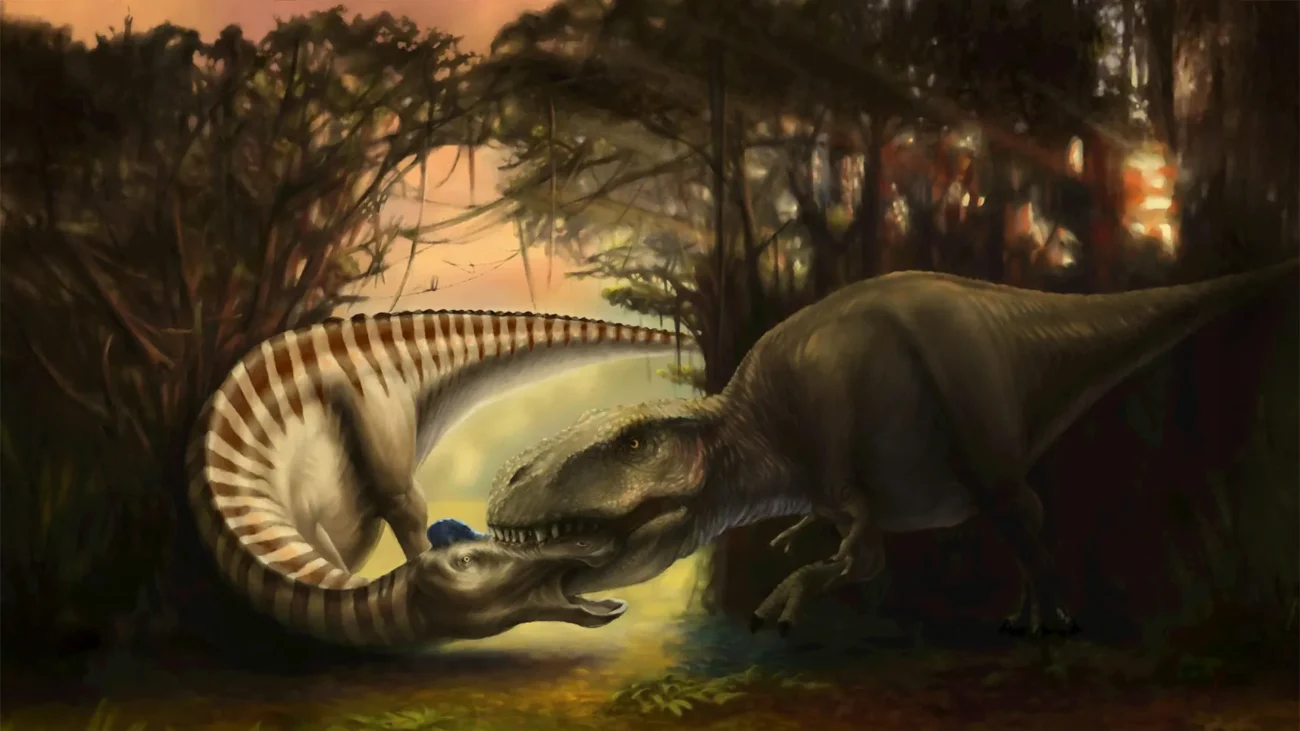
Paleontologists have long debated the complex ecological dynamics of the late Cretaceous period, yet concrete physical evidence of predator-prey interactions remains exceptionally scarce in the fossil record. Now, a remarkable specimen housed within the paleontology collections at Montana State University’s Museum of the Rockies is providing researchers with an unprecedented, high-resolution view of how the apex predator Tyrannosaurus hunted and subdued its prey. The artifact in question—a remarkably well-preserved duck-billed dinosaur skull bearing a broken, deeply embedded tyrannosaur tooth—has become the focal point of a comprehensive new scientific investigation spearheaded by researchers from Montana State University and Canada’s University of Alberta.
The findings, which illuminate the violent mechanics of a Cretaceous predation event that transpired approximately 66 million years ago, were recently published in the peer-reviewed scientific journal PeerJ. Led by University of Alberta doctoral student Taia Wyenberg-Henzler alongside Dr. John Scannella, the Curator of Paleontology at the Museum of the Rockies, the collaborative study treats the ancient fossil much like a modern forensic crime scene, utilizing advanced medical imaging and comparative osteology to reconstruct the terminal moments of a prehistoric herbivore.
The Setting: Hell Creek and the Late Cretaceous Ecosystem
To understand the significance of this discovery, scientists must look back to the final chapters of the Mesozoic Era, just millions of years before the cataclysmic asteroid impact that precipitated the Cretaceous-Paleogene extinction event. During this geological epoch, the geographic region encompassing modern-day Montana was a sprawling, subtropical coastal floodplain characterized by meandering river systems, dense coastal forests, and expansive wetland habitats.
This lush landscape supported a diverse and megafaunal ecosystem dominated by some of the largest land-dwelling animals ever to evolve. Within the boundaries of the Hell Creek Formation—a famous geologic formation spanning parts of Montana, North Dakota, South Dakota, and Wyoming—Tyrannosaurus rex reigned as the undisputed apex predator. Weighing upwards of nine metric tons and possessing a bite force capable of crushing bone, this massive theropod shared its habitat with an array of formidable herbivores. Among its contemporaries were the heavily armored, horned Triceratops, the armored ankylosaur Anatosaurus, and massive duck-billed hadrosaurs such as Edmontosaurus.
It was within this specific paleo-environment that the fateful encounter between a tyrannosaur and an adult Edmontosaurus took place, leaving behind a subtle yet profound structural signature that would remain buried beneath layers of sedimentary rock for over six decades of modern geological time.
Chronology of the Discovery and Investigation
The journey from underground strata to museum display case spans nearly two decades, marked by meticulous field excavation, laboratory preparation, and high-tech non-destructive analysis.
The timeline of the specimen’s modern scientific journey unfolds across key milestones:
- Summer 2005: Field researchers operating in the rich fossil beds of the Hell Creek Formation in eastern Montana—on public lands managed by the United States Department of the Interior’s Bureau of Land Management (BLM)—discover a nearly complete skull belonging to an adult Edmontosaurus. Recognizing the structural integrity and scientific value of the specimen, excavation crews carefully jacket and transport the fossils back to the laboratory.
- Post-2005 to 2020s: The skull is accessioned into the permanent collections of the Museum of the Rockies in Bozeman, Montana. It is eventually placed on public exhibition within the museum’s renowned Hall of Horns and Teeth, where its unique morphological features begin to attract the attention of visiting researchers.
- The Collaborative Study: Recognizing that a foreign fragment is physically wedged within the nasal region of the hadrosaur skull, a research team is formed between the University of Alberta and the Museum of the Rockies. Taia Wyenberg-Henzler and John Scannella initiate a formalized study to definitively identify the lodged object and determine its taphonomic and behavioral implications.
- Advanced Imaging Phase: To peer inside the bone without causing destructive alterations to the priceless fossil, researchers transport the skull to Advanced Medical Imaging at Bozeman Health Deaconess Hospital. High-resolution computed tomography (CT) scans are performed, generating digital three-dimensional models of the internal bone density, fracture patterns, and the exact spatial orientation of the embedded tooth fragment.
- Publication: Following comparative anatomical analysis against every known carnivorous dinosaur species from the Hell Creek ecosystem, the research team confirms the tooth belongs to a Tyrannosaurus. The comprehensive findings are formally published in PeerJ, drawing international attention from the paleontological community.
Forensic Paleontology: CT Scans and Anatomical Analysis
While paleontologists routinely unearth fossilized bones bearing superficial scrape marks, gouges, and puncture wounds attributed to carnivorous feeding strategies, the discovery of an entire tooth fragment locked deep within the skeletal architecture of a prey animal is exceptionally rare.
"Although bite marks on bones are relatively common, finding an embedded tooth is extremely rare," stated Taia Wyenberg-Henzler during discussions surrounding the publication of the study. "The great thing about an embedded tooth, particularly in a skull, is it gives you the identity of not only who was bitten but also who did the biting. This allowed us to paint a picture of what happened to this Edmontosaurus, kind of like Cretaceous crime scene investigators."
To arrive at this conclusion with absolute scientific certainty, the research team undertook a rigorous elimination process. Every predatory theropod species documented in the Hell Creek Formation—including smaller dromaeosaurids, troodontids, and tyrannosauroids—was evaluated. By comparing the serration density, enamel thickness, cross-sectional curvature, and root morphology of the embedded fragment against the dentition of these diverse carnivores, investigators definitively matched the specimen to Tyrannosaurus.
Furthermore, the integration of medical-grade computed tomography provided critical insights into the physical dynamics of the strike. The CT scans revealed how the massive tooth penetrated the outer layers of the hadrosaur’s facial bones before snapping off under the immense lateral and compressive stress of the bite. Because the surrounding bone tissue displays a complete absence of reactive healing or osteological remodeling—the biological process by which bone grows back around a non-fatal injury—scientists can reconstruct the temporal relationship between the attack and the animal’s demise.
"A fossil like this is extra exciting because it captures a behavior: a tyrannosaur biting into this duckbill’s face," noted Dr. John Scannella. "The skull shows no signs of healing around the tyrannosaur tooth, so it may have already been dead when it was bitten, or it may be dead because it was bitten."
Behavioral Implications: Active Predator vs. Opportunistic Scavenger
For decades, the broader scientific community has engaged in vigorous academic debates concerning the precise ecological niche occupied by Tyrannosaurus. While early twentieth-century depictions universally characterized the animal as an aggressive, active apex predator, subsequent generations of paleontologists debated whether the creature’s massive body proportions, relatively small eyes, and specialized olfactory bulbs indicated that it functioned primarily as an obligate scavenger, relying on its keen sense of smell to locate carcasses already slain by environmental factors or smaller predators.
The discovery of the embedded tooth in the Edmontosaurus skull contributes robust physical evidence supporting the active predation hypothesis. The specific anatomical location of the impact—smash-landed directly into the nasal bones of the hadrosaur—suggests an aggressive, direct confrontation rather than passive scavenging of an abandoned skeleton.
"Looking at the way the tooth is embedded in the nose of the Edmontosaurus suggests that it met its attacker face-to-face, something that usually happens to an animal that was killed by a predator," Wyenberg-Henzler explained. "The amount of force necessary for a tooth to have become broken off in bone also points to the use of deadly force. For me, this paints a terrifying picture of the last moments of this Edmontosaurus."
The biomechanical forces required to shatter a tyrannosaurid tooth—a structure evolved to withstand immense compressive stress—against the facial bones of a large herbivore underscore the sheer kinetic and muscular power involved in a tyrannosaur attack. When a predator delivers a bite of this magnitude, the interaction moves beyond simple opportunistic feeding and enters the realm of complex, high-stakes predatory engagement.
Broader Impact on Modern Paleontological Research
The implications of the Montana State University and University of Alberta study extend well beyond the specific interaction between a single predator and prey item. By establishing a methodological framework that combines high-resolution CT scanning, comparative paleopathology, and taphonomic analysis, the research team has provided contemporary paleontologists with a replicable model for investigating other disputed fossil specimens.
In recent years, the field of paleontology has shifted increasingly toward interdisciplinary approaches, merging traditional comparative anatomy with advanced engineering, biomechanical computer simulations, and medical imaging technologies. This evolution allows researchers to extract microscopic and structural data from fossils that previous generations could only study from an external perspective.
As museum collections continue to be re-examined with these modern analytical tools, specimens that have sat quietly in storage drawers or public galleries for decades are frequently yielding unexpected secrets. The Edmontosaurus skull from the Hell Creek Formation stands as a prime example of this scientific renaissance, demonstrating how a single, flawed tooth—shattered and lost millions of years ago—can still pierce the veil of deep time to illuminate the brutal, dynamic realities of the ancient world.

