


For generations, the foundational dogma of paleontology and molecular biology was built upon a clear, seemingly unbreakable rule: the process of fossilization is an absolute eraser of biological history. According to long-standing scientific consensus, once an organism died and its remains were buried under layers of sediment, the passage of tens or hundreds of millions of years would inevitably lead to the total destruction and replacement of original organic molecules. Bones, teeth, and soft tissues were thought to be thoroughly infiltrated and substituted by inorganic minerals, leaving behind a rocky replica devoid of original proteins, DNA, or labile biochemical compounds.
Under this traditional view, the recovery of endogenous biomolecules from creatures that roamed the Earth during the Mesozoic Era was considered a biochemical impossibility. Organic materials like proteins are inherently unstable; they undergo spontaneous hydrolysis and degradation over relatively short geological timescales—typically thousands, or at most a few hundred thousand years—long before a dinosaur fossil could ever be unearthed.
However, a paradigm-shifting study led by an interdisciplinary team of researchers at the University of Liverpool has shattered this long-held assumption. Providing some of the strongest evidence to date, the new research demonstrates unequivocally that original organic materials, specifically traces of structural proteins, can survive within select Mesozoic fossils. By deploying state-of-the-art analytical chemistry and advanced mass spectrometry techniques, scientists have successfully identified remnants of collagen preserved within the hip bone of an Edmontosaurus, a massive duck-billed dinosaur that lived near the close of the Cretaceous period.
This monumental discovery not only injects groundbreaking momentum into a contentious scientific debate that has persisted for roughly three decades, but it also promises to fundamentally rewrite how researchers approach the molecular study of extinct life.
Anatomy of a Discovery: The Edmontosaurus Sacrum
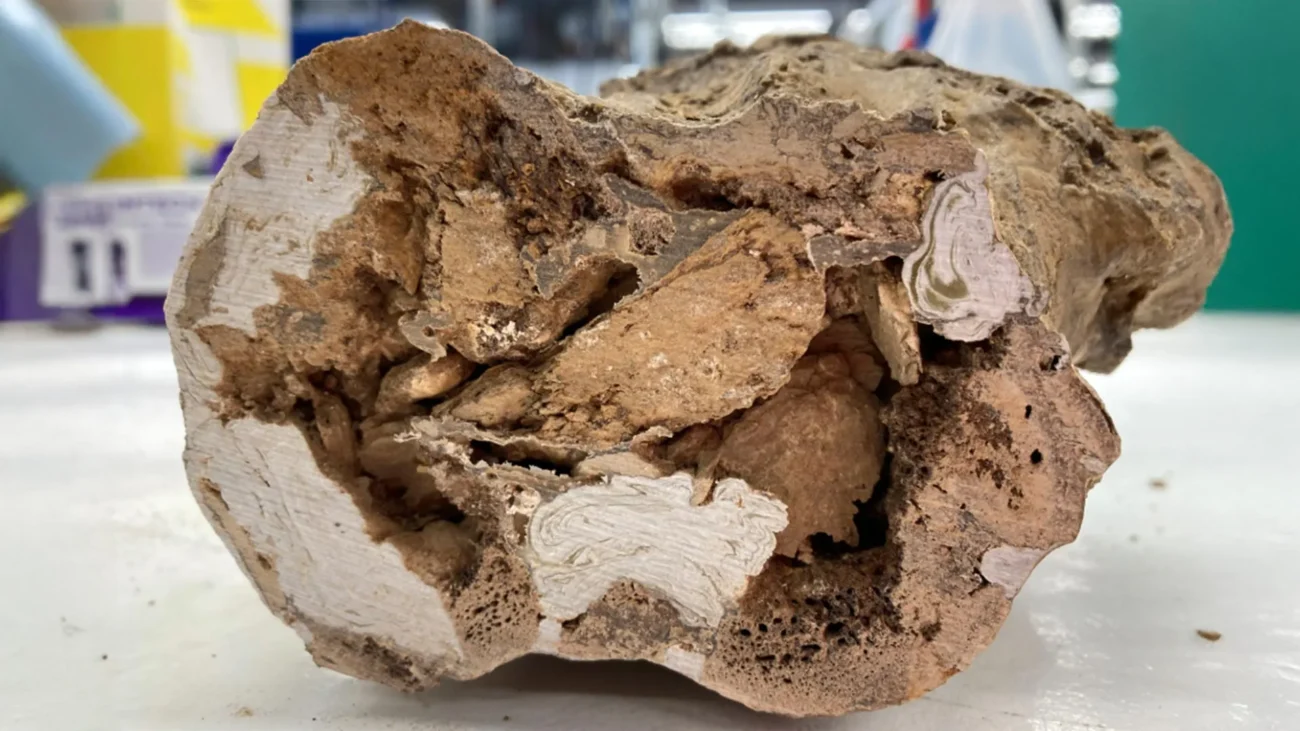
At the center of this scientific breakthrough is an exceptionally well-preserved 22-kilogram sacrum—a complex structure of fused vertebrae connected to the pelvis, forming the lower spine—of an Edmontosaurus. The specimen was originally excavated from the richly fossiliferous Upper Cretaceous rock layers of the Hell Creek Formation in South Dakota, a geological treasure trove renowned for yielding some of the world’s most complete dinosaur fossils from the twilight of the Mesozoic era. Today, the specimen resides securely within the scientific collections of the University of Liverpool, where it became the subject of intensive, high-resolution biochemical interrogation.
The decision to focus on this particular bone was driven by its unusual state of physical preservation. Unlike many crushed or heavily mineralized fossils found in the field, this sacrum retained microstructural integrity that caught the attention of researchers looking to push the boundaries of paleoproteomics—the study of ancient proteins.
To interrogate the fossil, the research team bypassed traditional macroscopic examination in favor of cutting-edge molecular detection methods. These included advanced protein sequencing and high-precision mass spectrometry, a powerful analytical technique that identifies and characterizes molecules by measuring their mass-to-charge ratio and chemical fragmentation patterns. Through these methods, the team hunted for molecular signatures unique to collagen, the primary fibrous structural protein that constitutes the vast majority of the organic matrix in vertebrate bone.
The results, published in the peer-reviewed journal Analytical Chemistry, provided a definitive chemical signature. Researchers successfully identified specific fragments of collagen alpha-1, the predominant form of collagen found in healthy bone tissue. Furthermore, specialists from the University of California, Los Angeles (UCLA), utilized tandem mass spectrometry to detect and quantify, for the first time in this context, the amino acid hydroxyproline. Because hydroxyproline is heavily concentrated in collagen and plays a critical role in stabilizing its triple-helix structure, finding it embedded within a dinosaur bone provided undeniable chemical proof that degraded, yet authentic, collagen fragments have survived the ravages of deep time.
The Contamination Controversy and the 30-Year Scientific Battle
To fully appreciate the weight of the University of Liverpool-led study, one must understand the fraught history of molecular paleontology. For approximately thirty years, the field has been locked in an intense, highly skeptical debate regarding the authenticity of organic molecules recovered from ancient fossils.
When pioneering researchers first claimed to have discovered fragments of dinosaur bone proteins and blood vessels in the 1990s and early 2000s, the scientific community met the announcements with profound skepticism. Critics and analytical chemists argued that what researchers were observing could not possibly be ancient dinosaur tissue. Instead, they hypothesized that any organic material detected in ancient fossils was the result of modern contamination.
According to this skeptical framework, exogenous organic compounds could easily infiltrate porous fossilized bone over millions of years—or during excavation, curation, and laboratory handling. Potential culprits included modern bacterial biofilms, fungal contamination, humic acids from surrounding soils, or even residues left behind by human handlers. Because proteins from living organisms share structural similarities across species, proving that a recovered peptide sequence belonged to a Cretaceous dinosaur rather than a modern bacterium or handler skin cell proved extraordinarily difficult.
The new study directly confronts and dismantles this contamination objection. By utilizing a multi-institutional approach combining the expertise of the University of Liverpool’s Mass Spectrometry Research Group, the Materials Innovation Factory, the Centre for Proteome Research, and UCLA, the researchers established rigorous controls and multi-layered verification protocols. The detection of specific peptide sequences and characteristic amino acid degradation products like hydroxyproline confirms that the material is intrinsic to the fossilized bone matrix, rather than a superficial modern contaminant.
"This research shows beyond doubt that organic biomolecules, such as proteins like collagen, appear to be present in some fossils," stated Professor Steve Taylor, chair of the Mass Spectrometry Research Group at the University of Liverpool’s Department of Electrical Engineering & Electronics.
"Our results have far-reaching implications. Firstly, it refutes the hypothesis that any organics found in fossils must result from contamination."
Revisiting a Century of Microscopy Archives
Beyond resolving the contamination debate, the Liverpool study opens an unexpected and potentially massive avenue for future paleontological research. For nearly a century, geologists and paleontologists have utilized cross-polarized light microscopy to examine thin sections of fossilized bone. This specialized imaging technique uses polarized light to reveal internal structural details, crystal orientations, and micro-architectures that remain invisible under standard white-light microscopy.
For generations, researchers looked at these cross-polarized light images primarily to understand the mineralogical diagenesis—how bone turns to stone—of fossilized remains. However, Professor Taylor and his colleagues suggest that these historical archives should be immediately revisited.
The research team points out that certain visual anomalies and intact patches observed in century-old microscopy collections may actually represent preserved pockets of bone collagen. If scientists can successfully correlate optical signatures seen in cross-polarized light with the physical presence of preserved proteins, it would create an immediate, ready-made trove of fossil candidates for targeted molecular analysis.
Instead of blindly sampling rare and valuable fossils for destructive mass spectrometry, researchers could screen existing museum collections using optical microscopy, zeroing in only on specimens that display high potential for organic preservation. This retrospective approach could drastically accelerate the discovery rate of ancient proteins without requiring wholesale new excavations.
The Broader Implications for Evolutionary Biology and Taxonomy
The confirmation of surviving dinosaur proteins carries profound implications for our understanding of evolutionary biology and the tree of life. Traditionally, paleontologists have relied exclusively on macroscopic skeletal morphology—the shape, size, and articulation of bones—to reconstruct the evolutionary relationships and phylogenies of extinct animals. While anatomical studies have yielded a remarkably detailed picture of prehistoric life, they also possess inherent limitations, particularly when dealing with convergent evolution, where unrelated species develop similar physical traits due to similar ecological pressures.
Paleoproteomics offers an entirely independent, highly objective line of evidence. Proteins are direct translations of an organism’s genetic code; while they degrade much faster than DNA, they persist significantly longer than genetic material. By sequencing ancient proteins, scientists can construct molecular phylogenies for extinct species, comparing amino acid sequences across millions of years.
The ability to extract and sequence proteins from creatures like the Edmontosaurus could soon allow researchers to map precise biochemical connections between extinct dinosaur lineages and their modern living descendants, such as birds and reptiles. It could resolve long-standing debates regarding dinosaur metabolism, growth rates, and physiological adaptations by examining the very structural blocks that built their skeletons.
The Enigma of Deep-Time Preservation
Despite the triumph of the analytical techniques used in the study, the discovery leaves paleontologists and biochemists grappling with a profound theoretical mystery: How do proteins manage to survive across tens of millions of years?
In controlled laboratory environments at room temperature, peptide bonds break down via hydrolysis over relatively short spans. Even under ideal, cool, and stable geological conditions, theoretical models dictate that proteins should completely disintegrate over a few million years. The Hell Creek Formation in South Dakota, while exceptional for fossil preservation, has experienced fluctuating temperatures and geological pressures since the Cretaceous period ended approximately 66 million years ago.
How did fragments of collagen alpha-1 evade complete microbial consumption and chemical degradation for over six decades of millions of years?
Scientists currently hypothesize that unique taphonomic conditions—the specific sequence of events following an organism’s death, including rapid burial, specific local chemistry, and perhaps mineral-organic cross-linking—play a critical role. It is possible that when bone minerals crystallize around protein fibrils during the earliest stages of fossilization, they create a protective cage that shields the organic molecules from water, oxygen, and enzymes. Furthermore, the iron-rich minerals often found in bone matrices may act as natural antioxidants, inhibiting the oxidative degradation that typically destroys biological macromolecules.
Unlocking a New Frontier in Paleontology
The collaborative effort behind this research—bringing together mass spectrometrists, materials scientists, and protein chemists—underscores how modern paleontology has evolved from a purely descriptive, field-based science into a multidisciplinary molecular discipline.
By definitively proving that original proteins can survive the fossilization process, the University of Liverpool-led study closes a decades-long chapter of skepticism and opens a vast new frontier. As researchers apply these advanced analytical frameworks to other museum specimens and historical microscopy archives, the walls separating deep geological time from molecular biology are beginning to crumble.
Scientists are no longer limited to studying the mere shapes of bones. They are now poised to read the faint, durable biochemical whispers of animals that walked the Earth in an age of giants, gaining access to biological data that twentieth-century science assumed was lost forever.

