


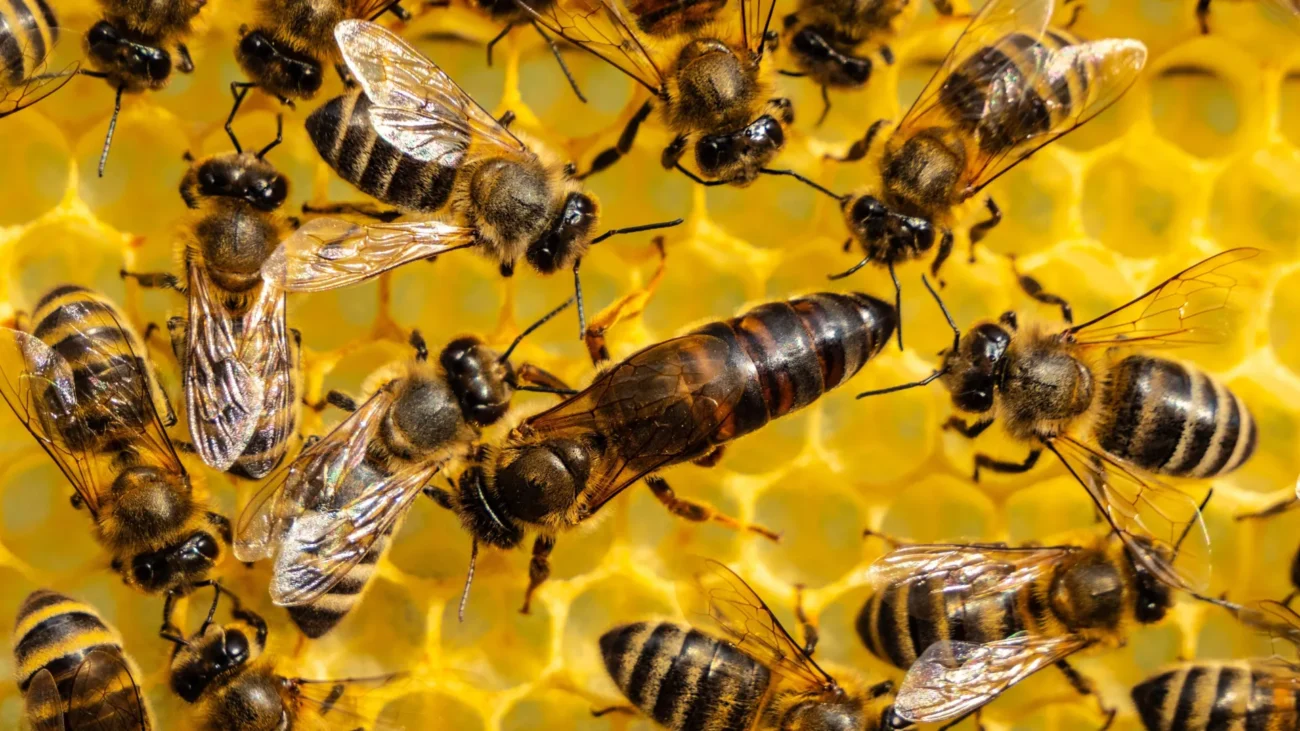
The survival of a honeybee colony relies on a complex, highly coordinated division of labor where worker bees act as the first line of defense against environmental hazards. For decades, entomologists and toxicologists understood that these industrious foragers filtered out heavy metals, pathogens, and agricultural chemicals before those toxins could reach the vulnerable center of the hive. However, groundbreaking research published in the journal Current Biology has uncovered a previously unknown biological safety valve: when the protective barriers maintained by worker bees finally fail, honeybee queens deploy an internal survival mechanism known as maternal offloading, systematically transferring accumulated pesticides directly into their eggs.
Led by a collaborative team from the University of California, Davis, in partnership with the Lawrence Livermore National Laboratory (LLNL) and the U.S. Department of Agriculture’s Agricultural Research Service (USDA-ARS), the study shatters long-held assumptions about how toxicity is managed within the hive. While previous ecotoxicological studies have heavily concentrated on the impacts of chemical exposure on forager and worker bees, this new investigation traces the precise trajectory of chemical burdens throughout the entire colony structure, offering alarming insights into how chronic agricultural exposure quietly threatens the future of bee populations.
The Mechanics of Maternal Offloading
At the heart of the discovery is a desperate physiological trade-off. As honeybee queens are persistently exposed to agrochemicals via their diet over extended periods, those toxic compounds do not simply pass harmlessly through their digestive tracts. Instead, they accumulate within the queen’s bodily tissues, threatening her neurological and reproductive systems. To preserve her own life, the queen redirects these harmful substances away from her vital organs and packages them directly into the oocytes that will become her eggs.
"In order to protect herself, the queen bee offloads these chemicals into her eggs to get rid of them," explained Sascha Nicklisch, senior author of the study and an associate professor in the Department of Environmental Toxicology at UC Davis. "No one has shown this in honeybees before."
This transfer process presents a devastating paradox for the colony. While maternal offloading successfully lowers the chemical concentration within the queen—allowing her to survive acute poisoning events—it immediately compromises the next generation. Eggs heavily laden with pesticides may fail to develop properly, suffer from severe developmental abnormalities, or die before hatching, ultimately starving the colony of the fresh workforce it needs to survive.
Unraveling the Limits of Worker Bee Defense
For generations, scientists operated under the premise that the hive operated as an impenetrable fortress, with worker bees serving as active biochemical filters. When foragers return to the hive laden with nectar and pollen collected from treated agricultural fields, nurse bees process and consume these resources, theoretically neutralizing or trapping harmful synthetic compounds before they can be fed to the developing brood or the sovereign queen.
Yet, this defensive mechanism has a finite capacity. Angela Encerrado-Manriquez, the study’s lead author and a recent Ph.D. graduate from UC Davis, noted that the protective buffer provided by worker bees degrades under prolonged environmental stress.
"In our study, pesticides began to accumulate in queens over time, suggesting that worker filtration capacity can be overwhelmed," Encerrado-Manriquez stated. "When this happens, queens have their own defense. Maternal offloading allows them to shunt the toxic burden to their eggs."
To observe and measure this hidden dynamic, the research team designed an innovative experimental framework. Constructing miniature, highly controlled environments known as "nanocolonies," the scientists simulated the micro-architecture and functional dynamics of a natural hive. Each nanocolony comprised a small conical plastic container featuring a netted bottom, housing precisely one queen and sixty worker bees.
Over the course of the trial, these confined colonies were provided with standardized rations of pollen, water, and food deliberately contaminated with trace amounts of methyl parathion—an organophosphate insecticide widely utilized in modern agriculture. To track the exact movement of the chemicals through the biological system with absolute precision, the pesticide was tagged with a low-level radioactive marker.
Cutting-Edge Technology Tracks Invisible Threats
Tracing minute quantities of pesticides through biological tissues required advanced analytical tools. This is where the specialized infrastructure of the Lawrence Livermore National Laboratory proved indispensable. LLNL researchers utilized biological accelerator spectrometry (BioAMS), an ultrasensitive technology capable of detecting radioactive isotopes at extraordinarily low, environmentally relevant concentrations.
"With BioAMS, we can trace very low levels of a pesticide," said Bruce Buchholz, an LLNL scientist and co-author of the study. "The pesticide concentrations we used were not lethal and were environmentally relevant to that seen in nature."
The data captured by BioAMS revealed a stark decline in the hive’s defensive efficacy over time. On the very first day of exposure, worker bees demonstrated remarkable filtering efficiency, successfully intercepting and removing roughly 95 percent of the pesticide from the food supply, diverting the toxins instead into the honeycomb wax. However, by the tenth day of continuous exposure, that filtration rate dropped significantly to 86 percent. As the worker bees became saturated and fatigued, the chemical onslaught breached the hive’s outer defenses, forcing the queen to activate her internal offloading mechanism.
Chronology and Scope of the Research
The collaboration between UC Davis, LLNL, and the USDA-ARS represents a milestone in apicultural toxicology, bridging the gap between field observation and molecular-level tracking. The project’s timeline spanned multiple phases:
- Phase Design and Setup: USDA researchers contributed foundational expertise in honeybee biology to design the nanocolony architecture, ensuring the experimental conditions mirrored natural colony behavior as closely as possible.
- Administration of Toxins: Bees were subjected to non-lethal, environmentally realistic doses of methyl parathion laced with radioactive tracers, simulating the chronic, low-level chemical exposure typical of agricultural borderlands.
- Tracking and Sampling: Over extended intervals, scientists tracked the migration of the radioactive markers, measuring concentrations within the worker bees, the honeycomb wax, the queen’s body, her ovaries, and finally, her laid eggs.
- Data Synthesis: LLNL’s BioAMS technology processed the samples, mapping the quantitative shift in chemical accumulation from worker filtration to maternal offloading.
The research team also included Julia Fine and Eliza Litsey from the USDA-ARS, alongside David Baliu-Rodriguez and Sean Leonard from LLNL. Financial and institutional backing for the study was provided by the USDA’s National Institute of Food and Agriculture, the Non-Assistance Cooperative Agreement program, the PAm-Costco USA Scholarship program, the University of California National Laboratory Fees Research Program, and the U.S. Department of Energy.
Broad Implications for Agriculture and Food Security
The implications of these findings extend far beyond academic toxicology laboratories, raising urgent questions for commercial beekeepers, crop growers, and policymakers shaping integrated pest management (IPM) strategies.
Honeybees are foundational to global food production, responsible for pollinating approximately one-third of the human diet, including numerous fruits, nuts, and vegetables. A decline in colony health directly threatens agricultural yields and economic stability across the farming sector. While acute pesticide poisonings—where whole colonies die suddenly after massive exposure events—are well-documented, the new study points toward a more insidious danger: a slow, cumulative degradation of colony viability.
"When pesticides accumulate to the extent that the queen bee has eggs that are so loaded they may no longer develop properly, there could be a tipping point," Nicklisch warned. "There may be a slow creeping effect of chemical accumulation that will contribute to delayed colony collapse."
A honeybee queen is an irreplaceable biological asset, capable of producing between 1,500 and 2,000 eggs per day to sustain the population. Because she is the sole reproductive engine of the hive, any physiological stress placed upon her ripples instantly through the entire social structure. If successive generations of worker bees hatch with diminished vigor, neurological deficits, or shortened lifespans due to maternal toxin transfer, the colony’s collective ability to forage, defend itself, and maintain hive temperature collapses from within.
Unanswered Questions and Future Horizons
Despite the clarity brought by the Current Biology study, researchers emphasize that many critical questions remain unanswered. Scientists do not yet know the precise threshold at which maternal offloading transitions from a manageable survival strategy to a reproductive dead end. Furthermore, it remains unclear whether different classes of synthetic pesticides—such as neonicotinoids, pyrethroids, or systemic fungicides—trigger identical offloading behaviors, or if certain chemicals are more readily shunted into eggs than others.
Another pressing area for future investigation is the potential reversibility of the process. If a colony is removed from a contaminated environment and granted access to clean forage, can a queen recover her physiological baseline, or is the damage to her reproductive output permanent?
As agricultural intensification continues to expose pollinators to complex cocktails of synthetic chemicals, answering these questions will be vital for developing effective conservation protocols. For now, the discovery of maternal offloading serves as a stark reminder of the hidden biochemical costs borne by nature’s most essential pollinators, highlighting the urgent need for safer agricultural practices that protect the health of queens and colonies alike.

