


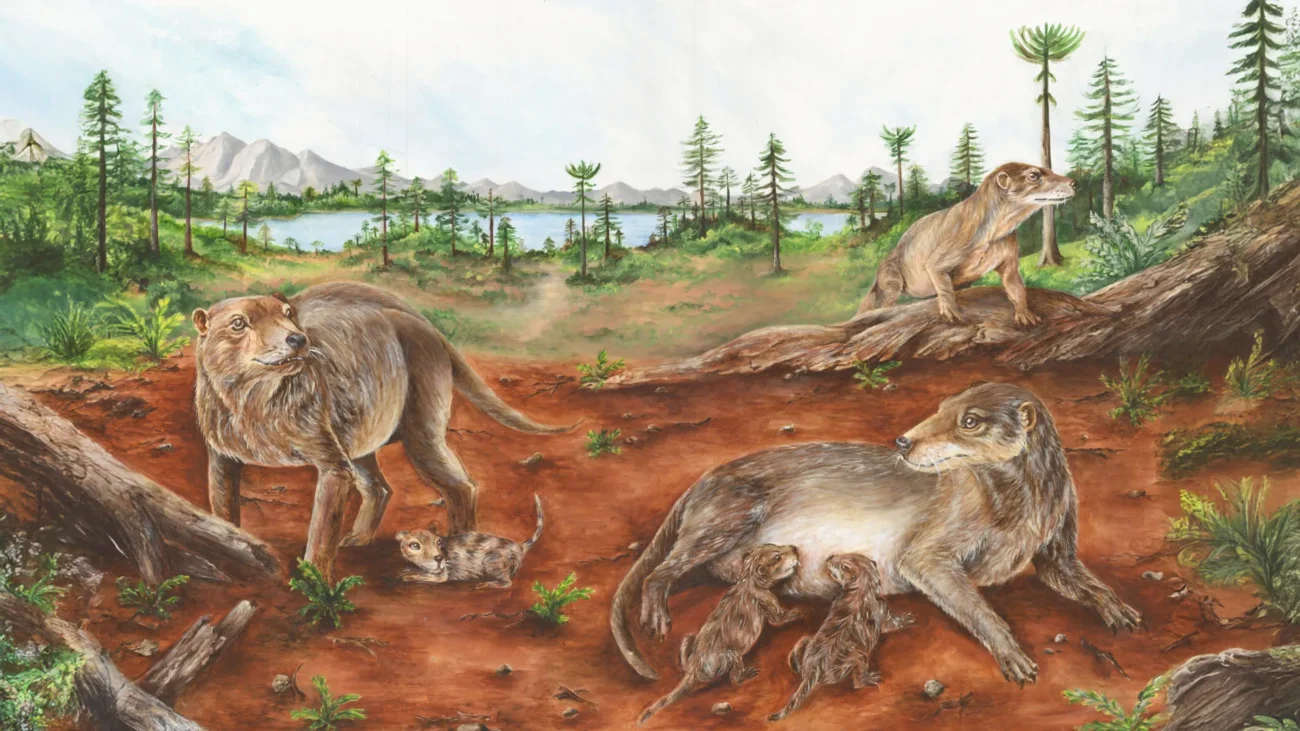
The evolutionary timeline of mammalian reproduction is undergoing a profound reassessment following the publication of a groundbreaking study in Frontiers in Mammal Science. Paleontologists have uncovered compelling microscopic evidence indicating that certain cynodonts—the ancestral precursors to modern mammals—may have been giving birth to live young roughly 236 million years ago. This discovery suggests that viviparity, the physiological trait of bearing live offspring rather than laying eggs, emerged in the mammalian lineage up to 95 million years earlier than conventional scientific consensus has long maintained.
Led by Dr. Leandro Gaetano, a prominent paleontologist at Argentina’s National Scientific and Technical Research Council (CONICET), the research centers on an analysis of Chiniquodon theotonicus, a predatory cynodont that roamed the earth during the Triassic period. By examining the microstructural anatomy of fossilized bone, the research team identified a distinct neonatal growth line, opening a rare window into the reproductive strategies of deep evolutionary history and challenging long-held assumptions regarding how early mammalian ancestors nurtured their developing offspring.
Unlocking a Longstanding Paleontological Mystery
For generations, the reproductive physiology of early mammal-like reptiles has remained one of paleontology’s most stubborn enigmas. Because soft tissues rarely fossilize, direct evidence of gestation, eggshells, or embryonic development is exceptionally scarce in the fossil record. Consequently, scientists have largely relied on indirect inferences derived from skeletal morphology, metabolic indicators, and comparisons with extant taxonomic groups to reconstruct how ancient fauna reproduced.
The breakthrough began serendipitously during a postgraduate academic course in Argentina. Researchers were analyzing a fully grown Chiniquodon theotonicus fossil that had been previously unearthed in the fossil-rich badlands of northwestern Argentina. Upon examining thin sections of the bone under a high-powered microscope, the team noticed an unusual and distinct growth mark embedded within the tissue’s microarchitecture.
In modern living animals, such structural signatures frequently correspond to a neonatal line—a specific histological ring that forms in bones and teeth as a direct physiological response to the abrupt, intense metabolic and physical acceleration that occurs immediately after birth. To verify whether this interpretation held scientific weight, the researchers devised an innovative comparative methodology. They estimated the animal’s body mass both at the moment of birth, using the dimensions indicated by the neonatal line, and at its final adult stage, using the outer parameters of the mature bone.
These calculated values were then cross-referenced against an extensive comparative dataset encompassing thousands of species of living mammals, non-avian reptiles, and birds. This quantitative approach allowed the researchers to bypass the traditional limitations of the fossil record, substituting direct morphological observation with robust allometric scaling and statistical modeling.
Triassic Pressures and the Advantage of Viviparity
To fully understand the significance of this discovery, scientists must contextualize the harsh environmental conditions of the Triassic period. Spanning from approximately 252 million to 201 million years ago, the Triassic was characterized by global ecosystem restructuring following the devastating Permian-Triassic extinction event—the most severe biotic crisis in Earth’s history, which wiped out over 70 percent of terrestrial vertebrate species.
Senior study author Adriana Mancuso, a CONICET researcher specializing in the evolution of terrestrial ecosystems, noted that the surviving fauna faced intense competition for dwindling ecological niches, alongside ferocious predatory pressures. Compounding these biological challenges was a pervasive global trend toward extreme aridity, fluctuating environmental temperatures, and pronounced seasonal volatility.
In such volatile landscapes, reproductive strategy can mean the difference between evolutionary persistence and extinction. Eggs deposited in external nests are notoriously vulnerable to environmental fluctuations, extreme heat, sudden drought, and opportunistic predation. Conversely, viviparous species internalize embryonic development, providing offspring with a buffered, thermally stable internal environment during their most vulnerable developmental stages.
The transition from oviparity (egg-laying) to viviparity would have granted early cynodonts a vital adaptive edge. By protecting developing embryos within the maternal body, these animals could better navigate the ecological instability of the post-extinction Triassic world, shielding their progeny from environmental stressors that routinely devastated egg-laying competitors.
Quantitative Insights: An Unusually Large Newborn
The mathematical and biometric findings of the study offer striking confirmation of the researchers’ hypothesis. Calculations derived from the fossilized skeletal remains of Chiniquodon theotonicus indicate that the specimen weighed an estimated 1.7 kilograms at birth and reached a final adult body mass of roughly 12 kilograms prior to death.
This establishes a neonatal-to-adult body mass ratio of approximately 14 percent. In practical terms, the newborn Chiniquodon theotonicus constituted a substantial fraction of its mother’s overall weight—a developmental profile drastically divergent from modern reptiles and birds, yet remarkably consistent with contemporary placental mammals.
To contextualize these ratios, the research team contrasted their findings with extant amniotes of comparable adult mass:
- Reptiles: Modern reptiles within the 8-kilogram to 14.5-kilogram weight range—such as specific heavy-bodied snakes, monitor lizards, and crocodilians—typically produce hatchlings weighing between a mere 9 grams and 53 grams. Their corresponding neonate-adult body mass ratios remain exceptionally low, hovering between 0.1 percent and 0.6 percent.
- Birds: Avian species of similar adult scale, including various heavy-bodied cranes, pelicans, and vultures weighing 8 kilograms to 21.5 kilograms, generally yield hatchlings ranging from 110 grams to 357 grams. This places their mass ratios significantly lower than mammals, between 1.3 percent and 4.5 percent.
- Placental Mammals: In stark contrast, modern placental mammals with adult body masses spanning 8 kilograms to 15 kilograms frequently deliver significantly heavier neonates, ranging from 35.5 grams to nearly 1.87 kilograms. Their neonate-to-adult mass ratios can surge as high as 18.77 percent.
As a primary comparative baseline, the researchers pointed to the bay duiker antelope, a modern forest-dwelling mammal that yields newborns mirroring the estimated birth weight of the ancient Chiniquodon theotonicus. Crucially, the research team deliberately excluded non-placental mammals—such as monotremes, which lay eggs, and marsupials, which give birth to underdeveloped, highly altricial young that complete development in external pouches—from these specific upper-range calculations.
"We were amazed to find that Chiniquodon theotonicus grouped with extant placental mammals, being clearly distinct from other amniotes like reptiles or birds," Dr. Gaetano observed, underscoring the unexpected precision of the biometric clustering.
Redefining the Evolutionary Timeline of Mammalian Traits
For decades, mainstream evolutionary biology maintained that live birth was a relatively late acquisition within the synapsid lineage, emerging concurrently with or shortly after the appearance of true, modern mammals during the Jurassic or Cretaceous periods. The identification of a functional neonatal line and a high neonate-to-adult mass ratio in a Triassic cynodont fundamentally disrupts this orthodox chronology.
"In cynodonts, embryonic tissues were never observed before, let alone a neonatal line," noted co-author María Miceli Baro, a graduate student at the University of Buenos Aires. "Through its analysis, we found that a trait that is generally linked to evolutionary success was present in animals long before true mammals originated."
This revelation forces paleozoologists to reconsider the piecemeal acquisition of mammalian physiological traits. It raises compelling questions regarding whether other complex biological systems historically attributed to later mammalian evolution—such as specialized lactation mechanisms, complex thermoregulation, and heightened metabolic rates—may also have roots extending deep into the Triassic period.
Furthermore, scientists emphasize that Chiniquodon theotonicus is unlikely to represent an anomalous evolutionary outlier. Rather, it may signal a broader, systemic physiological transition across the cynodont clade as these animals navigated the ecological upheavals of their changing world.
Broader Implications and Future Research Directions
While the study provides robust, quantitatively backed evidence for viviparity in at least one cynodont species, the scientific community emphasizes the necessity of empirical replication. Researchers are actively examining additional fossil specimens across various global institutions to determine whether similar histological markers exist in contemporary or closely related therapsid taxa.
"It is very well possible that Chiniquodon theotonicus does not represent an isolated case of viviparity among cynodonts," Dr. Gaetano concluded. "It could be evidence of the general switch from laying eggs to giving birth to live young early on in the mammalian lineage. But we need more evidence to test this hypothesis. Still, it looks like some cynodonts were in fact very similar to present-day mammals."
As paleontologists continue to apply advanced histological, microscopic, and allometric methodologies to fragmentary fossil collections, the once-opaque history of early mammalian reproduction is slowly coming into focus. What was once dismissed as an inscrutable mystery of deep time is now revealing a complex, dynamic evolutionary history—one where the foundations of mammalian motherhood were laid tens of millions of years earlier than humanity ever imagined.

