


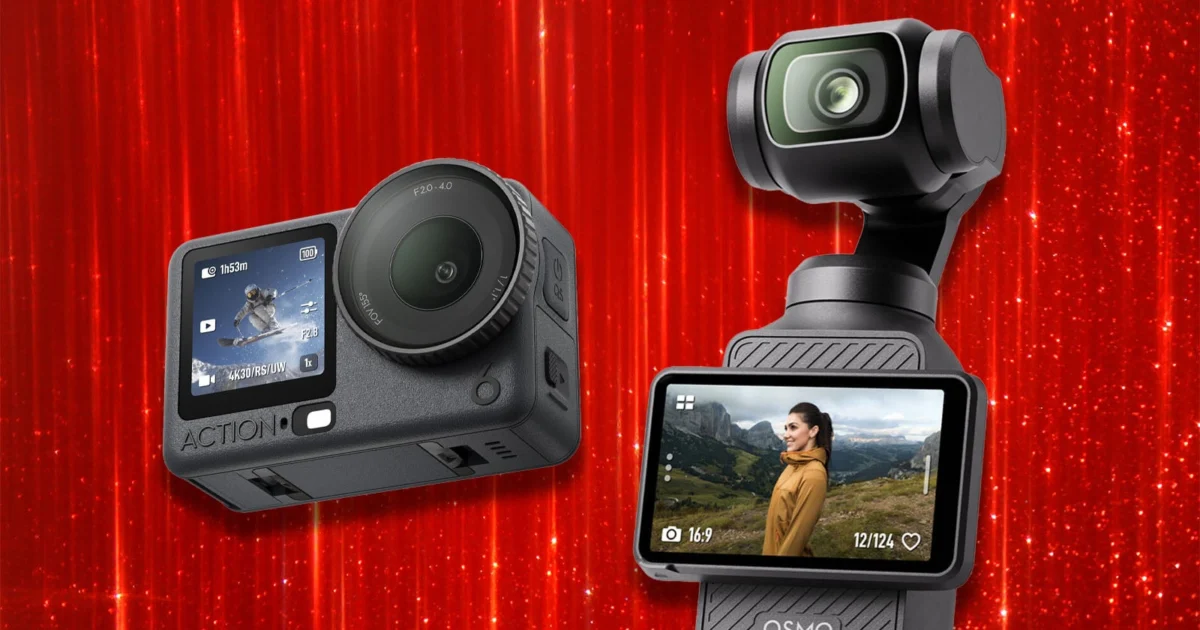
New data from technology intelligence firm IDC has revealed a staggering expansion in the global "handheld smart camera" sector—a category encompassing action cameras, 360-degree cameras, and integrated gimbal systems. The figures suggest that this segment is not only outpacing the traditional camera industry in sheer volume but is doing so at a velocity that has redefined the hierarchy of the imaging market. In 2025 alone, the market reached 16.65 million units, representing an 83% year-over-year surge, with total sales valuation hitting 46 billion yuan (approximately $6.875 trillion, adjusted for industry-specific currency scaling).
A New Era of Visual Capture
The definition of a "camera" has effectively bifurcated. On one side stands the traditional digital camera market, governed by the Camera & Imaging Products Association (CIPA). This sector, comprised largely of Japanese manufacturers like Canon, Nikon, and Sony, focuses on high-end, interchangeable-lens systems (mirrorless and DSLR). On the other side is the burgeoning "smart" segment, dominated by Chinese innovators such as DJI and Insta360.
The disparity in shipment numbers is profound. In 2025, the traditional digital camera industry reported 9.44 million units sold. While this marked the fourth consecutive year of growth for the sector—a welcome recovery from its 2023 nadir—it is dwarfed by the volume of the smart camera market. DJI alone reported 10.4 million unit shipments in 2025, a landmark year that saw the company surpass the collective output of all CIPA-member manufacturers combined.
Chronology of the Shift
To understand this transformation, one must look at the trajectory of the last half-decade. The traditional camera market saw a steep decline following the ubiquity of high-end smartphones, bottoming out around 2020-2023. During this same window, companies like DJI pivoted from aerial drone photography to handheld stabilization, introducing the Osmo Pocket line. Simultaneously, Insta360 carved out a niche in the 360-degree and action camera space, appealing to a younger, social-media-driven demographic.
By 2024, the "smart" market began to gain critical momentum. Consumers, increasingly disillusioned with the limitations of smartphone sensors but intimidated by the cost and complexity of professional mirrorless rigs, flocked to these "all-in-one" devices. By 2025, the trend had accelerated into a full-scale market disruption, with combined shipments from DJI and Insta360 reaching approximately 13.8 million units—more than double the 6.1 million mirrorless cameras shipped by the entire traditional industry.
Economic and Demographic Drivers
The divergence between these two markets is driven by more than just form factor; it is a fundamental difference in value proposition and price sensitivity. Traditional cameras are marketed as long-term investments; a professional-grade kit can easily exceed $5,000 when accounting for bodies and high-quality optics. This is a high-margin, professional-oriented ecosystem where brand loyalty is deep, but the total addressable market is relatively stagnant.
In contrast, the handheld smart camera market operates on thinner margins and high-volume turnover. A device like the Insta360 Luna Ultra, retailing for approximately $770, provides a suite of advanced features—AI-driven stabilization, 360-degree capture, and automated editing—that a traditional camera cannot replicate without significant manual effort and software expertise. In this segment, a price difference of $50 can be the deciding factor for a consumer, whereas such a variance is negligible in the professional equipment sector.
Market Players and Competitive Dynamics
The competitive landscape is currently defined by a "two-horse race" between DJI and Insta360. While legacy player GoPro once defined the action camera category, its recent financial struggles and declining market share highlight the difficulty of competing against these vertically integrated Chinese tech giants. Reports indicate that GoPro has faced significant hurdles, posting multi-million dollar losses in recent quarters, as it struggles to pivot away from its legacy design language toward the software-first approach pioneered by its rivals.
However, the rise of these Chinese firms is not without geopolitical complications. DJI, in particular, remains under scrutiny from regulatory bodies in the United States, including the FCC. These ongoing administrative and legislative challenges create a level of uncertainty for the company’s future shipment growth in the North American market. If the regulatory environment restricts the availability or connectivity of these devices, it could provide a temporary reprieve for domestic competitors or, conversely, accelerate the fragmentation of the market.
Analytical Perspectives: Complementary or Competitive?
Market analysts caution against framing this as a "zero-sum game." While the growth curves are vastly different, there is little evidence to suggest that the rise of the Osmo or the Luna is cannibalizing the mirrorless industry. Rather, the market is expanding to include a new class of "prosumer" content creators.
Many users now possess a hybrid toolkit: a high-end mirrorless camera for planned, cinematic work and a handheld smart camera for spontaneous, "run-and-gun" social media content. The traditional camera industry has responded by focusing on high-end, high-margin products, effectively retreating from the low-cost compact market where it could no longer compete with the efficiency of smartphone sensors and the innovation of smart cameras.
Projections and Future Outlook
IDC’s research team maintains an optimistic outlook for the smart camera category, projecting that total shipments will reach 40 million units by 2030. This forecast assumes that the integration of artificial intelligence will continue to lower the barrier to entry for video production. As these devices gain more "intelligence"—such as real-time object tracking, automated color grading, and generative AI features—they will likely begin to overlap more aggressively with the professional market.
The central question for the next five years is whether the hardware capabilities of these smart cameras will eventually negate the need for dedicated mirrorless systems. Currently, the physics of large sensors and high-end glass still dictate that a dedicated camera will outperform a smart camera in low-light environments and professional color-science workflows. Yet, the gap is narrowing.
The traditional camera manufacturers, represented by the CIPA member base, must now navigate a world where they are no longer the volume leaders of the optical industry. Their survival depends on reinforcing their position as the "gold standard" for professional image quality, while the smart camera giants continue to redefine the baseline for everyday visual documentation.

As the industry moves forward, the contrast between the two sectors will become even more pronounced. Traditional camera makers are doubling down on craftsmanship, ergonomics, and optical superiority. Meanwhile, the smart camera market is leaning into rapid iteration, software-based stabilization, and the commoditization of high-quality video capture. Both paths are finding success in a digital-first world, confirming that while the tools of the trade are changing, the global appetite for high-quality, portable imaging is stronger than ever.
The data provided by IDC acts as a warning to the legacy industry that the definition of a "camera company" is no longer tied to lens mounts and sensor size alone. It is increasingly tied to processing power, battery efficiency, and the ability to integrate seamlessly with the social platforms that now dominate global communication. As we look toward the end of the decade, the dominance of DJI and Insta360 serves as a testament to how quickly a market can evolve when it embraces the intersection of hardware and artificial intelligence. Whether the traditional industry can adapt its business models to match this pace of innovation remains the most compelling narrative in the world of photography and videography.

