


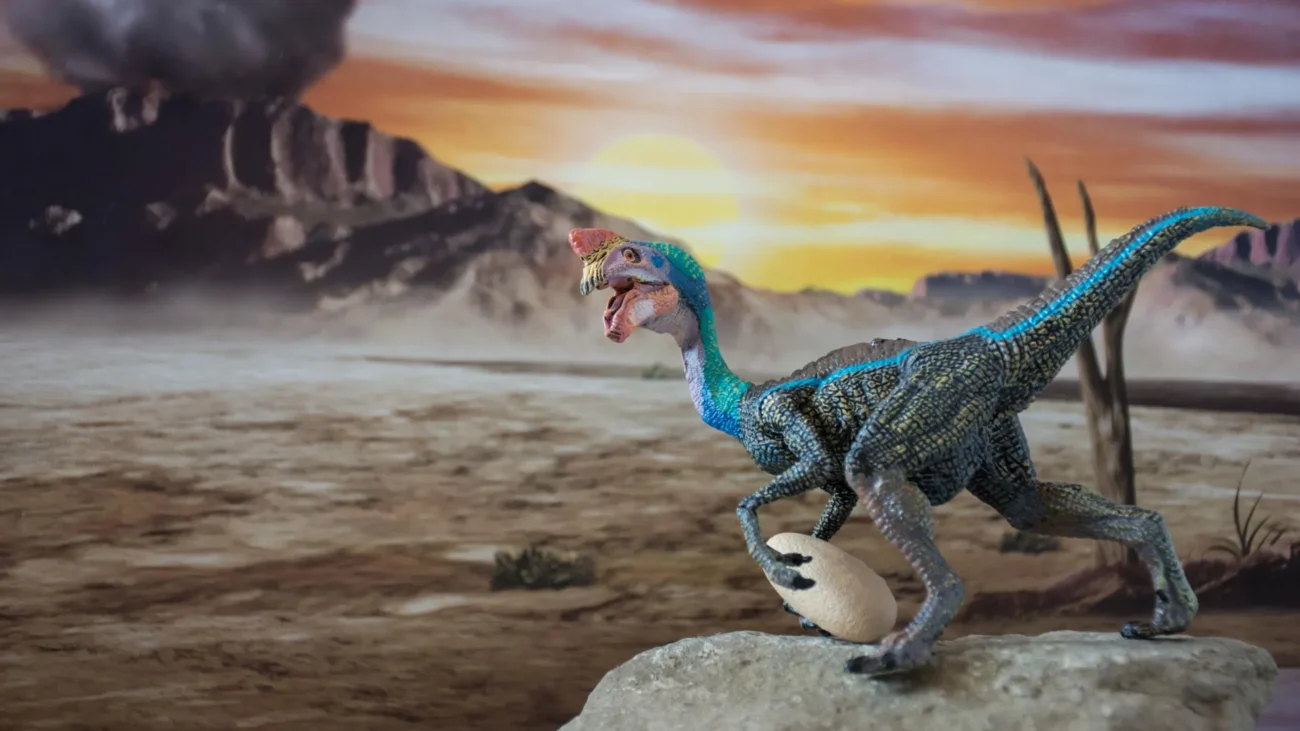
For decades, paleontologists have debated the reproductive strategies of feathered, non-avian dinosaurs, specifically questioning whether creatures like the oviraptor incubated their eggs with the devoted warmth of modern birds or relied more heavily on environmental heat sources like contemporary reptiles. A groundbreaking study published in the journal Frontiers in Ecology and Evolution offers compelling new insights into this prehistoric puzzle. By pairing physical experimentation with sophisticated computer simulations, researchers in Taiwan have reconstructed a Late Cretaceous nesting site to demonstrate that oviraptors and the sun acted as co-incubators—a hybrid brooding method that bridges the gap between ancient reptilian habits and modern avian biology.
The Origins of the Research and the Oviraptor Enigma
The subjects of the study, oviraptors, were a specialized group of small- to medium-sized, feathered, bird-like dinosaurs that roamed the earth during the Late Cretaceous Period, spanning roughly from 100 to 66 million years ago. Primarily discovered in the rich fossil beds of Asia, particularly in modern-day Mongolia and China, these animals possessed distinctive physical characteristics, including beak-like jaws, long necks, and often elaborate cranial crests. Primarily omnivorous, they adapted to varied diets that included plants, seeds, small animals, shellfish, and potentially other food sources.
Their moniker, translating paradoxically from Latin as "egg thief," stems from a historical misidentification. When the first oviraptor fossil was unearthed in the 1920s resting atop a clutch of fossilized eggs, researchers immediately assumed the animal had been caught in the act of raiding a nest. It took decades of subsequent fossil discoveries—many showing adult dinosaurs preserved in protective brooding postures directly over their eggs—to correct this reputation. Scientists now recognize that oviraptors were not thieves, but rather dedicated parents exhibiting complex brooding behaviors.
These creatures hold immense scientific value because they occupy a pivotal position in the evolutionary lineage connecting non-avian dinosaurs to modern birds. Their skeletal structures, feathers, and nesting habits provide tangible evidence that parental care and avian-like traits evolved long before the first true birds took flight. Yet, despite widespread agreement on their parental devotion, the precise thermal mechanics of how oviraptors transferred heat to their developing young remained elusive until now.
Reconstructing a Late Cretaceous Nesting Environment
To address the mechanical and thermal questions surrounding oviraptor reproduction, an innovative research team led by scientists in Taiwan set out to physically reconstruct an entire nesting scenario. The team focused specifically on Heyuannia huangi, a well-documented oviraptor species that inhabited what is now China between 70 and 66 million years ago. A typical adult of this species measured approximately 1.5 meters in length, weighed around 20 kilograms, and constructed intricate, semi-open nests featuring distinctive double rings of eggs.
Because studying fossilized eggs alone cannot reveal how heat moved through a clutch, the researchers constructed a life-sized physical model of the dinosaur. The adult oviraptor’s torso was meticulously built using a sturdy wooden framework filled with polystyrene foam, while layers of cotton, cloth, and bubble paper were incorporated to simulate the soft tissues and insulating feathers of a living animal.
Recreating the eggs presented a unique engineering hurdle. Because oviraptor eggs possess unique morphometric properties unlike those of any living species, standard artificial eggs were insufficient. The team cast custom resin eggs designed to mirror the exact dimensions, shape, and thermal conductivity of genuine Heyuannia huangi specimens. These resin eggs were then arranged in the characteristic double-ring layout observed in the fossil record, creating a fully functional experimental testing ground.
The Dual Role of Adult Brooding and Environmental Heat
With the physical model and nest in place, the researchers subjected the reconstruction to various controlled environmental conditions, measuring how both the presence of the brooding adult and external ambient temperatures influenced the internal temperature of the eggs.
The findings revealed that the position of the adult relative to the nest dictated the efficiency and uniformity of the warming process. Under cooler ambient conditions, eggs located in the outer ring of the nest—further away from the central mass of the adult’s body—exhibited significant temperature discrepancies, fluctuating by up to 6 degrees Celsius compared to inner eggs. In biological terms, such a pronounced thermal gradient would likely trigger asynchronous hatching, meaning that certain hatchlings within the same clutch would emerge days ahead of their siblings.
However, when the researchers simulated warmer environmental conditions, the temperature gap between the inner and outer rings dropped dramatically to just 0.6 degrees Celsius. This reduction indicated that solar radiation played an indispensable role in thermal regulation. Because oviraptor nests were semi-open and exposed to the open air rather than buried beneath soil or vegetation like the nests of modern crocodiles or turtles, ambient sunlight served as a powerful supplementary heat source.
"It’s unlikely that large dinosaurs sat atop their clutches," explained Dr. Tzu-Ruei Yang, senior author of the study and associate curator of vertebrate paleontology at Taiwan’s National Museum of Natural Science. "Supposedly, they used the heat of the sun or soil to hatch their eggs, like turtles. Since oviraptor clutches are open to the air, heat from the sun likely mattered much more than heat from the soil."
Contrasting Prehistoric Brooding with Modern Avian Biology
To contextualize their findings, the research team compared oviraptor incubation mechanics with the reproductive strategies observed in modern birds. Today, the vast majority of avian species rely on thermoregulatory contact incubation, commonly abbreviated as TCI. This advanced biological strategy requires three strict conditions: the brooding parent must maintain direct physical contact with every individual egg, the parent’s body must serve as the primary and nearly exclusive heat source, and the entire clutch must be maintained within a very narrow, highly regulated temperature range.
The physical experiments demonstrated that oviraptors could not fulfill these stringent criteria. Due to the wide, multi-ringed design of their nests and the anatomical constraints of their bodies, adult oviraptors were incapable of making direct contact with every egg simultaneously. Consequently, the dinosaurs and the ambient environment operated as joint thermal managers.
"Oviraptors may not have been able to conduct TCI as modern birds do," noted Chun-Yu Su, the study’s first author, who was a high school student in Taichung when the research was conducted. Instead, Su suggests that these dinosaurs and the sun functioned as co-incubators. While this dual-source method proved less thermally efficient than modern avian incubation, it represents a successful evolutionary stepping stone. This adaptation likely marked a transitional phase away from buried reptilian nests toward the open, parent-attended brooding behaviors that ultimately characterized the rise of true birds.
Implications, Limitations, and Future Directions
While the study offers a revolutionary look at dinosaur reproductive biology, the authors are careful to outline the limitations of their work. The conclusions are specifically tied to the exact architectural dimensions of the reconstructed nest used in the experiment. Furthermore, Earth’s climate during the Late Cretaceous Period was considerably warmer and more stable than the modern global climate, factors that would have influenced absolute thermal transfer rates. Paleontologists also generally believe that oviraptors required significantly longer overall incubation periods than modern birds of comparable body sizes.
Despite these variables, the integration of physical reconstructions with computer-based heat transfer modeling establishes a powerful new paradigm for paleontological research. By moving beyond static fossil analysis, scientists can begin to reconstruct the dynamic, living behaviors of extinct animals in quantitative detail.
Beyond its academic contributions, the study holds symbolic significance for the scientific community in Taiwan. Dr. Yang emphasized that groundbreaking paleontological research can thrive even in regions devoid of local dinosaur fossil deposits. "It also truly is an encouragement for all students, especially in Taiwan," Yang concluded. "There are no dinosaur fossils in Taiwan, but that does not mean that we cannot do dinosaur studies."
Ultimately, the research cautions against viewing evolutionary history through a competitive lens where modern traits are deemed inherently superior to ancestral ones. As Yang observed, neither oviraptor brooding nor modern avian incubation is objectively "better"; each strategy simply represents a finely tuned biological response optimized for a specific organism operating within a very different prehistoric world.

