


The landscape of avian ownership and conservation is increasingly defined not only by the care provided in aviaries and homes but by the complex legal frameworks established in city halls, state capitals, and federal agencies. For the American Federation of Aviculture (AFA) and the broader community of bird enthusiasts, the task of monitoring legislation has evolved from a secondary interest into a primary necessity for the survival of the hobby and the profession. Legislation, historically defined as the proposing of laws, has become a sophisticated mechanism through which the rights of bird owners, breeders, and exhibitors are often challenged. In the modern era, most proposed changes arrive in the form of a "Bill"—a document that serves as a draft of a potential law. While these bills often include introductory summaries intended to explain their purpose to the public, these summaries can frequently be misleading or incomplete, masking the true regulatory impact on specific communities such as aviculturists.
The origin of these legislative efforts is a critical point of concern for the AFA. While bills are formally introduced by elected representatives, they frequently originate from the drafting rooms of powerful lobbying organizations. Specifically, animal rights and animal welfare groups with substantial political influence often craft the language of these bills before presenting them to lawmakers. This creates a disconnect, as the agendas of these organizations rarely align with the views or practical needs of the general public or the specialized community of bird keepers. For the AFA, monitoring these developments is the first line of defense against regulations that could negatively impact the keeping of pet birds, breeding stock, and birds used in educational or exhibition settings.
Understanding the Hierarchy of Legal Controls: Bills, Ordinances, and Regulations
To navigate the legislative environment effectively, one must understand the distinctions between different types of legal mandates. At the local level, legislative proposals are typically referred to as "ordinances." These are often perceived by the public as common-sense measures intended to ensure community safety or cleanliness, such as limiting the number of dogs or cats in a single household. However, the language used in these ordinances is frequently broad. An animal ordinance may begin by listing common pets like dogs and cats but can easily be amended or interpreted to include birds, primates, fish, or small mammals.
Consider the hypothetical but realistic scenario of a dedicated canary breeder. If a local ordinance is passed to limit a household to six animals—intended initially for dogs—and the language is later clarified to include all vertebrate animals, that breeder, who may have six pairs of canaries, suddenly finds themselves in violation of the law. Because ordinances are civil rather than criminal matters, the consequences often involve escalating fines and court appearances. While a bird owner may not face immediate arrest, a judge has the authority to enforce these ordinances through significant financial penalties or by holding the individual in contempt of court if the "violation" is not corrected.
Beyond bills and ordinances lie "regulations," which are the specific rules written by government agencies to implement a law. Unlike bills, which must be voted on by elected officials such as city councils, state assemblies, or the U.S. Congress, regulations can often be adjusted by administrative bodies without a direct legislative vote, provided a specific bureaucratic process is followed. A primary example of this is the U.S. Fish and Wildlife Service (USFWS) adding a species to the Endangered Species Act (ESA) or the United States Department of Agriculture (USDA) updating standards under the Animal Welfare Act (AWA). These administrative shifts can have immediate and profound effects on the legality of owning or transporting certain bird species.
A Chronology of Avian Legislation and Advocacy
The history of legislative monitoring in the United States reflects a growing tension between conservation through captive breeding and the push for restrictive animal ownership laws.
- 1973-1974: The Endangered Species Act (ESA) is passed, and the Convention on International Trade in Endangered Species of Wild Fauna and Flora (CITES) is drafted. In response to the increasing complexity of these international and federal rules, the American Federation of Aviculture is founded to provide a unified voice for bird owners.
- 1992: The Wild Bird Conservation Act (WBCA) is enacted, significantly restricting the importation of many exotic bird species into the United States. This shift placed a renewed emphasis on the importance of domestic breeding programs.
- 2000s-2010s: A surge in local "retail pet sale bans" begins to take hold in various municipalities. While often aimed at "puppy mills," the broad language in many of these bills begins to affect the availability of captive-bred birds in local markets.
- 2023: After years of litigation and public comment periods, the USDA finalizes new regulations under the Animal Welfare Act specifically addressing birds. This marks one of the most significant shifts in federal oversight for avian breeders and exhibitors in decades, requiring many to obtain federal licenses for the first time.
The Influence of Lobbying and the "Slippery Slope" in Legislation
The AFA Legislative Committee, working in concert with other animal-keeping organizations, maintains a constant watch over legislative trends that may seem unrelated to birds at first glance. For instance, a local bill proposing a ban on the use of animals in circuses may appear irrelevant to a parrot owner. However, experienced advocates know that the specific wording in such bills often creates a legal precedent. Once a "prohibition of use" is established for one category of animals, it becomes significantly easier for activists to introduce amendments that expand the ban to include other exotic animals, including birds.
The current volume of anti-animal-ownership legislation being introduced at the state and local levels is unprecedented. Many of these bills use emotive language, suggesting they are designed solely to eliminate "inhumane treatment" or "overpopulation." While these are goals that most citizens support, the actual regulations written under the umbrella of such laws can be so restrictive that they effectively prohibit the keeping of pet birds or the operation of specialized breeding facilities. By framing the legislation as a moral necessity, proponents often bypass the practical concerns of responsible owners who provide high standards of care.
Data and Economic Implications of the Aviculture Sector
The impact of restrictive legislation is not merely a matter of personal hobbyist rights; it has significant economic and conservation-related consequences. According to data from the American Pet Products Association (APPA), millions of households in the United States include birds. The avian sector contributes billions of dollars to the economy through the sale of specialized food, housing, veterinary services, and supplies.
Furthermore, private aviculture plays a documented role in the conservation of species. When legislative hurdles make it impossible for private breeders to maintain diverse genetic pools of rare birds, the burden falls entirely on zoological institutions, which often lack the space or resources to maintain large populations of every threatened species. Data suggests that for certain species, the captive population held by private individuals far exceeds the population in the wild or in public zoos. Legislation that discourages or criminalizes this "citizen science" can lead to the functional extinction of certain species if wild populations collapse.
Reactions from the Avicultural Community and Related Parties
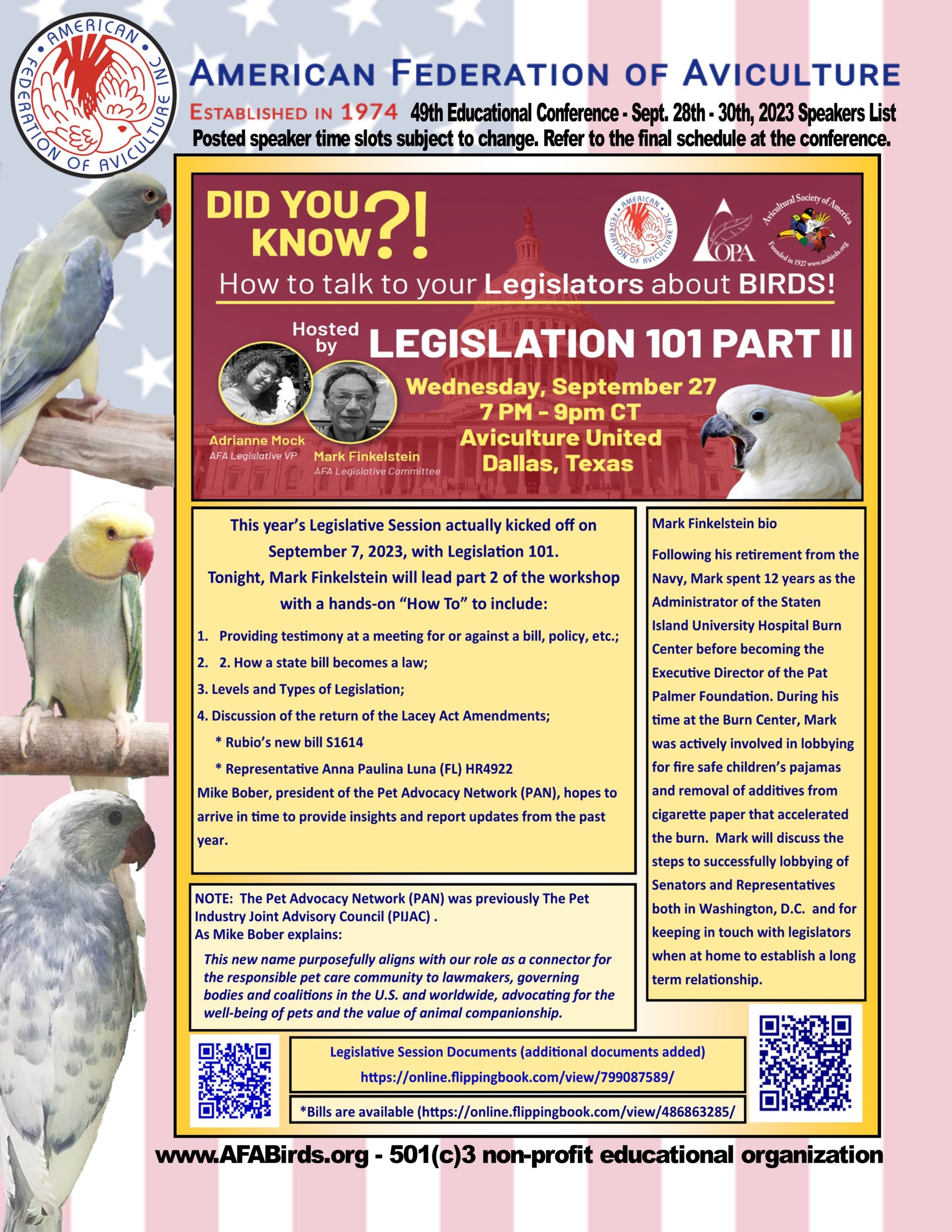
The reaction to increasing legislative pressure has been a movement toward greater professionalization and political engagement within the bird-keeping community. Organizations like the AFA have developed educational courses, such as "Legislation 101," to teach bird owners how to read a bill, how to contact their representatives, and how to provide effective testimony at public hearings.
Legal experts within the pet industry have noted that the "incremental" approach used by some lobbying groups is highly effective. By passing small, seemingly innocuous ordinances in minor jurisdictions, they create a "patchwork" of laws that make it difficult for breeders to transport birds across county or state lines. This legislative friction eventually makes the hobby so difficult to navigate that younger generations are discouraged from participating, leading to a natural decline in the community—a result that many lobbying groups view as a victory.
Broader Impact and Future Implications
The ongoing battle over avian legislation serves as a bellwether for the future of all animal ownership. If bird owners fail to monitor and respond to proposed changes in the law, the precedent set will likely be applied to other sectors, including the keeping of reptiles, small mammals, and eventually traditional pets. The AFA emphasizes that while a proposed bill in a different state might not seem to have an immediate effect, the "contagion" of legislation is a real phenomenon. Laws passed in one jurisdiction are frequently used as templates for others.
As the legal environment becomes more complex, the necessity for a centralized, informed, and proactive advocacy group becomes clear. The AFA’s "Current Legislative Issues" platform serves as a critical resource for those looking to stay informed about the bills that could shape the future of bird keeping. The ultimate goal of these monitoring efforts is to ensure that birds remain a part of human life, both as companions and as subjects of dedicated conservation, and to prevent the total elimination of aviculture through incremental regulatory overreach. Without vigilant oversight, the right to keep, breed, and study these unique creatures may be legislated out of existence, one ordinance at a time.

