


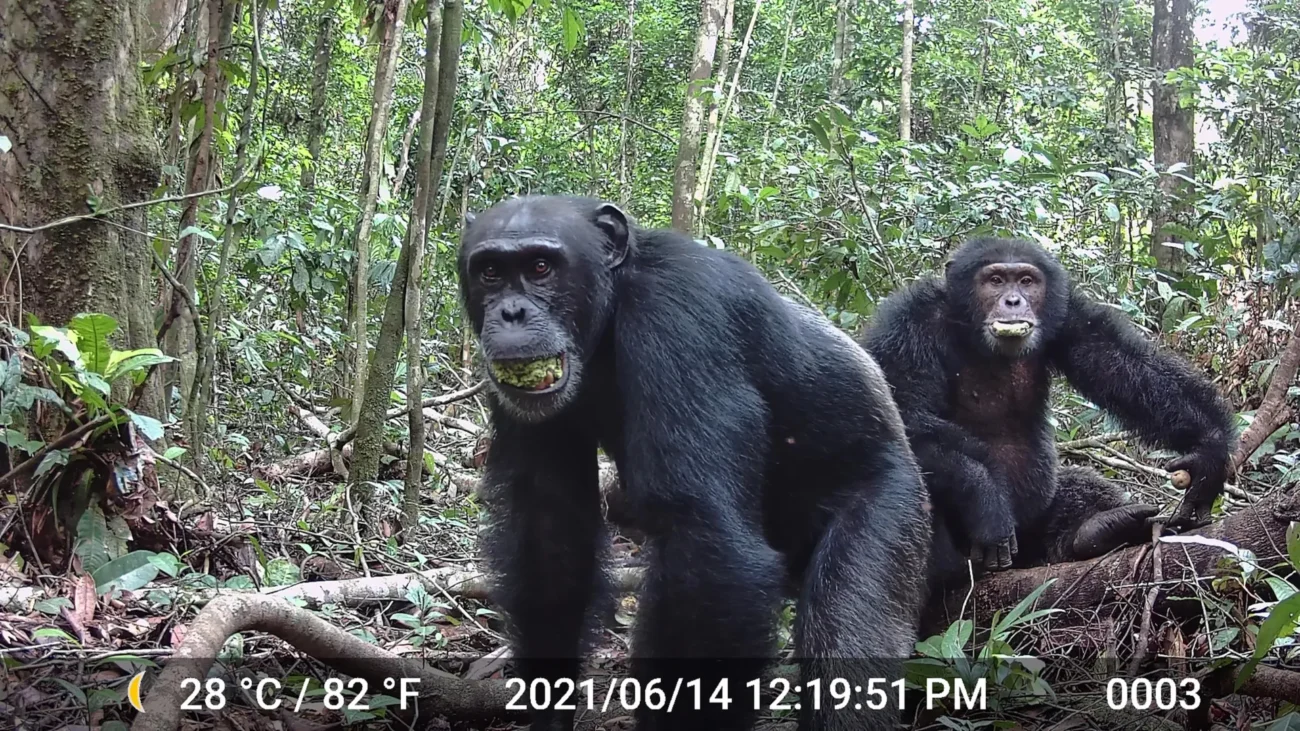
The first-ever comprehensive measurements of the ethanol content in fruits consumed by chimpanzees in their natural African habitats reveal a consistent daily intake equivalent to more than two standard alcoholic drinks per animal. This groundbreaking research, conducted by scientists at the University of California, Berkeley, suggests that alcohol has been a regular component of the chimpanzee diet for millennia, offering crucial insights into the evolutionary roots of alcohol consumption in primates, including humans.
A Daily Dose of Fermentation: Unveiling Chimpanzee Dietary Habits
Researchers have meticulously analyzed 21 different fruit species regularly eaten by chimpanzees at two long-term study sites: Ngogo in Uganda’s Kibale National Park and Taï National Park in Côte d’Ivoire. The findings, published in the esteemed journal Science Advances, indicate that these fruits, on average, contain approximately 0.26% alcohol by weight. When factoring in the estimated daily fruit consumption of chimpanzees – an impressive 10 pounds (4.5 kilograms), which constitutes about three-quarters of their total food intake – the daily ethanol intake emerges as substantial.
"Across all sites, male and female chimpanzees are consuming about 14 grams of pure ethanol per day in their diet, which is the equivalent to one standard American drink," stated Aleksey Maro, a lead graduate student in UC Berkeley’s Department of Integrative Biology and the paper’s first author. He further elaborated on the implications of body mass differences: "When you adjust for body mass, because chimps weigh about 40 kilos versus a typical human at 70 kilos, it goes up to nearly two drinks." A standard American drink is defined as containing 14 grams of ethanol, regardless of the consumer’s size.
The study highlights that the most frequently consumed fruits at each site were also the most alcohol-rich. At Ngogo, the fig species Ficus musuco emerged as a prime source of ethanol, while at Taï, the plum-like fruit of the evergreen Parinari excelsa held this distinction. Notably, male chimpanzees at Ngogo have been observed congregating in the canopies of F. musuco trees, suggesting a deliberate attraction to these alcohol-laden fruits. Similarly, elephants, known for their attraction to alcohol, are also frequent consumers of P. excelsa.
The "Drunken Monkey" Hypothesis: An Evolutionary Link
This research provides robust empirical support for the "drunken monkey" hypothesis, first proposed by UC Berkeley Professor Robert Dudley over two decades ago. This theory posits that humans’ enduring fascination with alcohol has deep evolutionary origins, stemming from the foraging habits of our ancient primate ancestors who regularly consumed fermenting fruits.
Professor Dudley, the senior author of the study, explained the significance of the findings: "The chimps are eating 5 to 10% of their body weight a day in ripe fruit, so even low concentrations yield a high daily total — a substantial dosage of alcohol." He further suggested that the observed consumption rate might be a conservative lower limit. "If the chimps are randomly sampling ripe fruit as did Aleksey, then that’s going to be their average consumption rate, independent of any preference for ethanol. But if they are preferring riper and/or more sugar-rich fruits, then this is a conservative lower limit for the likely rate of ethanol ingestion."
The "drunken monkey" hypothesis initially faced skepticism from some scientists, particularly primatologists, who questioned the prevalence of fermented fruits in wild primate diets. However, a growing body of evidence, including recent observations of chimpanzees in Guinea-Bissau consuming fermented fruit and captive primate studies demonstrating active alcohol preference, has bolstered Dudley’s long-standing theory. For instance, research from Dartmouth University in 2016 showed that captive aye-ayes and slow lorises consistently chose nectar with higher alcohol content. Furthermore, in 2022, Dudley’s team documented wild spider monkeys in Panama consuming fermented fruits and excreting alcohol metabolites in their urine, further solidifying the link between primates and alcohol in their natural environments.
Methodological Rigor: Measuring Alcohol in the Wild
The scientific rigor behind these findings is considerable. Aleksey Maro undertook two field seasons at Ngogo and one at Taï, commencing in 2019. He collected freshly fallen, intact fruits from beneath trees where chimpanzees had recently fed. These samples were immediately sealed in airtight containers and detailed notes on their characteristics were recorded. Back at the research base camps, the fruits were flash-frozen to preserve their alcohol content and prevent further fermentation.
To accurately measure the ethanol levels, Maro employed three distinct techniques, all validated in Professor Dudley’s Berkeley laboratory prior to fieldwork: a semiconductor-based sensor akin to a breathalyzer, a portable gas chromatograph, and a chemical assay. Two of these methods involved preparing the fruit pulp, allowing alcohol to volatilize into the "headspace" of a sealed container for analysis. The third method utilized a chemical reaction with liquid extracted from the pulp. This multi-pronged approach ensured the reliability and consistency of the alcohol readings, processing approximately 20 samples daily under challenging field conditions.
Beyond Chimpanzees: A Broader Evolutionary Perspective
The implications of this research extend beyond chimpanzees and humans. Professor Dudley noted that alcohol consumption is not exclusive to primates. A study published earlier in 2023 revealed alcohol metabolites in the feathers of 10 out of 17 bird species analyzed, indicating that ethanol is a common component in the diets of nectar-feeding, grain-eating, and insectivorous birds.
"The consumption of ethanol is not limited to primates," Dudley commented. "It’s more characteristic of all fruit-eating animals and, in some cases, nectar-feeding animals." He proposed several hypotheses for why animals might seek out ethanol: its aroma could serve as an olfactory cue to locate energy-rich, sugary foods; alcohol might enhance the palatability or reward associated with eating; or its consumption could foster social bonding within groups.
The study underscores the need for continued research into the evolutionary underpinnings of alcohol attraction and abuse in modern humans. "It just points to the need for additional federal funding for research into alcohol attraction and abuse by modern humans. It likely has a deep evolutionary background," Dudley emphasized.
Next Steps: Unraveling the Nuances of Alcohol Consumption
The current research establishes a critical baseline for future investigations. Maro plans to return to Ngogo to collect chimpanzee urine samples during sleep. This challenging endeavor, involving the use of an umbrella to capture samples from sleeping chimps in trees, will allow for the testing of alcohol metabolites using kits similar to those employed in workplace drug testing. In parallel, working with undergraduate researcher Laura Clifton Byrne from San Francisco State University, Maro will continue to observe foraging chimpanzees, collecting and analyzing the alcohol content of fruits dislodged from the canopy.
These future studies aim to discern whether chimpanzees actively select fruits with higher ethanol concentrations over less fermented options, shedding light on the intentionality behind their alcohol consumption. The research team, which includes collaborators Aaron Sandel from the University of Texas, Austin; Bi Z. A. Blaiore and Roman Wittig from the Taï Chimpanzee Project; and John Mitani from the University of Michigan, Ann Arbor, is poised to further illuminate the intricate relationship between primates, their diets, and the evolutionary history of alcohol. The findings are expected to contribute significantly to our understanding of primate behavior, evolution, and the deep-seated biological drivers that may influence human alcohol consumption.
The research was made possible by funding from UC Berkeley and represents a significant leap forward in our understanding of how ancient dietary habits may have shaped modern physiological and behavioral traits in both primates and humans. The meticulous fieldwork and rigorous scientific methodology employed by the Berkeley team have provided an unprecedented window into the complex interplay between natural food sources and the consumption of alcohol in wild chimpanzee populations.

