


The American Federation of Aviculture (AFA) has intensified its call for bird owners, breeders, and exhibitors to maintain a vigilant watch over local, state, and federal legislative developments, citing a significant increase in "anti-animal use" bills that could inadvertently or intentionally dismantle the hobby and industry of aviculture. As the legal landscape surrounding animal ownership becomes increasingly complex, the AFA warns that the distinction between well-intended welfare measures and restrictive rights-based legislation is often blurred by misleading summaries and vague terminology. Understanding the mechanics of how a bill becomes a law, the role of lobbying organizations, and the subtle shift from municipal ordinances to federal regulations is no longer optional for the modern bird enthusiast; it is a prerequisite for the survival of the practice.
The Anatomy of Modern Legislation and the Influence of Lobbying
In its most traditional sense, legislation is defined as the proposing of a law or laws. In contemporary governance, this process typically begins with the introduction of a "Bill," a document that outlines the specific legal framework intended by its author. While bills often include an introductory summary designed to explain the law’s purpose, enforcement mechanisms, and community impact, the AFA highlights that these summaries can be strategically misleading.
A significant portion of modern animal-related legislation does not originate within the offices of elected representatives. Instead, these bills are frequently drafted by lobbying arms of external organizations, specifically those focused on animal rights or animal welfare. While the terms "rights" and "welfare" are often used interchangeably by the public, their legislative agendas differ fundamentally. Welfare organizations generally focus on the humane treatment and care of animals, whereas rights-based organizations may seek to end the human-animal bond entirely, including the keeping of pets or the managed breeding of avian species. When these organizations present pre-drafted "model legislation" to representatives, the resulting bills often reflect agendas that do not align with the views of the general public or the practical realities of bird ownership.
The "Ordinance Creep": How Local Laws Impact Aviculture
One of the most immediate threats to bird owners occurs at the municipal level through the enactment of ordinances. Unlike federal laws, which may take years to debate, local ordinances can be passed relatively quickly by city councils or county boards. The AFA points to a phenomenon known as "ordinance creep," where laws designed for one species are expanded to include others.
A common example involves "limit laws" or "animal hoarding" ordinances. A city may propose an ordinance to limit a household to six dogs or cats to prevent nuisance complaints or neglect. On the surface, such a law might appear fair or even beneficial to the community. However, these ordinances often begin with a broad list of subject animals, including dogs, cats, fish, birds, and primates. If a canary breeder maintains six pairs of birds for a specialized breeding program, they would suddenly find themselves in violation of a law originally marketed as a dog and cat control measure.
Furthermore, the AFA emphasizes that these ordinances are typically civil rather than criminal matters. While this means an owner is unlikely to be arrested immediately, it introduces a system of escalating fines and judicial oversight. If a bird owner is found in violation of a local ordinance regarding the number or type of birds kept on their property, they may be taken to court. A judge, tasked with enforcing the ordinance, can assess significant financial penalties or hold the owner in contempt of court if the "problem"—which in this case is the birds themselves—is not removed.
Distinguishing Between Laws, Ordinances, and Regulations
To effectively monitor the legal environment, stakeholders must understand the hierarchy of government mandates. Laws and ordinances are legislative products that require a formal vote by elected officials, such as a State General Assembly, the U.S. Senate, or a City Council. These represent the "what" of the legal system—the established rules of the land.
In contrast, regulations represent the "how." Regulations are the specific rules written by government agencies to implement and enforce the laws passed by legislators. Crucially, regulations can often be changed without a direct vote from elected officials, provided a specific administrative process is followed. A primary example of this is the U.S. Fish and Wildlife Service (USFWS) adding a bird species to the Endangered Species Act (ESA). While the ESA itself is a law passed by Congress, the list of protected species and the specific restrictions on their movement or sale are regulatory decisions made by agency officials.
The AFA Legislative Committee, in collaboration with other national animal-keeping organizations, monitors both the legislative and regulatory fronts. This dual-pronged approach is necessary because a law that seems harmless in its primary text can become devastating once the "implementing regulations" are drafted by agency staff who may have a bias against captive bird management.
Chronology of Legislative Shifts in Aviculture
The history of avian legislation in the United States has seen several pivotal moments that have shaped the current environment.
- The Lacey Act (1900 and subsequent amendments): Originally designed to prevent the interstate shipment of illegally killed game, the Lacey Act has been expanded multiple times. Recent attempts to amend the act have sought to create a "blacklist" or "whitelist" for the importation of non-native species, which would have profound impacts on the availability of diverse bird species in the U.S.
- The Wild Bird Conservation Act (1992): This federal law significantly restricted the importation of wild-caught birds into the United States. While it aimed to protect species in the wild, it placed the burden of species survival on domestic, captive-breeding programs—the very programs now under threat from local limit laws.
- The Animal Welfare Act (AWA) Inclusion (2023): After decades of exclusion, the USDA recently finalized regulations to include birds under the Animal Welfare Act. This shift requires many breeders and exhibitors to obtain federal licenses and adhere to strict facility standards, illustrating how regulatory changes can transform the landscape of aviculture overnight without a new act of Congress.
- Modern State-Level Bans: In recent years, several states have introduced "Big Cat" or "Exotic Animal" bans. While the public focus is often on tigers or primates, the AFA warns that the verbiage in these bills is frequently broad enough to include many parrot species or "non-traditional" poultry, often under the guise of public safety or disease prevention.
The Strategy of Insinuation and Unchecked Amendments
A significant concern for the AFA Legislative Committee is the use of "insinuation" in bill language. A bill may be titled as an "Act to Prevent Inhumane Treatment of Performance Animals" or a "Local Circus Prohibition Act." To the average citizen, these sound like noble causes. However, experienced legislative monitors look for wording that allows for unchecked amendments.
Once a bill is in the system, its language can be modified in committee meetings or during floor debates. A prohibition that initially targeted elephants in traveling circuses can be amended to include "all exotic animals used for public display," which could legally encompass a local bird club’s educational outreach program at a library or a small-scale breeder showing their birds at a county fair. The AFA notes that the current volume of anti-animal use bills being introduced at the state and local levels is "astounding," necessitating a constant, expert-led review of every new filing.
Economic and Conservation Implications of Restrictive Legislation
The impact of legislative overreach extends beyond the individual pet owner; it threatens the economic and conservationist foundations of aviculture. According to industry data, the pet bird sector contributes billions of dollars to the U.S. economy through the sale of specialized feeds, veterinary services, and equipment. Restrictive laws that discourage or criminalize bird ownership threaten the livelihoods of thousands of small business owners and avian veterinarians.
From a conservation perspective, private aviculture serves as a critical "insurance population" for species that are extinct or endangered in the wild. Programs like the Spix’s Macaw recovery have historically relied on the expertise and populations maintained by private keepers. If local ordinances make it impossible for breeders to maintain viable genetic pools of various species, the world loses a vital safeguard against total extinction. The AFA argues that legislation should focus on encouraging responsible husbandry rather than the "elimination of birds from our lives."
Official Responses and the Call to Action
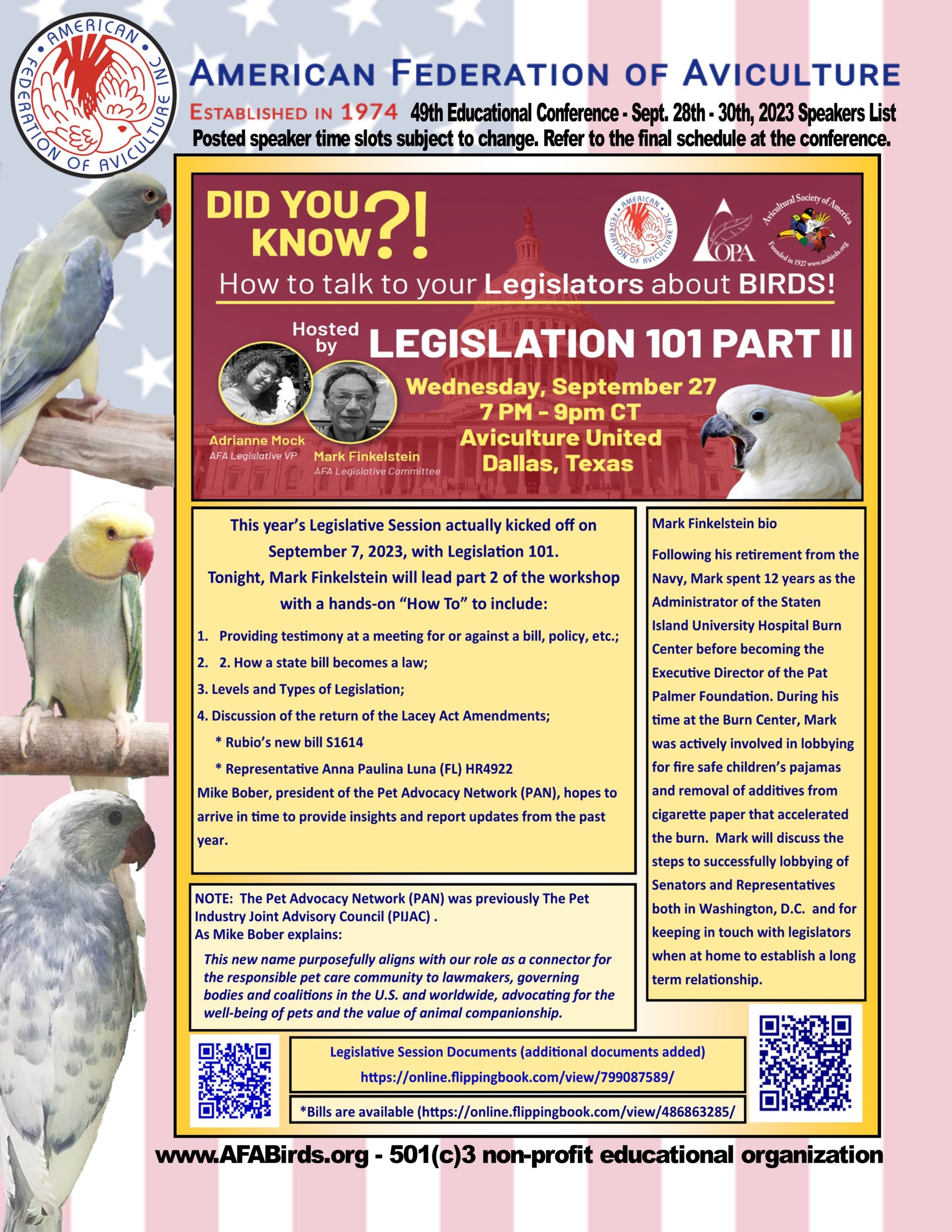
In response to these growing threats, the AFA has developed resources such as the "Legislation 101: Training Course" to help bird owners become effective advocates. The organization emphasizes that bird owners must move from a reactive to a proactive stance. This involves building relationships with local representatives before a problematic bill is introduced and staying informed through the AFA’s "Current Legislative Issues" portal.
The AFA’s Legislative Committee works alongside other groups, such as the Pet Advocacy Network (formerly PIJAC), to provide a unified voice for animal owners. Their stance is clear: while humane treatment is a shared goal, it must not be used as a Trojan horse for the incremental abolition of bird ownership.
As the legal landscape continues to evolve, the AFA maintains that "proposed legislation may not have an immediate effect on you and your birds today, but if passed in other states, it becomes easier to propose in others." The organization urges all stakeholders to monitor the bills in their areas, noting that the ultimate goal of many lobbying groups is the complete removal of birds from the private sphere. By understanding the legislative process and remaining vigilant, the avicultural community can ensure that birds remain a vibrant part of human life and conservation efforts for generations to come.

