


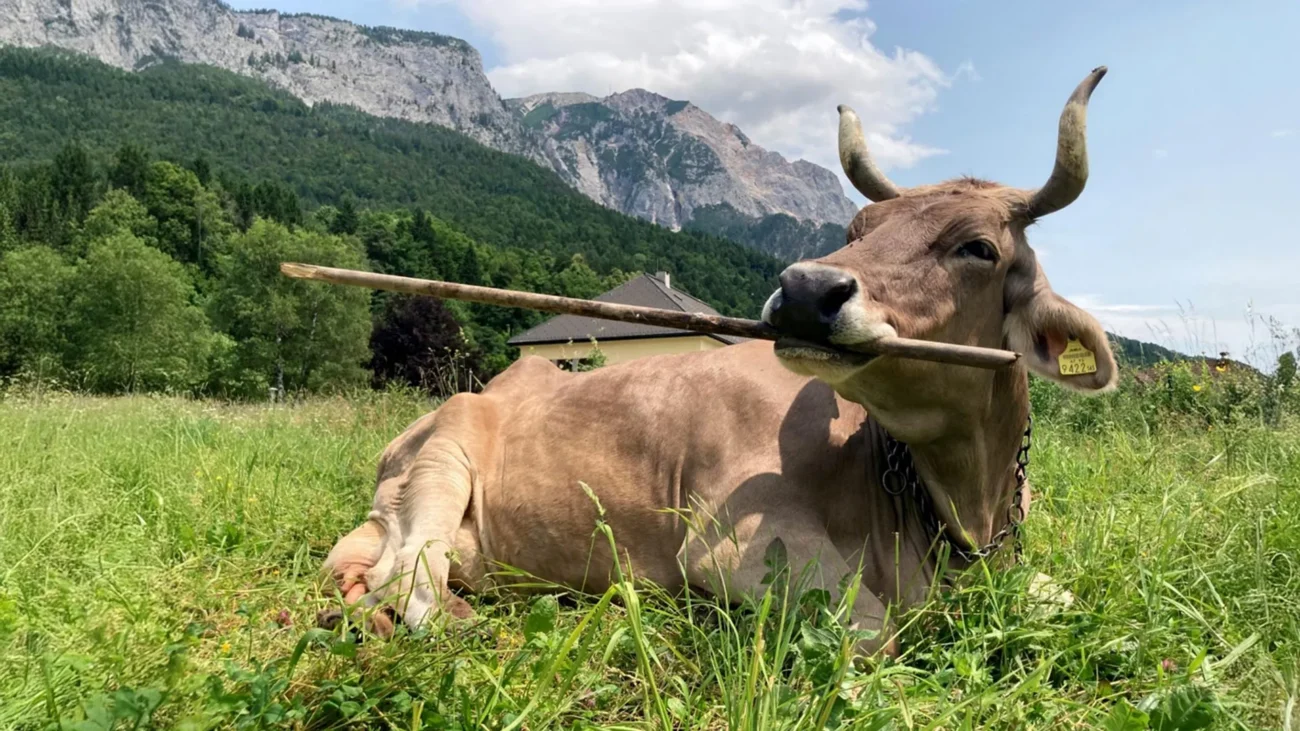
In a development that challenges long-held assumptions about animal cognition, a single Swiss Brown cow named Veronika has become the first documented case of a domestic bovine exhibiting flexible tool use. The groundbreaking findings, published in the prestigious journal Current Biology, are forcing scientists to re-evaluate the cognitive capabilities of livestock, a species often relegated to the background in discussions of animal intelligence. This discovery directly contradicts the humorous premise of Gary Larson’s iconic 1982 Far Side comic, "Cow Tools," which depicted a cow surrounded by an assortment of baffling, seemingly useless implements, playing on the widely accepted notion that cows are incapable of creating or utilizing tools.
Challenging Perceptions: The Legacy of "Cow Tools"
The Far Side comic strip, "Cow Tools," became an enduring cultural touchstone, encapsulating a humorous, yet prevalent, perception of cows as creatures of limited intellectual capacity. Larson’s simple yet effective illustration presented a cow with an expression of proud accomplishment next to a collection of abstract shapes, all labeled as "tools." The humor stemmed from the stark contrast between the cow’s apparent pride and the utter impracticality of the objects, reinforcing the idea that such sophisticated behavior was far beyond the realm of bovine possibility. For decades, this image served as a lighthearted, albeit unintentional, scientific benchmark, representing the perceived apex of cow ingenuity – or rather, its absence. However, Veronika’s actions are now poised to dismantle this caricature, revealing a depth of cognitive flexibility previously unimagined in cattle.
Veronika: A Companion Animal’s Remarkable Discovery
Veronika’s journey from an ordinary companion animal to a scientific marvel began not in a controlled laboratory setting, but within the unique environment of an organic farm in Austria. Owned by Witgar Wiegele, an organic farmer and baker who considers Veronika an integral part of his family rather than a commodity for food production, she has enjoyed a life rich in sensory input and social interaction. It was over a decade ago that Wiegele first observed Veronika engaging in an unusual behavior: using sticks to scratch herself. Initially, this was viewed as an idiosyncratic habit, a quirk of an adored pet. However, the consistency and apparent intentionality of her actions eventually piqued scientific curiosity, leading to video recordings that were subsequently shared with researchers.
Dr. Alice Auersperg, a cognitive biologist at the University of Veterinary Medicine, Vienna, was among the first to examine the footage. Her reaction was one of immediate recognition that this was no mere accidental act. "When I saw the footage, it was immediately clear that this was not accidental," Auersperg stated. "This was a meaningful example of tool use in a species that is rarely considered from a cognitive perspective." This initial observation set in motion a series of rigorous scientific investigations designed to understand the nature and extent of Veronika’s tool-using abilities.
The Scientific Scrutiny: Rigorous Testing of Bovine Dexterity
To move beyond anecdotal observation and establish the validity of Veronika’s behavior as true tool use, researchers designed a series of controlled experiments. A key element of these tests involved introducing a deck brush, an object with distinct features suitable for scratching, into Veronika’s environment. The brush was strategically placed in various positions, and Veronika’s interactions were meticulously documented.
The results of these trials were compelling. Veronika demonstrated a remarkable ability to select specific parts of the brush for different scratching needs. Her choices were not random; they consistently corresponded to the body areas she intended to alleviate itchiness or discomfort. This indicated a level of intentionality and problem-solving that went beyond simple object manipulation.
Dr. Antonio Osuna-Mascaró, a lead researcher on the study, emphasized the significance of these findings. "We show that a cow can engage in genuinely flexible tool use," he explained. "Veronika is not just using an object to scratch herself. She uses different parts of the same tool for different purposes, and she applies different techniques depending on the function of the tool and the body region." This articulated the core of the discovery: Veronika was not merely interacting with an object, but demonstrating a sophisticated understanding of its potential utility.
Flexible and Multi-Purpose Tool Use: A Sophisticated Strategy
Further analysis of Veronika’s behavior revealed a nuanced approach to tool use. Researchers identified clear patterns in how she utilized the deck brush, demonstrating an adaptability that surprised even seasoned animal behaviorists. For more robust scratching needs on larger, firmer areas of her body, such as her back, Veronika consistently opted for the bristled side of the brush. Conversely, when targeting more sensitive regions on her lower body, she adeptly switched to the smoother handle of the brush.
This deliberate selection of tool components was complemented by an adjustment in her physical movements. Scratching her upper body involved broader, more forceful motions, suggesting a strategy to apply pressure effectively. In contrast, movements directed at her lower body were noticeably slower and more precise, indicating a careful consideration of the different sensitivities and needs of these areas.
The scientific definition of tool use involves the employment of an external object to achieve a specific goal through physical interaction. Veronika’s actions not only met this fundamental definition but significantly exceeded it by exhibiting flexible, multi-purpose tool use. This designation signifies her capacity to utilize different features of the same object to achieve distinct outcomes, a behavior pattern that is exceptionally rare among non-human species. Prior to Veronika’s case, such well-documented, flexible tool use had been predominantly observed in primates, particularly chimpanzees, making this discovery in a bovine particularly astonishing.
Overcoming Physical Limitations: Ingenuity in the Face of Constraints
Veronika’s tool use is categorized as "egocentric tool use," meaning the tool is directed at her own body. While this form of tool use is generally considered less complex than manipulating tools to interact with external objects, it still presents significant challenges, especially for an animal lacking dexterous appendages like hands. Cows, by their very nature, must rely on their mouths for object manipulation.
Despite this inherent physical limitation, Veronika exhibited remarkable control and a clear foresight of the consequences of her actions. She demonstrated the ability to adjust her grip on the brush and modify her movements to achieve the desired scratching effect. This suggests a sophisticated level of motor control and a predictive understanding of how manipulating the tool would impact her own body. This capacity to compensate for physical limitations and achieve a complex goal highlights a level of cognitive flexibility that has been largely overlooked in cattle.
Explaining the Rarity: Environmental and Social Catalysts
The researchers hypothesize that Veronika’s unique living conditions played a crucial role in fostering her extraordinary behavior. Unlike the vast majority of cattle, who are raised in environments primarily focused on production and often exhibit restricted social and physical stimulation, Veronika has experienced a prolonged period in a complex and enriching habitat. Her daily life includes regular, meaningful interactions with humans and access to a variety of objects that she can explore and manipulate.
These factors likely created an environment conducive to exploration, experimentation, and innovation – opportunities that are largely absent in conventional livestock farming. The researchers themselves noted this contrast, writing, "[Veronika] did not fashion tools like the cow in Gary Larson’s cartoon, but she selected, adjusted, and used one with notable dexterity and flexibility. Perhaps the real absurdity lies not in imagining a tool-using cow, but in assuming such a thing could never exist." This concluding remark serves as a poignant commentary on anthropocentric biases in our understanding of animal intelligence.
Broader Implications: Rethinking Animal Intelligence and Conservation
The discovery of Veronika’s tool-using abilities represents a pivotal moment in our understanding of animal cognition. It marks the first confirmed instance of such behavior in cattle, significantly expanding the repertoire of species known to exhibit this complex cognitive skill. More importantly, it raises the compelling possibility that similar, as-yet-undocumented behaviors may exist in other cattle populations, hidden by the limitations of observation and the prevalent assumptions about their intellectual capacity.
The research team is now focused on investigating the specific environmental and social conditions that facilitate the development of such behaviors. Their findings have direct implications for animal welfare, suggesting that enriched environments may unlock cognitive potentials previously unknown in livestock. Furthermore, they are actively encouraging the public and scientific community to report any similar observations of cows or bulls exhibiting purposeful use of objects.
"Because we suspect this ability may be more widespread than currently documented," Osuna-Mascaró stated, "we invite readers who have observed cows or bulls using sticks or other handheld objects for purposeful actions to contact us." This open invitation signifies a commitment to a broader scientific inquiry, aiming to compile further evidence and challenge the established paradigms of animal intelligence. This research underscores the vital importance of continued observation and open-mindedness in understanding the diverse and often surprising capabilities of the animal kingdom. The story of Veronika, the tool-using cow, is not just a scientific curiosity; it is a profound reminder that intelligence can manifest in unexpected forms and in species we have long underestimated.

