


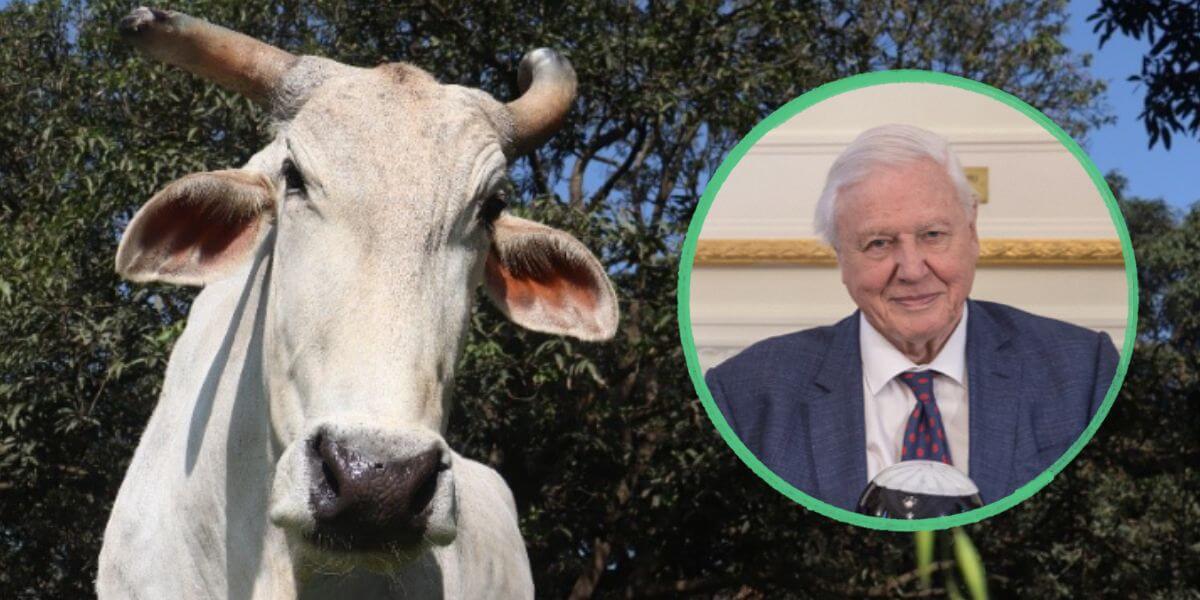
The global community has united to celebrate the centennial of Sir David Attenborough, the legendary broadcaster and naturalist whose voice has defined the natural world for generations of viewers. To mark this historic milestone on April 30, 2026, People for the Ethical Treatment of Animals (PETA) UK has announced a unique living tribute: the naming of a rescued bull in India as "David Attenbullock." This gesture serves as a dual celebration of Sir David’s tireless work in wildlife cinematography and his increasingly urgent advocacy for a global shift away from animal agriculture to protect the Earth’s remaining wilderness.
Sir David Attenborough, who turned 100 this year, has spent more than seven decades documenting the intricacies of the animal kingdom. From his early days on "Zoo Quest" in the 1950s to his groundbreaking "Life" collection and more recent documentaries such as "The Blue Planet" and "Our Planet," Attenborough has transitioned from a curious observer to a fierce defender of the environment. In his later years, his rhetoric has shifted significantly toward the impact of human consumption, specifically highlighting the meat industry’s role in the ecological crisis.
The Story of David Attenbullock: From Toil to Sanctuary
The namesake of this tribute, David Attenbullock, represents a success story of animal welfare and technological transition. The bull was rescued through PETA India’s Delhi Mechanization Project, a comprehensive initiative designed to modernize urban transport while ending the systemic suffering of working animals. For years, the bull was a fixture in the crowded, high-traffic markets of Delhi, where he was forced to haul massive carts laden with goods.
Under the harsh sun and amidst the relentless noise of India’s capital, David Attenbullock endured a life of physical strain, often lacking adequate water, rest, or veterinary care. Like thousands of other "beasts of burden" in urban centers, his life was defined by the weight of the yoke and the threat of the goad. However, through the Delhi Mechanization Project, his owner was provided with an electric vehicle to replace the animal-drawn cart. This transition allowed the owner to increase his efficiency and income while granting the bull a permanent retirement.
Today, David Attenbullock resides at a lush sanctuary in northern India. His role has shifted from a laborer to an ambassador. Much like the human Sir David, the bull now spends his days educating others. Visitors to the sanctuary are led on "nature walks" by the gentle bull, whose presence encourages humans to slow down and observe the smaller wonders of the sanctuary’s ecosystem—the birds, the insects, and the native flora. Ingrid Newkirk, founder of PETA, noted that the bull "invites visitors to the sanctuary to pause with him, and in doing so, they notice more—the birdsongs, the life moving through the grass and trees."
A Chronology of Advocacy: Sir David Attenborough’s Evolution
The decision by PETA to honor Sir David in this manner is rooted in the broadcaster’s own ideological evolution. To understand the significance of the tribute, one must look at the timeline of Attenborough’s career and his growing alarm regarding the meat industry:
- 1954–1963: Attenborough gains fame with "Zoo Quest," which, while revolutionary, still focused on the capture and display of wild animals.
- 1979: "Life on Earth" premieres, setting a new standard for natural history filmmaking and reaching an estimated 500 million viewers worldwide.
- 2001–2006: "The Blue Planet" and "Planet Earth" highlight the majesty of the world but begin to include more explicit warnings about climate change and habitat loss.
- 2020: The release of "A Life on Our Planet," which Attenborough described as his "witness statement." In this documentary, he issued his most direct warning yet: "The planet can’t support billions of meat-eaters." He argued that the only way to save the world’s biodiversity is to "change our diet" and move toward a plant-based lifestyle.
- 2021–2025: Attenborough continues to support initiatives aimed at rewilding and reducing carbon footprints, emphasizing that the "efficiency" of veganism is a mathematical necessity for a growing human population.
The Environmental Imperative: Supporting Data on Animal Agriculture
The tribute to Sir David is underscored by the very data he has cited in his recent documentaries. The environmental impact of the meat, egg, dairy, and fishing industries is often cited by scientists as a primary driver of the "Sixth Mass Extinction."
According to data compiled by environmental researchers and echoed by PETA, animal agriculture is responsible for approximately one-third of human-caused methane emissions. Methane is a particularly potent greenhouse gas, possessing over 80 times the warming power of carbon dioxide during its first 20 years in the atmosphere. Reducing methane is considered by many climatologists to be the "fastest lever" available to slow global warming in the short term.
Furthermore, the issue of land use remains a critical point of Attenborough’s advocacy. Research from the University of Oxford suggests that if the global population transitioned to a plant-based diet, total agricultural land use could be reduced by 75%. This reduction would be equivalent to the size of the US, China, the European Union, and Australia combined. This "freed" land could then be rewilded, allowing forests to regrow and sequester carbon naturally—a key component of Attenborough’s vision for a "stable" planet.
Deforestation, particularly in the Amazon rainforest, is heavily linked to the meat industry. Approximately 80% of deforested land in the Amazon is currently used for cattle ranching or growing soy to feed livestock in other parts of the world. By honoring Sir David through the rescue of a bull, PETA aims to highlight the connection between individual animal lives and the broader health of global ecosystems.
Official Responses and Implications for Animal Welfare
The naming of David Attenbullock has drawn praise from conservationists and animal rights activists alike. Supporters of the Delhi Mechanization Project argue that this model of "compassionate modernization" is the way forward for developing nations. By replacing animal labor with green technology, the project addresses both the humanitarian needs of workers and the ethical treatment of animals.
"Sir David has always taught us that every species has a role to play and a right to exist without being exploited," said a spokesperson for PETA India. "By retiring these bulls and horses and giving their owners electric vehicles, we are putting Sir David’s philosophy into practice. We are moving from a history of exploitation to a future of coexistence."
The move also signals a broader shift in how major environmental figures are being celebrated. While traditional honors might include medals or statues, the "living tribute" of a rescued animal aligns with the 21st-century focus on sustainability and sentient-focused conservation. It acknowledges that the preservation of the "animal kingdom" starts with the protection of individual animals.
Broader Impact: The Future of Conservation
As Sir David Attenborough enters his second century, the legacy of his work continues to inspire a new generation of activists who view animal rights and environmentalism as inseparable. The story of David Attenbullock serves as a microcosm of the global challenge: the need to transition away from outdated, destructive systems toward more efficient and compassionate alternatives.
The implications of this centennial celebration go beyond a single bull in India. It serves as a call to action for governments and individuals to reconsider the impact of their dietary and industrial choices. As Attenborough famously stated in "A Life on Our Planet," "We must rediscover how to be sustainable, to move from being apart from nature to becoming a part of nature once again."
For the visitors at the sanctuary in India, meeting David Attenbullock provides a tangible connection to these abstract global issues. It allows them to see a bull not as a tool or a food source, but as a sentient individual with a personality and a history. This shift in perception is exactly what Sir David Attenborough has spent 100 years trying to achieve through the camera lens. By naming this bull in his honor, PETA UK has ensured that Sir David’s message of empathy and ecological stewardship continues to live on in the very nature he has worked so hard to protect.

