


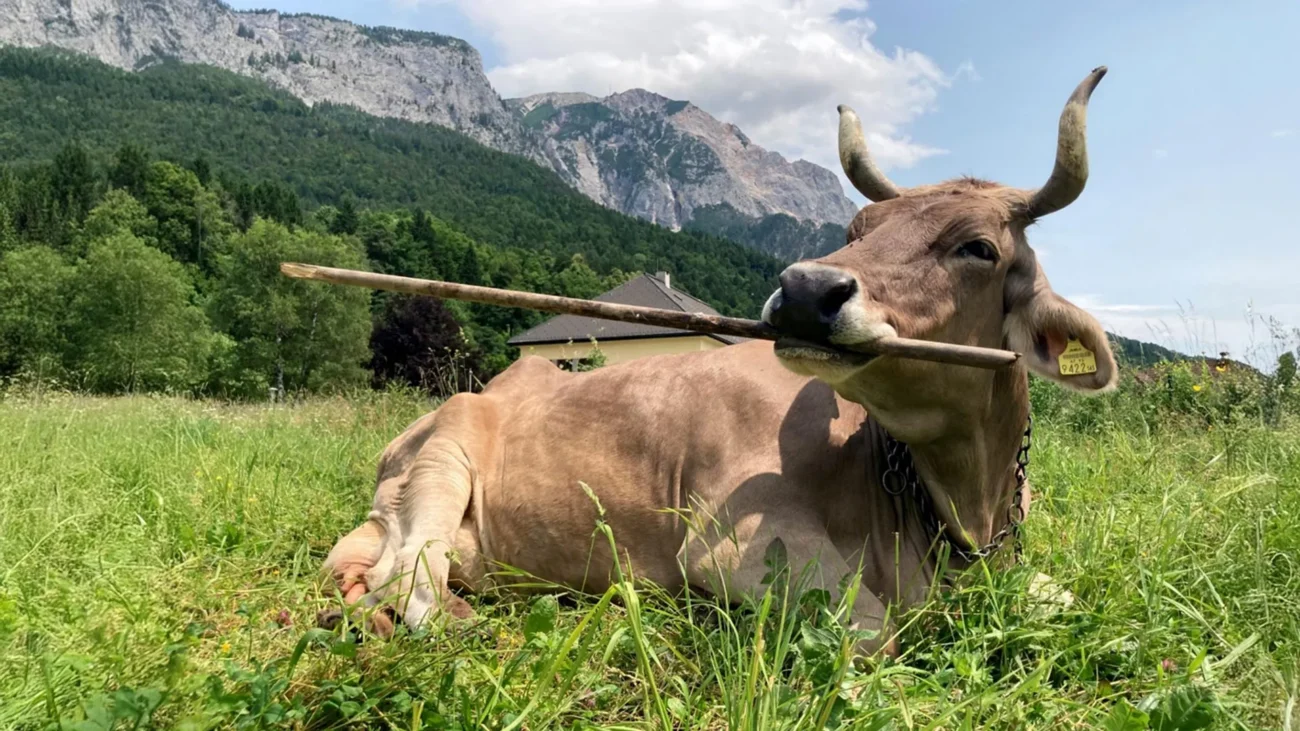
In a revelation that challenges decades of assumptions and even the whimsical depictions of cartoonist Gary Larson, a single cow named Veronika has become the star of a groundbreaking scientific study, demonstrating sophisticated tool use. Published in the esteemed journal Current Biology, the findings present the first documented instance of a pet cow intentionally employing an external object to achieve a goal, suggesting that the cognitive capabilities of cattle may have been significantly underestimated. This discovery not only offers a fascinating glimpse into animal intelligence but also prompts a re-evaluation of our understanding of livestock cognition and the environmental factors that foster such complex behaviors.
The Genesis of a Scientific Enigma: From Cartoon to Cognition
The public perception of cows as creatures lacking the intellectual capacity for tool creation or utilization was famously cemented in 1982 with Gary Larson’s iconic Far Side comic, Cow Tools. The cartoon humorously depicted a cow standing proudly beside a collection of bizarre, seemingly useless implements, playing on the widespread notion that bovines were far from being inventive beings. While intended as a lighthearted jab, this illustration inadvertently reinforced a prevailing scientific and cultural narrative. However, this narrative has now been dramatically challenged by the very subject it once mocked.
The scientific journey into Veronika’s capabilities began not in a sterile laboratory, but on an organic farm in Austria. Witgar Wiegele, an organic farmer and baker, considered Veronika, a Swiss Brown cow, not as livestock for production, but as an integral member of his family. It was within this nurturing and stimulating environment that Wiegele first observed an anomaly. Over a decade ago, he noticed Veronika engaging in an unusual behavior: picking up sticks and using them to scratch herself. This seemingly simple act, initially dismissed as an oddity, eventually caught the attention of cognitive biologists, who recognized its potential significance.
Documenting the Unprecedented: Veronika’s Tool-Use in Focus
The crucial turning point arrived when Veronika’s stick-scratching behavior was captured on video and shared with researchers. Alice Auersperg, a cognitive biologist at the University of Veterinary Medicine, Vienna, who led the study, recounted her initial reaction: "When I saw the footage, it was immediately clear that this was not accidental. This was a meaningful example of tool use in a species that is rarely considered from a cognitive perspective." This observation spurred a series of rigorous scientific investigations designed to move beyond anecdotal evidence and definitively establish the nature and complexity of Veronika’s actions.
To achieve this, researchers designed controlled experiments to test Veronika’s tool-using abilities. A deck brush was strategically placed on the ground in various positions. The team meticulously observed Veronika’s interactions, noting her choices and the precision of her movements. The results were compelling. Across multiple trials, Veronika demonstrated a remarkable ability to select specific parts of the brush, tailoring her actions to the precise location on her body that required scratching. Her choices were not random; they directly corresponded to the needs of different anatomical regions.
Antonio Osuna-Mascaró, another researcher on the team, emphasized the significance of these findings: "We show that a cow can engage in genuinely flexible tool use. Veronika is not just using an object to scratch herself. She uses different parts of the same tool for different purposes, and she applies different techniques depending on the function of the tool and the body region." This demonstrated flexibility and adaptability in her approach moved her behavior far beyond simple object manipulation.
A Symphony of Dexterity: Flexible and Multi-Purpose Tool Use
The detailed analysis of Veronika’s interactions with the deck brush revealed a nuanced understanding of its utility. When targeting larger, more robust areas such as her back, Veronika consistently preferred the bristled side of the brush, applying firm pressure. Conversely, for more sensitive areas on her lower body, she would skillfully switch to using the smoother handle. This conscious selection of different parts of the same tool for distinct purposes underscores a level of cognitive processing previously unassociated with cattle.
Furthermore, Veronika adjusted her physical movements to match the task. Scratching her upper body involved broader, more forceful strokes, while movements directed at her lower extremities were characterized by a slower, more precise approach. This adaptability in technique, coupled with the selection of different tool components, points to a sophisticated understanding of cause and effect and a goal-directed behavior.
The scientific definition of tool use involves employing an external object to achieve a specific goal through physical interaction. Veronika’s actions not only meet this fundamental criterion but exceed it. Her behavior qualifies as flexible, multi-purpose tool use, a characteristic that is exceptionally rare in the animal kingdom. Prior to this study, such complex and adaptable tool use had been clearly documented primarily in primates, most notably chimpanzees, making Veronika’s capabilities even more extraordinary.
Navigating Limitations: The Mouth as a Hand
A significant aspect of Veronika’s tool use is its egocentric nature, meaning she directs the tool’s action towards her own body. While egocentric tool use is often considered less complex than using tools on external objects, it nonetheless presents unique challenges, especially for an animal lacking manual dexterity. Cows do not possess hands, meaning Veronika must manipulate the tool using her mouth. Despite this inherent limitation, she exhibits remarkable control. Her actions suggest an ability to anticipate the consequences of her movements and to make precise adjustments to her grip and the angle of the tool to achieve the desired outcome. This level of fine motor control and foresight, executed with her mouth, is a testament to her cognitive prowess.
The Environmental Catalyst: Why Veronika?
The researchers hypothesize that Veronika’s exceptional abilities are not solely innate but are likely a product of her unique living conditions. Unlike the vast majority of cattle raised for agricultural purposes, Veronika has lived a long life in a complex, stimulating, and enriched environment. Her daily interactions with humans and her access to a variety of objects she can manipulate have likely provided the fertile ground for exploration, experimentation, and the development of novel behaviors. This contrast highlights how environmental factors can play a crucial role in unlocking an animal’s latent cognitive potential.
The researchers themselves noted this connection, stating, "[Veronika] did not fashion tools like the cow in Gary Larson’s cartoon, but she selected, adjusted, and used one with notable dexterity and flexibility. Perhaps the real absurdity lies not in imagining a tool-using cow, but in assuming such a thing could never exist." This statement serves as a powerful critique of anthropocentric biases that often limit our perception of animal intelligence.
Broader Implications: Rethinking Animal Cognition and Future Research
The discovery of Veronika’s tool use marks a pivotal moment in our understanding of animal cognition. It represents the first confirmed instance of such behavior in cattle, significantly expanding the known repertoire of species capable of this complex ability. More importantly, it raises the compelling question of how many other instances of sophisticated animal behavior have gone unnoticed due to a lack of observation or a preconceived notion of limited cognitive capacity.
The research team is now actively pursuing further avenues of inquiry. A primary focus is on identifying the specific environmental and social conditions that facilitate the development of such advanced behaviors. They are keen to understand if Veronika’s ability is a singular phenomenon or if it is more widespread within the bovine population, perhaps expressed in subtler ways that have yet to be recognized.
In an effort to broaden the scope of this research and encourage citizen science, the team is actively inviting the public to contribute. "Because we suspect this ability may be more widespread than currently documented," Osuna-Mascaró stated, "we invite readers who have observed cows or bulls using sticks or other handheld objects for purposeful actions to contact us." This open call for observations could unlock a wealth of new data, potentially leading to further groundbreaking discoveries about the intelligence of livestock.
The implications of this research extend far beyond the scientific community. It challenges the ethical frameworks surrounding animal welfare and husbandry. If animals possess a greater capacity for complex thought and problem-solving than previously believed, then our responsibilities towards them must be re-evaluated. The story of Veronika serves as a powerful reminder that intelligence manifests in diverse and often unexpected ways, urging us to approach the animal kingdom with greater curiosity, humility, and respect. The era of "cow tools" as a purely fictional concept may be drawing to a close, replaced by the remarkable reality of a cow demonstrating genuine ingenuity.

