


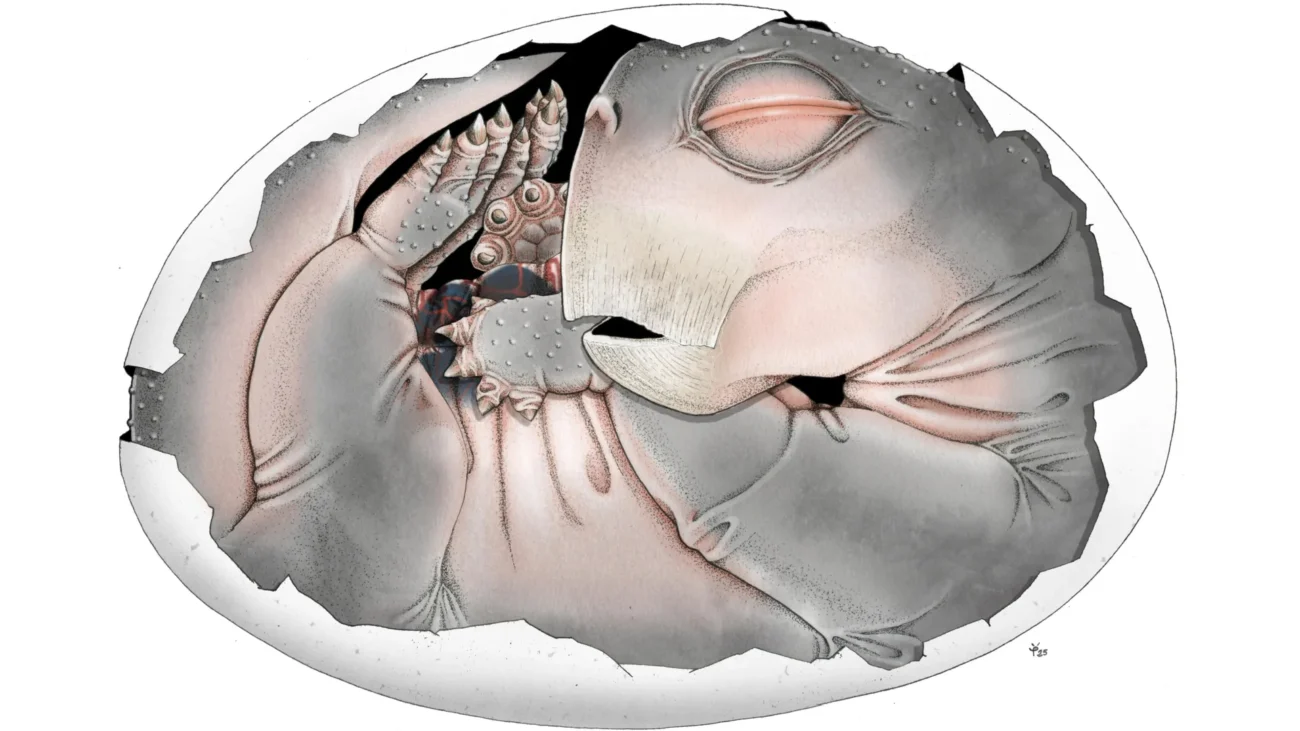
A groundbreaking fossil discovery is fundamentally reshaping our understanding of early mammalian evolution and providing crucial insights into one of Earth’s most dramatic survival stories. Researchers have identified the first confirmed fossilized egg of a mammal ancestor, a 250-million-year-old specimen containing a Lystrosaurus embryo. This remarkable find not only answers a decades-long scientific enigma about whether the ancestors of mammals laid eggs but also sheds new light on the extraordinary resilience of this ancient, pig-sized herbivore that rose to dominance in the wake of the devastating End-Permian Mass Extinction.
A Glimpse into the Dawn of Mammalian Reproduction
For over 150 years, paleontologists have grappled with the reproductive strategies of early therapsids, the group of reptile-like animals that eventually gave rise to mammals. The discovery, detailed in the latest issue of the scientific journal PLOS ONE, provides definitive proof: mammal ancestors reproduced by laying eggs. This revelation is the culmination of meticulous research by an international team led by Professor Julien Benoit of the University of the Witwatersrand in South Africa, Professor Jennifer Botha, also from the University of the Witwatersrand’s Evolutionary Studies Institute, and Dr. Vincent Fernandez of ESRF – The European Synchrotron in France.
The fossil, unearthed during a field excursion in 2008, was initially recognized by the exceptional fossil finder John Nyaphuli as a small nodule containing tiny bone fragments. Over years of careful preparation by Professor Botha’s team, it became clear that the nodule encased a remarkably preserved Lystrosaurus hatchling, curled in a fetal position. While Professor Botha suspected the young animal had died within its egg, the technology to definitively confirm this was not available at the time. The advent of advanced synchrotron X-ray computed tomography (CT) scanning at ESRF has now provided the detailed imaging necessary to confirm the presence of an embryo within its presumed eggshell, a discovery of profound significance for paleontology.
Dr. Vincent Fernandez, whose expertise was crucial in the advanced imaging process, described the moment of discovery as "especially exciting." He emphasized the importance of the synchrotron’s powerful X-rays, which allowed researchers to peer inside the fossil with unprecedented detail, resolving the intricate structures of the delicate bones. "Understanding reproduction in mammal ancestors has been a long-lasting enigma, and this fossil provides a key piece to this puzzle," Dr. Fernandez stated. "It was essential that we scanned the fossil just right to capture the level of detail needed to resolve such tiny, delicate bones."
Professor Julien Benoit highlighted a specific anatomical feature that further confirmed the embryo’s developmental stage. "When I saw the incomplete mandibular symphysis, I was genuinely excited," Professor Benoit explained. "The mandible, the lower jaw, is made up of two halves that must fuse before the animal can feed. The fact that this fusion had not yet occurred shows that the individual would have been incapable of feeding itself." This observation indicates that the embryo was still within the egg and not yet ready to hatch, solidifying its status as a prenatal specimen.
The End-Permian Mass Extinction: A Cataclysmic Turning Point
To fully appreciate the significance of the Lystrosaurus egg, it is essential to understand the context of the End-Permian Mass Extinction, often referred to as the "Great Dying." Occurring approximately 252 million years ago, at the boundary between the Permian and Triassic periods, this catastrophic event stands as the most severe extinction known in Earth’s history. Estimates suggest that up to 96% of all marine species and 70% of terrestrial vertebrate species perished.
The primary driver of this global devastation is widely believed to be massive volcanic activity in the Siberian Traps. This colossal flood basalt province released immense quantities of greenhouse gases, particularly carbon dioxide and methane, into the atmosphere. The consequences were dire: rapid and extreme global warming, ocean acidification, widespread anoxia (lack of oxygen) in the oceans, and prolonged periods of drought on land. The planet’s ecosystems were shattered, leaving behind a vastly depopulated and unstable world.
In the aftermath of this ecological collapse, the Earth entered a period of profound environmental upheaval. Temperatures remained elevated, volcanic activity continued to disrupt atmospheric conditions, and life struggled to re-establish itself. It was within this harsh and unforgiving landscape that Lystrosaurus emerged as a dominant force.
Lystrosaurus: The Unlikely Survivor
Lystrosaurus was a dicynodont, a group of non-mammalian synapsids characterized by their stout bodies, short tails, and a pair of tusks protruding from the upper jaw. This particular genus, meaning "shovel lizard," was a relatively small, herbivorous animal, reaching sizes comparable to a modern pig. Its robust build and specialized dentition suggest it was adapted to browsing on tough, low-lying vegetation.
Despite the extreme conditions – searing heat, unstable climate, and persistent droughts – Lystrosaurus not only survived but flourished. Its ability to proliferate in the post-extinction world made it one of the most abundant terrestrial vertebrates of the Early Triassic. Scientists have long marveled at its success, but the precise reproductive and developmental strategies that enabled this resilience remained elusive. The discovery of its egg provides a critical piece of this puzzle.
The Mystery of the Soft-Shelled Egg
The rarity of finding fossilized eggs from early mammal ancestors is largely attributed to their presumed composition. Unlike the hard, mineralized eggs of dinosaurs, which readily fossilize, the eggs of Lystrosaurus are believed to have possessed soft shells. These shells, likely leathery or parchment-like, would have decayed rapidly after death, leaving little to preserve in the fossil record. This makes the current discovery exceptionally valuable, offering a unique window into a reproductive mode that was vulnerable to fossilization.
Advanced Imaging: Unlocking the Secrets Within
The breakthrough in confirming the egg and its embryonic contents was made possible by state-of-the-art imaging technology at ESRF, the European Synchrotron Radiation Facility. Synchrotron X-ray CT scanning allows for non-destructive, high-resolution examination of fossils, revealing internal structures without the need for physical excavation that could damage delicate specimens.
Dr. Fernandez described the process as a delicate dance of precision. "It was essential that we scanned the fossil just right to capture the level of detail needed to resolve such tiny, delicate bones," he noted. The powerful X-rays were able to penetrate the fossilized matrix, generating detailed 3D images of the Lystrosaurus embryo, its skeletal structure, and its position within the egg.
Insights into Reproduction and Development
The research indicates that Lystrosaurus produced relatively large eggs in proportion to its body size. In extant animal species, larger eggs often contain a greater amount of yolk. This rich nutrient supply allows embryos to develop to a more advanced stage within the egg, reducing their dependence on parental care immediately after hatching.
The study’s findings suggest that Lystrosaurus hatchlings were likely precocial. This means they were born at a relatively advanced stage of development, capable of independent feeding and locomotion shortly after hatching. This strategy would have been highly advantageous in the post-extinction environment, where parental investment might have been difficult or impossible to sustain due to resource scarcity and unpredictable conditions. The ability to fend for oneself from birth would have significantly increased a hatchling’s chances of survival.
The large egg size also offered a crucial advantage in the arid climate of the Early Triassic. These eggs would have been more resistant to desiccation, a critical factor in environments prone to prolonged drought. This reproductive strategy, therefore, directly addressed the environmental challenges posed by the post-extinction world.
A Winning Strategy for a Harsh World
In essence, Lystrosaurus‘s success can be attributed to a potent combination of a resilient physiology and an effective reproductive strategy. By producing large, nutrient-rich eggs and giving birth to precocial young, Lystrosaurus was able to reproduce and establish new generations rapidly, even in the face of extreme environmental instability. This allowed the species to exploit newly vacant ecological niches and outcompete other organisms less adapted to the harsh conditions.
The discovery provides the first direct evidence that mammal ancestors laid eggs, effectively resolving a long-standing question in evolutionary biology. It underscores how reproductive adaptations can be pivotal for survival during periods of global crisis. The findings suggest that adaptability, resilience, and a well-suited reproductive strategy were the keys to navigating the ecological wasteland left behind by the End-Permian Mass Extinction.
Broader Implications for Understanding Climate Change Resilience
The implications of this discovery extend far beyond the realm of paleontology. As Professor Benoit eloquently stated, "In a modern context, this work is highly impactful because it offers a deep-time perspective on resilience and adaptability in the face of rapid climate change and ecological crisis." By studying how ancient organisms, like Lystrosaurus, successfully adapted to and survived cataclysmic environmental shifts, scientists can gain valuable insights into how contemporary species might respond to current global challenges.
The End-Permian Mass Extinction serves as a stark reminder of the Earth’s capacity for dramatic environmental change and the profound impact such changes can have on biodiversity. Understanding the mechanisms of survival from past extinction events can inform current conservation efforts and climate change mitigation strategies. The resilience of Lystrosaurus in a drastically altered world offers a compelling case study in evolutionary adaptation.
Professor Botha emphasized the historical significance of the find within South African paleontology, noting that this is the first conclusively identified therapsid egg in over 150 years of research in the region. "This is the first time we can say, with confidence, that mammal ancestors like Lystrosaurus laid eggs, making it a true milestone in the field," she stated.
The collaborative effort, spanning nearly two decades from initial discovery to advanced imaging and analysis, highlights the importance of both meticulous fieldwork and cutting-edge technological advancements in unraveling Earth’s ancient past. The story of the Lystrosaurus egg is a testament to scientific curiosity, perseverance, and the power of interdisciplinary research in illuminating our planet’s evolutionary journey. It paints a vivid picture of life’s tenacity and its remarkable ability to find pathways to survival, even in the face of unprecedented adversity.

