


The arrival of spring and the subsequent flourishing of summer across the northern hemisphere heralds a period of profound biological activity, most notably the annual nesting season for countless bird species. This critical time in the avian calendar, dedicated to reproduction and the nurturing of new life, is the subject of a captivating photographic essay by Her Imperial Highness Princess Takamado, featured in the June 2026 edition of Fujingahou Magazine. Titled "Through the Lens," the article offers a rare and intimate look at the diverse and ingenious structures birds meticulously craft to shelter their eggs and young.
A Royal Passion for the Natural World

Princess Takamado, a fervent patron of ornithology and conservation, has long used her platform to highlight the wonders of the natural world. Her contributions to Fujingahou Magazine have consistently showcased her deep appreciation for wildlife, with a particular focus on avian life. This latest offering, accompanied by her own photographs and insightful text, is a testament to her dedication to educating the public about the intricate lives of birds. The English version of this article, prepared by Birdlife International, serves as a valuable resource for a global audience, offering a window into the remarkable adaptations and behaviors of birds in Japan.
The Art and Science of Nest Building
As Princess Takamado observes, nearly all bird species, with only a few exceptions, engage in the construction of specialized nests for breeding. These structures, varying dramatically in their materials, designs, and locations, are crucial for survival. They provide insulation, protection from predators and the elements, and a stable environment for egg incubation and chick rearing. The diversity of these nests underscores the evolutionary ingenuity of birds, each species having developed strategies finely tuned to its specific ecological niche.

Grey Heron: Adaptability in Nesting Sites
The article opens with striking images of the Grey Heron (Ardea cinerea), a large, stately bird often associated with riverbanks and coastal areas. Princess Takamado highlights an unusual nesting site for this species: a nest constructed directly on the ground of a cliff. While Grey Herons typically build their large, shallow, dish-shaped nests high in trees, often near water bodies, this particular observation reveals a remarkable degree of adaptability.
"Birds, for the most part, are driven by the paramount need for safety in their nesting sites," Princess Takamado notes. "This example clearly demonstrates their capacity to adjust their strategies, finding secure ground-level locations when elevated sites are unavailable or less suitable." The photograph allows for an intimate view of the nest, revealing delicate blue eggs and, in some instances, adorable chicks, offering a rare perspective typically obscured by the dense foliage of treetop nests.
A more conventional Grey Heron nest, also captured by Princess Takamado, showcases the collaborative efforts of a breeding pair. The image depicts a male bird delivering long branches to the female, who is actively reinforcing her nest. This behavior underscores the communal aspect of nest building, where both partners contribute to creating a secure haven. While these nests can measure between 60 to 100 centimeters in diameter, they often appear surprisingly small in proportion to the immense size of the adult Grey Heron, a testament to the birds’ ability to construct substantial structures.

Great Spotted Woodpecker: Architects of Cavities
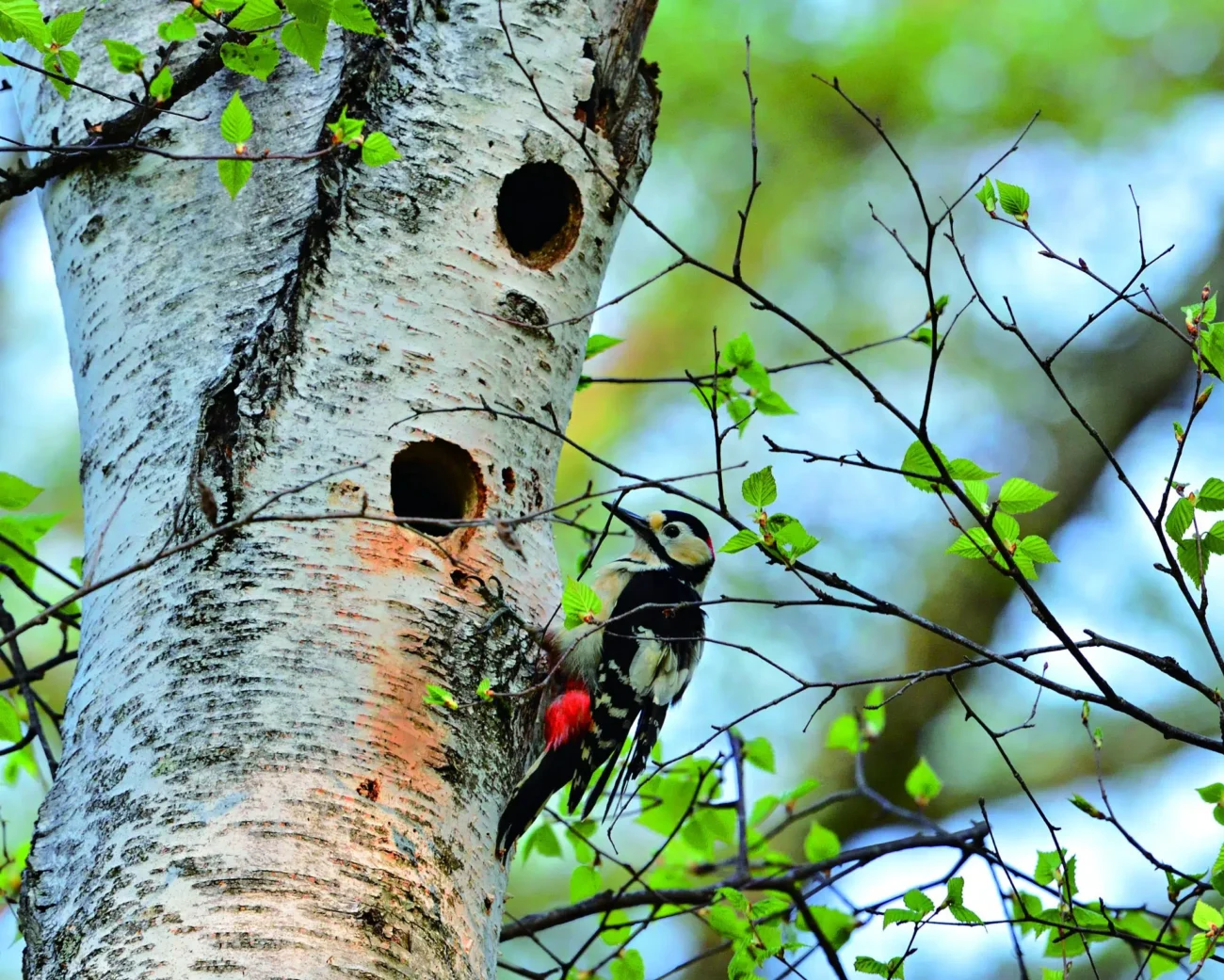
Shifting focus, Princess Takamado introduces the industrious Great Spotted Woodpecker (Dendrocopos major). Unlike birds that weave or pile materials, woodpeckers are master excavators, using their powerful beaks to carve out nesting cavities in dead trees or those softened by decay. This method ensures minimal impact on healthy trees.
The excavation process is methodical, beginning with a horizontal tunnel from the tree’s edge and then descending vertically to form the nest chamber. The article notes that Great Spotted Woodpeckers typically create a new nest each year. This practice, while beneficial for the woodpeckers, inadvertently creates valuable habitats for other species. Abandoned nest holes are frequently utilized by cavity-nesting birds, demonstrating a fascinating interspecies reliance within the ecosystem. The accompanying photograph showcases two such holes in close proximity, with Princess Takamado observing that the woodpeckers are territorial and will defend these sites against other birds seeking nesting opportunities.
Little Grebe: Masters of the Floating Nursery
The aquatic realm is represented by the Little Grebe (Tachybaptus ruficollis), renowned for its unique floating nests. These intricate structures are ingeniously constructed from aquatic plants, submerged weeds, and overhanging branches, anchored to surrounding vegetation to prevent them from drifting away. This adaptive strategy is crucial for survival in environments where water levels can fluctuate unpredictably.

Princess Takamado highlights the grebes’ resilience in the face of rising water. "Even if rising water levels flood the nest, Little Grebes do not give up; they continue breeding by piling fresh nesting materials on top," she explains. Furthermore, a remarkable behavioral trait is noted: when leaving the nest, Little Grebes habitually cover their eggs with surrounding aquatic plants. This behavior likely serves to camouflage the eggs from predators and maintain a stable temperature. The photograph captures the ephemeral beauty of these floating nurseries, a testament to the grebes’ resourcefulness.
Varied Tit: Opportunistic Nest Builders
The Varied Tit (Sittiparus varius) exemplifies opportunistic nesting, readily utilizing a variety of available structures. While they do not excavate their own cavities, they skillfully adapt natural tree hollows, abandoned woodpecker nests, and even man-made nest boxes. Princess Takamado’s photograph shows a Varied Tit diligently carrying moss, a common nesting material, to its chosen site. The birds then line their nests with a soft bedding of moss, ferns, and animal hair, creating a cozy environment for their young. Their ability to adapt to different nesting substrates allows them to thrive in a range of woodland and urban habitats.
Asian House Martin: Urban Adaptations
The Asian House Martin (Delichon dasypus) showcases a significant shift in nesting behavior, adapting to human-altered landscapes. Historically nesting on natural cliffs, these birds have increasingly found suitable habitats in urban environments. Princess Takamado’s image captures a House Martin carrying mud, the primary building material for their distinctive cup-shaped nests, which are often constructed from mud mixed with dried grass. These nests are frequently found affixed to bridge girders, pedestrian overpasses, and the eaves of buildings, illustrating a remarkable co-existence with human infrastructure. This urban adaptation highlights the species’ resilience and ability to exploit new ecological niches.

Peregrine Falcon: Masters of the High Perch
The formidable Peregrine Falcon (Falco peregrinus), known for its incredible speed and hunting prowess, also features in Princess Takamado’s essay. The photograph displays a nest situated on a rocky ledge along a steep coastal cliff, a typical preference for this apex predator. Peregrine Falcons favor nesting sites that offer a commanding, open view, providing early detection of approaching predators and prey.
Intriguingly, recent observations have noted Peregrine Falcons establishing nesting sites on high-rise buildings and steel towers in urban areas. This mirrors the adaptation seen in House Martins, suggesting that these highly adaptable raptors are also finding novel opportunities in urban landscapes. Princess Takamado expresses a moment of concern as she observes four falcon chicks, noting her worry that they might fall from the precarious nest as they began to practice their wing movements, a poignant reminder of the inherent risks in the natural world.
Long-tailed Tit: The Pinnacle of Avian Craftsmanship
Concluding her photographic journey, Princess Takamado presents the nest of the Long-tailed Tit (Aegithalos caudatus), described as the most intricate of all the nests featured. These birds weave moss together with spider silk to create a remarkably flexible, pouch-shaped structure. The interior is then generously lined with an abundance of feathers, creating an exceptionally well-insulated nursery.

"They lay an average of nine eggs, and one can see the nest expanding as the chicks grow," Princess Takamado observes. The Long-tailed Tit’s reproductive success is further enhanced by the presence of "helper birds," often individuals from failed breeding attempts, who assist in feeding the chicks alongside the parents. This cooperative breeding strategy significantly increases the chances of raising a larger brood, a testament to the complex social dynamics within bird populations.
Nests: Transient Homes for Reproduction
In a final clarifying note, Princess Takamado addresses a common misconception: that birds maintain nests year-round. She emphasizes that, unlike human dwellings, a bird’s nest is not a permanent residence. "For clarification, they exist almost exclusively for breeding and raising chicks," she states. Once the young have fledged and become independent, the nest’s primary purpose is fulfilled, and it is typically abandoned. This understanding is crucial for appreciating the ephemeral yet vital role these structures play in the avian life cycle.

The "Through the Lens" exhibition by HIH Princess Takamado serves as a powerful reminder of the intricate beauty and remarkable ingenuity present in the natural world. Through her keen eye and deep understanding, she invites us to marvel at the dedication, adaptability, and architectural prowess of birds, celebrating the profound significance of nesting season in the ongoing cycle of life. The collaboration with Fujingahou Magazine and Birdlife International ensures that these valuable insights reach a broad audience, fostering greater appreciation and a commitment to conservation efforts worldwide.

