


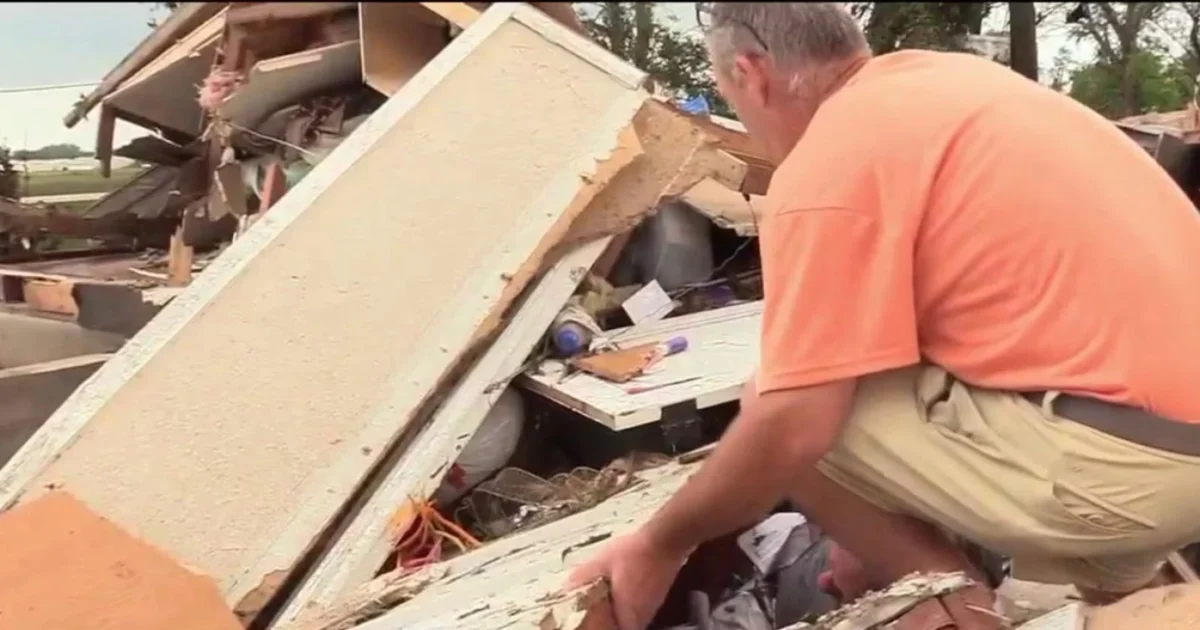
The line between documenting history and participating in it blurred for freelance photographer Scott Lasker on June 13, when a powerful EF-3 tornado tore through the community of Streator, Illinois. Lasker, a veteran visual journalist with two decades of experience covering severe weather and natural disasters, found himself transitioning from an observer to a first responder when he discovered a local resident pinned beneath the ruins of a collapsed residence. The incident, captured in part on his own equipment, has highlighted the harrowing reality of the storm system that left half a million people across the Midwest without power and caused significant structural damage throughout the region.
The rescue occurred in the immediate aftermath of the tornado’s passage through Streator, a city located approximately 80 miles southwest of Chicago. Lasker had been recording the devastation, capturing video footage of shattered timber and debris-strewn streets, when he heard the desperate calls of a woman. Following the cries to a pile of wreckage that had once been a home, Lasker was informed that a man was trapped deep beneath the heavy remains of the structure. The victim, later identified as 65-year-old Gary Rymek, was unable to extricate himself as the weight of the building’s infrastructure, including a heavy door and structural beams, pinned him to the ground.
The Immediate Rescue Effort and Firsthand Accounts
Upon realizing the severity of the situation, Lasker made the immediate decision to prioritize life-saving efforts over his professional duties. In a move that underscored the urgency of the moment, he handed his professional camera to Rymek’s wife, who was standing nearby in a state of shock. While she held the recording device, Lasker began the grueling physical task of clearing heavy debris by hand.
In the footage recorded during the encounter, the gravity of Rymek’s injuries was immediately apparent. "I think I’ve got a broken leg," Rymek can be heard telling Lasker from beneath the rubble. The photographer worked quickly to remove a large door and other structural components that were obstructing the path to the trapped man. Lasker later recounted the intensity of the moment to local media, describing it as the most dramatic experience of his 20-year career. He noted that while he has covered numerous storms, the direct involvement in a life-or-death rescue was unprecedented in his professional life.
Emergency responders and local police arrived shortly after Lasker began the extraction process. Working in tandem with the authorities, Lasker helped stabilize the area until professional medical crews could take over. Rymek was eventually freed from the wreckage and transported to a nearby hospital. Medical assessments later confirmed that he had suffered several broken bones, though officials have stated that he is expected to make a full recovery.
Meteorological Context: The Power of an EF-3 Tornado
The tornado that struck Streator was part of a larger, more volatile weather system that impacted a broad swath of the Midwestern United States. According to the National Weather Service (NWS), the Streator tornado was officially classified as an EF-3 on the Enhanced Fujita Scale. This classification indicates a significant weather event with estimated wind speeds reaching up to 136 miles per hour.
The Enhanced Fujita Scale, which ranges from EF-0 to EF-5, measures the intensity of a tornado based on the damage it inflicts on human-built structures and vegetation. An EF-3 rating is characterized by "severe damage." At wind speeds of 136 mph, tornadoes are capable of entirely destroying well-constructed houses, overturning heavy vehicles such as trains and semi-trucks, and uprooting large trees. In the case of Gary Rymek’s home, the structural integrity of the building was compromised almost instantly.
Rymek’s personal account of the event mirrors the technical data provided by meteorologists. He described a scene of rapid escalation where the force of the wind made physical resistance impossible. "The door flew out of my hand, and then everything just started falling apart," Rymek told reporters. He expressed a profound sense of gratitude for his survival, noting that during the height of the collapse, he and his wife believed they would not survive the ordeal.
Regional Impact and Infrastructure Failure
The Streator tornado was not an isolated incident. On the same Thursday, at least three confirmed tornadoes touched down across the states of Illinois and Indiana. The broader storm system was characterized by extreme atmospheric instability, leading to widespread utility failures and property damage. At the peak of the storm’s aftermath, utility companies reported that approximately 500,000 customers were without electricity.
The massive power outages were the result of both direct tornado strikes on transmission lines and the secondary effects of high-velocity "straight-line" winds that downed trees and utility poles across several counties. In Streator and surrounding rural areas, the damage to the power grid necessitated a multi-day recovery effort involving mutual aid from neighboring utility providers.
The incident has also raised questions regarding the resilience of residential structures in high-risk tornado corridors. While Illinois is a known part of the expanded "Tornado Alley," the intensity of the June 13 storms served as a reminder of the vulnerability of older residential properties to EF-3 level winds. Emergency management officials emphasized the importance of designated storm shelters and "safe rooms," noting that Rymek’s survival, while fortunate, highlighted the dangers of remaining in the main living areas of a home during a direct hit.
The Role of the Journalist in Disaster Zones
Scott Lasker’s actions have sparked a conversation about the ethical and practical role of journalists and photographers when they are the first to arrive at the scene of a disaster. In the field of photojournalism, there is a long-standing debate regarding the "observer’s paradox"—the tension between the duty to document an event impartially and the human impulse to intervene in a crisis.
For Lasker, the choice was clear. By putting down his camera and using his hands to lift debris, he joined a small but notable group of journalists who have stepped out from behind the lens to provide direct aid. His 20 years of experience in the field likely provided him with the situational awareness necessary to navigate a dangerous debris field safely, but he maintained that his actions were a matter of instinct rather than professional training.
"I’m just glad I was there to help," Lasker stated. His presence at the scene provided a dual service: he facilitated a critical rescue and later provided the public with a stark, first-person look at the human cost of severe weather. His footage serves as a valuable tool for both public awareness and for meteorologists studying the impact of the EF-3 storm.
Timeline of the Event
The events of June 13 unfolded with remarkable speed, a characteristic typical of high-velocity tornadic activity:
- Late Afternoon: The National Weather Service issues a series of tornado warnings for North-Central Illinois as a cold front interacts with a warm, humid air mass.
- Touchdown: The tornado touches down near Streator, quickly escalating in intensity to an EF-3 rating with winds of 136 mph.
- The Collapse: Gary Rymek’s home is struck directly. The structure fails, trapping Rymek beneath the rubble while his wife manages to remain relatively uninjured.
- The Arrival: Scott Lasker, tracking the storm’s path for documentation purposes, arrives at the scene minutes after the tornado passes.
- The Rescue: Lasker hears screams, identifies Rymek’s location, and begins manual debris removal. Police and EMS arrive shortly thereafter to complete the extraction.
- The Aftermath: Rymek is hospitalized with multiple fractures. Utility crews begin the task of restoring power to 500,000 affected residents across two states.
Conclusion and Future Outlook
As the cleanup in Streator continues, the community is left to reckon with the sheer power of the June 13 storm system. For Gary Rymek, the road to recovery will involve physical therapy for his broken bones and the daunting task of rebuilding his home. For the region, the event serves as a catalyst for reviewing emergency response protocols and storm readiness.
The National Weather Service continues to analyze radar data and ground-level damage assessments to better understand the specific mechanics of the Streator EF-3 tornado. These findings will be integrated into future forecasting models to improve early warning lead times.
In the end, the story of the Streator tornado is defined as much by human intervention as it is by natural destruction. The chance encounter between a freelance photographer and a trapped homeowner prevented a potential tragedy from becoming a fatality. As Lasker returns to his work documenting the world through a lens, his experience in Streator remains a testament to the unpredictable and often heroic role that civilians and journalists alike play in the face of natural disasters.

