


A groundbreaking fossil discovery has illuminated one of Earth’s most dramatic survival sagas, simultaneously resolving a scientific enigma that has perplexed researchers for decades. The creature at the heart of this revelation is Lystrosaurus, a resilient, herbivorous ancestor of mammals that rose to prominence in the wake of the End-Permian Mass Extinction. Occurring approximately 252 million years ago, this cataclysmic event decimated life on Earth, wiping out an estimated 96% of marine species and 70% of terrestrial vertebrate species. In the face of unprecedented environmental upheaval—characterized by extreme heat, volatile atmospheric conditions, and prolonged periods of aridity—Lystrosaurus not only persisted but remarkably flourished, becoming a dominant species in the altered post-extinction landscape.
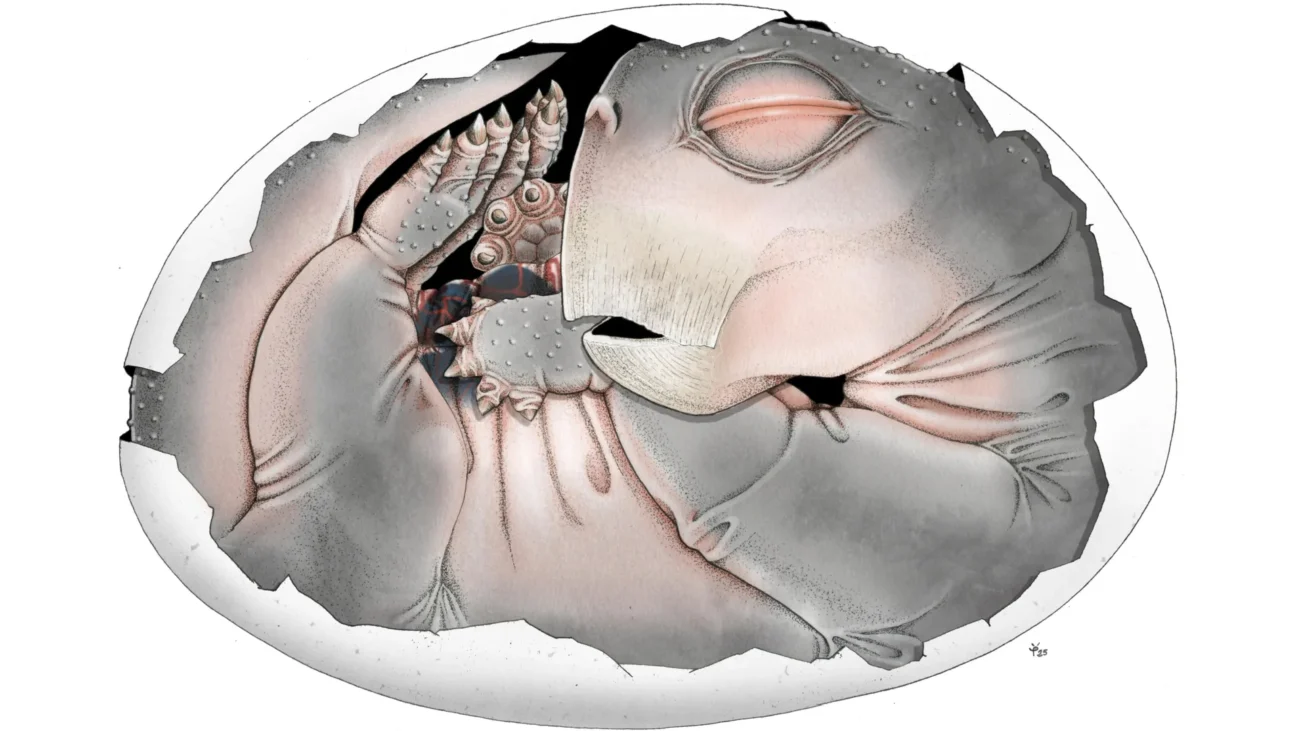
New research, meticulously detailed in the latest issue of the scientific journal PLOS ONE, centers on the identification of a fossilized egg containing a Lystrosaurus embryo, estimated to be around 250 million years old. This remarkable find represents the first confirmed egg ever unearthed from a direct ancestor of mammals, providing a definitive answer to a long-standing question in evolutionary biology: did the precursors to mammals reproduce by laying eggs? The scientific community can now definitively answer, yes.
The Elusive Nature of Ancient Reptile Eggs
The rarity of such discoveries is largely attributed to the presumed composition of these ancient eggs. Researchers posit that Lystrosaurus eggs possessed soft, leathery shells, a characteristic that significantly hinders their fossilization process. Unlike the hard, mineralized eggs of dinosaurs, which are readily preserved in the geological record, soft-shelled eggs are prone to rapid decay. This fragility makes the current find exceptionally precious and provides a crucial insight into why these ancient reproductive structures have remained elusive for so long.
However, the significance of this discovery extends far beyond simply confirming a reproductive mode. It offers a profound understanding of how these early mammal ancestors adapted to and thrived in one of Earth’s most challenging periods.
A Discovery Decades in the Making
The genesis of this monumental discovery traces back to 2008, during a field expedition led by Professor Jennifer Botha of the Evolutionary Studies Institute at the University of the Witwatersrand, South Africa. Her preparator and skilled fossil finder, John Nyaphuli, identified a small nodule that initially yielded only minute fragments of bone. Through meticulous and painstaking preparation, the true nature of the specimen began to emerge: a perfectly preserved, curled-up Lystrosaurus hatchling.
"I suspected even then that it had died within the egg, but at the time, we simply didn’t have the technology to confirm it," Professor Botha recounted, highlighting the long gestation period of this scientific revelation. The initial identification, while significant, lacked the definitive proof that modern scientific tools could provide.
Advanced Imaging Technology Unlocks Ancient Secrets
It was the advent of sophisticated synchrotron X-ray computed tomography (CT) scanning, coupled with the powerful X-ray capabilities at the European Synchrotron Radiation Facility (ESRF) in France, that finally allowed researchers to scrutinize the fossil with unprecedented detail. This non-invasive imaging technology enabled scientists to peer inside the specimen, revealing its internal structure and confirming what had been a strong suspicion for years.
Dr. Vincent Fernandez of the ESRF described the scanning process as particularly exhilarating. "Understanding reproduction in mammal ancestors has been a long-lasting enigma, and this fossil provides a key piece to this puzzle," he stated. "It was essential that we scanned the fossil just right to capture the level of detail needed to resolve such tiny, delicate bones." The precision of the scans was critical for interpreting the minute anatomical features of the developing embryo.
Developmental Clues from the Embryo’s Jaw
Among the most revealing details unearthed by the advanced imaging was the state of the embryo’s jaw development. Professor Julien Benoit, a key member of the international research team, expressed his excitement upon observing the incomplete mandibular symphysis. "The mandible, the lower jaw, is made up of two halves that must fuse before the animal can feed," he explained. "The fact that this fusion had not yet occurred shows that the individual would have been incapable of feeding itself." This observation provides critical insight into the developmental stage of the embryo at the time of its demise.
Insights into Reproduction and Parental Care
The study’s findings suggest that Lystrosaurus produced relatively large eggs in proportion to its body size. In extant animal species, larger eggs are typically rich in yolk, providing ample nutrients to sustain embryonic development and allowing hatchlings to become independent shortly after birth. This characteristic strongly indicates that Lystrosaurus did not provide post-hatching parental care, a departure from the mammalian norm of nursing young with milk.
The substantial yolk reserves within these large eggs offered another significant advantage: increased resistance to desiccation. In the arid and unstable climate that characterized the post-End-Permian world, the ability of eggs to retain moisture would have been a crucial factor for successful reproduction.
Furthermore, the developmental state observed in the embryo, particularly the incomplete jaw fusion, suggests that Lystrosaurus hatchlings were likely precocial. This means they were born or hatched at a relatively advanced stage of development, capable of self-sufficiency from an early age. Such precocial young would have been equipped to forage for food, evade predators, and rapidly reach maturity, all essential for survival in a harsh and unforgiving environment. In essence, Lystrosaurus‘s success can be attributed to a life strategy centered on rapid growth and early independence.
A Winning Strategy in a Devastated World
This combination of large, nutrient-rich eggs and precocial hatchlings proved to be a highly effective survival strategy in the aftermath of the End-Permian mass extinction. The discovery offers the first direct evidence that mammal ancestors laid eggs and provides a compelling explanation for the remarkable ecological dominance of Lystrosaurus in the post-extinction era.
As paleontologists continue to excavate and analyze the fossil record, a broader understanding of life’s resilience during periods of extreme global crisis is emerging. Survival in such challenging epochs appears to hinge on a potent combination of adaptability, resilience, and astute reproductive strategies. Lystrosaurus, it seems, possessed all three in abundance.
The Broader Implications of the Discovery
The implications of this discovery resonate across multiple scientific disciplines. It not only provides a definitive answer to a fundamental question about mammalian origins but also offers a deep-time perspective on the interplay between reproductive strategies and environmental pressures.
Professor Benoit emphasized the significance of the find in a broader context: "This research is important because it provides the first direct evidence that mammal ancestors, such as Lystrosaurus, laid eggs, resolving a long-standing question about the origins of mammalian reproduction. Beyond this fundamental insight, it reveals how reproductive strategies can shape survival in extreme environments: by producing large, yolk-rich eggs and precocial young, Lystrosaurus was able to thrive in the harsh, unpredictable conditions following the end-Permian mass extinction."
He further elaborated on the relevance to contemporary issues: "In a modern context, this work is highly impactful because it offers a deep-time perspective on resilience and adaptability in the face of rapid climate change and ecological crisis. Understanding how past organisms survived global upheaval helps scientists better predict how species today might respond to ongoing environmental stress, making this discovery not just a breakthrough in paleontology, but also highly relevant to current biodiversity and climate challenges." The opportunity to utilize cutting-edge technology at facilities like the ESRF was also highlighted as a crucial element of the research, enabling scientists to "see" inside the fossil with unprecedented clarity and piece together the complex puzzle of ancient life.
Professor Botha echoed these sentiments, underscoring the collaborative and historical nature of the research: "What makes this work especially exciting is that we were able to quite literally follow in John Nyaphuli’s footsteps, returning to a specimen he discovered nearly two decades ago and finally solve the puzzle he uncovered. At the time, all we had was a beautifully curled embryo, but no preserved eggshell to prove it had died within an egg. Using modern imaging techniques, we were able to answer that question definitively."
She also stressed the groundbreaking nature of the find within South African paleontology: "It is also thrilling because this discovery breaks entirely new ground. For over 150 years of South African paleontology, no fossil had ever been conclusively identified as a therapsid egg. This is the first time we can say, with confidence, that mammal ancestors like Lystrosaurus laid eggs, making it a true milestone in the field."
Historical Context: The End-Permian Extinction
The End-Permian Mass Extinction, often referred to as the "Great Dying," stands as the most severe extinction event in Earth’s history. Its causes are multifaceted and still debated by scientists, but a leading theory points to massive volcanic activity in the Siberian Traps. This colossal outpouring of lava released vast quantities of greenhouse gases, primarily carbon dioxide and methane, into the atmosphere.
The ensuing climatic changes were catastrophic:
- Global Warming: Temperatures soared, with estimates suggesting increases of 8 to 10 degrees Celsius (14 to 18 degrees Fahrenheit) or even more in some regions.
- Ocean Acidification and Anoxia: Increased atmospheric CO2 dissolved into the oceans, leading to acidification and a drastic reduction in dissolved oxygen (anoxia), suffocating marine life.
- Ozone Layer Depletion: Volcanic gases may have damaged the Earth’s protective ozone layer, exposing surface life to harmful ultraviolet (UV) radiation.
- Widespread Drought and Habitat Collapse: Terrestrial ecosystems were devastated by extreme heat, arid conditions, and changes in vegetation.
In this drastically altered world, only the most adaptable and resilient species could survive. The fossil record shows a stark reduction in biodiversity, followed by a slow recovery driven by a few hardy lineages that managed to fill the ecological niches left vacant by the extinction. Lystrosaurus, with its presumed low metabolic rate, ability to subsist on sparse vegetation, and perhaps its efficient reproductive strategy, was perfectly suited to this new, harsh environment. Its prevalence in the fossil record of the Early Triassic period, particularly in Gondwanan continents like South Africa, India, and Antarctica, attests to its widespread success.
Lystrosaurus: The Post-Extinction Survivor
Lystrosaurus was a dicynodont, a group of synapsids that are considered stem-mammals. These animals were characterized by a turtle-like beak and two tusks protruding from their upper jaw. Their dentition and skull structure suggest they were herbivores, likely feeding on tough, low-lying vegetation. Their broad, stocky build indicates they were likely terrestrial quadrupeds.
The fossil evidence suggests that Lystrosaurus was not a particularly large animal, with adult individuals typically measuring around one meter (about three feet) in length. This relatively modest size, combined with its likely efficient digestive system and ability to thrive on a variety of plant matter, would have made it a successful survivor in resource-scarce environments. The discovery of its egg and embryo provides a crucial piece of the puzzle, explaining how this seemingly unremarkable creature managed to dominate the planet for millions of years after the most devastating event in Earth’s history.
The research team’s findings, published in PLOS ONE, not only resolve a paleontological puzzle but also offer profound insights into the mechanisms of survival and adaptation in the face of planetary-scale environmental change, a topic of increasing relevance in our current era of anthropogenic climate disruption.

