


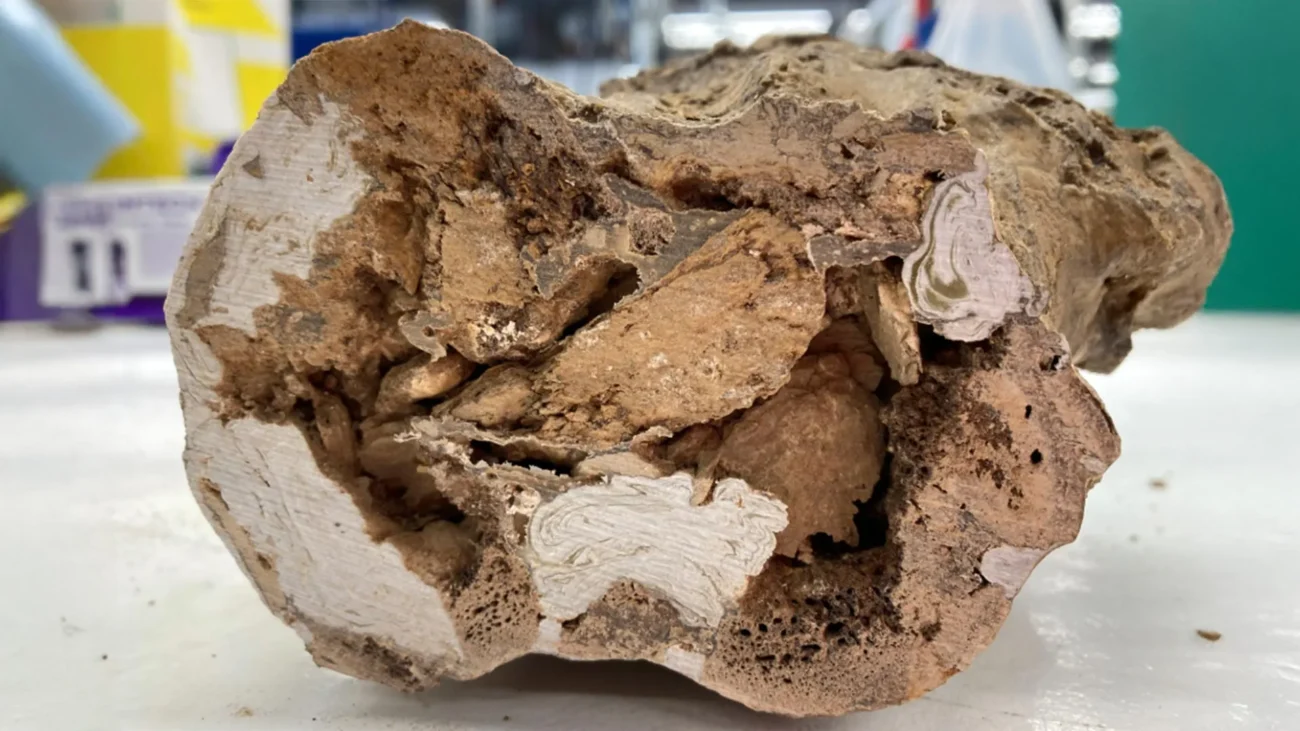
For generations, the prevailing scientific consensus held that dinosaur fossils were nothing more than mineralized relics, their original organic components long since surrendered to the ravages of time. This firmly entrenched view, treating ancient bones as essentially stony imprints, has been a cornerstone of paleontological study. However, a groundbreaking and rigorously conducted study centered on an exceptionally preserved Edmontosaurus fossil is poised to dramatically reshape this understanding, presenting compelling evidence that traces of original biological material, specifically collagen, can persist for tens of millions of years.
This extraordinary research, spearheaded by a team from the University of Liverpool, offers robust proof that original organic molecules, most notably collagen, remain embedded within dinosaur bones dating back approximately 66 million years. This discovery significantly bolsters a controversial hypothesis that has divided the paleontological community for over three decades, moving it from the realm of fervent debate toward empirical validation.
Preserved Collagen: A Paradigm Shift in Paleontology
The focal point of this transformative study is a substantial 22-kilogram Edmontosaurus sacrum, a crucial component of the dinosaur’s hip structure. Unearthed from the renowned Hell Creek Formation in South Dakota, this specimen belonged to a large, herbivorous duck-billed dinosaur that coexisted with apex predators like Tyrannosaurus rex at the twilight of the Cretaceous Period. The remarkable state of preservation of this fossil has been instrumental in the success of the research.
Employing a sophisticated arsenal of advanced laboratory techniques, including state-of-the-art protein sequencing and multiple forms of mass spectrometry, the scientists meticulously examined the fossilized bone. Their persistent efforts yielded the detection of distinct remnants of collagen, the principal structural protein that forms the organic matrix of bone tissue. Collagen is notoriously resilient, and its identification in this ancient context is exceptionally difficult to dismiss as mere modern contamination or superficial residue.
Further corroboration came from researchers at UCLA, who independently identified hydroxyproline, an amino acid intrinsically linked to collagen within bone tissue. According to the research team, this specific amino acid served as a critical confirmation, lending significant weight to the assertion that degraded collagen fragments were genuinely integral to the fossil’s original composition, rather than being introduced post-excavation.
Professor Steve Taylor, Chair of the Mass Spectrometry Research Group at the University of Liverpool’s Department of Electrical Engineering & Electronics and a lead author on the study, articulated the profound significance of their findings. "This research shows beyond doubt that organic biomolecules, such as proteins like collagen, appear to be present in some fossils," he stated. Professor Taylor further emphasized the far-reaching implications of their work, asserting, "Our results have far-reaching implications. Firstly, it refutes the hypothesis that any organics found in fossils must result from contamination." This direct refutation challenges a fundamental assumption that has long constrained the interpretation of fossil discoveries.
A Lingering Debate: The Battle Against Contamination Claims
The assertion of preserved soft tissues and proteins within dinosaur fossils has ignited a firestorm of scientific debate since the early 2000s. Skeptics, often citing the extreme age of these specimens, have consistently argued that any detected organic materials were the result of modern contamination from bacteria, environmental sources, or even the researchers themselves, rather than authentic dinosaurian molecules. This has created a significant schism within the paleontological community, with proponents of preserved biomolecules facing considerable resistance.
One of the most pivotal moments in this ongoing debate occurred in 2005 when paleontologist Mary Schweitzer and her colleagues reported the discovery of what appeared to be soft tissue structures within a Tyrannosaurus rex fossil. This initial revelation, though met with excitement, also intensified the scrutiny and skepticism. Subsequent studies continued to identify potential collagen and structures resembling blood vessels in additional dinosaur specimens, including hadrosaurs, a group closely related to the Edmontosaurus studied in the recent research. These earlier findings, while suggestive, often lacked the comprehensive analytical rigor required to definitively quell the contamination concerns.
The current Edmontosaurus analysis distinguishes itself through its multi-faceted and independent approach. By employing a battery of distinct testing methodologies on the very same fossil sample, the research team aimed to create an irrefutable case. The integration of high-resolution microscopy, detailed chemical analysis, and advanced protein sequencing was specifically designed to systematically eliminate the possibility of contamination and solidify the argument that the detected molecules were indeed endogenous – originating from the dinosaur itself. This convergence of evidence from multiple independent lines of inquiry significantly strengthens the validity of the findings.
The groundbreaking results of this meticulous investigation were formally published in the prestigious journal Analytical Chemistry in 2025. The study, titled "Evidence for Endogenous Collagen in Edmontosaurus Fossil Bone," provides a detailed account of their methodology, data, and conclusions, making their findings accessible for peer review and further scientific exploration.
The Profound Implications: Rewriting Our Understanding of Ancient Life
The confirmation of preserved collagen in ancient dinosaur fossils carries profound implications, potentially revolutionizing the field of paleontology. If proteins can indeed endure for tens of millions of years, scientists may unlock entirely new avenues for studying extinct animals, moving beyond the purely skeletal record.
The discovery suggests that even minuscule molecular traces could provide invaluable insights into the evolutionary relationships between dinosaur species, relationships that are often difficult to ascertain solely from the morphological characteristics of fossilized bones. Researchers might be able to trace lineages with greater precision, potentially resolving long-standing phylogenetic puzzles. Furthermore, the analysis of preserved biomolecules could offer unprecedented details about dinosaurian physiology, shedding light on their growth patterns, the aging process, metabolic rates, and even the prevalence of diseases that afflicted these ancient creatures.
Professor Taylor highlighted the potential for re-examination of existing fossil archives. "These images may reveal intact patches of bone collagen, potentially offering a ready-made trove of fossil candidates for further protein analysis," he explained. This suggests that valuable data may have been overlooked in fossil collections amassed over the past century. Cross-polarized light microscopy images, taken decades ago but perhaps not subjected to modern biochemical analysis, could contain hidden evidence of preserved collagen in ancient bones. "This could unlock new insights into dinosaurs, for example revealing connections between dinosaur species that remain unknown," Taylor added, underscoring the vast untapped potential of existing fossil collections.
The ability to study molecular remnants could also offer a window into the dietary habits and environmental conditions of dinosaurs. Isotopic analysis of preserved proteins, for instance, could reveal information about their food sources and the ecosystems they inhabited. This level of detail was previously considered unattainable from fossilized bone alone.
The Enigma of Molecular Longevity: How Did They Survive?
The discovery naturally gives rise to a fundamental and fascinating scientific question: how have these delicate organic molecules managed to survive for such immense geological timescales? Proteins, by their very nature, are complex structures that are prone to degradation over time, especially when subjected to the environmental pressures and chemical transformations that occur across millions of years.
However, a growing body of research suggests that certain fossils, under specific environmental conditions, possess an extraordinary capacity to preserve microscopic biological structures. Scientists are increasingly investigating the hypothesis that interactions between collagen molecules and the surrounding mineral matrix within bone may play a crucial role in shielding these protein fragments from complete decay. Recent studies exploring fossil biomolecules indicate that particular burial environments and the intricate microstructures of bone can create remarkably stable conditions, significantly slowing down the rate of chemical breakdown.
The Edmontosaurus fossils, in particular, have long been recognized for their exceptional preservation qualities. Over the last century, numerous specimens have been discovered that retain astonishingly detailed skin impressions and other soft tissue features, leading to them being colloquially dubbed "dinosaur mummies." This level of preservation has always hinted at the possibility of more than just mineralized remains.
More recent paleontological research has continued to uncover evidence of surprisingly detailed soft tissue preservation in Edmontosaurus specimens. These discoveries have included remnants of fleshy structures and remarkably preserved skin anatomy, further challenging the notion of fossils as solely inert mineral casts.
Collectively, these ongoing discoveries are fundamentally reshaping the scientific perception of fossils. Instead of viewing them exclusively as stony replicas of ancient life, researchers are increasingly recognizing some fossils as potential molecular time capsules, capable of preserving tangible traces of prehistoric biology for eons. This paradigm shift opens up unprecedented opportunities for understanding the intricate details of life in the deep past.
The implications extend beyond mere scientific curiosity. Understanding the mechanisms of biomolecule preservation could have applications in fields such as astrobiology, aiding the search for signs of ancient life on other planets, or in the development of new biomaterials inspired by these exceptionally durable natural structures. The Edmontosaurus study, by providing such compelling evidence, is not just a triumph for paleontology but a significant leap forward in our quest to understand the enduring legacy of life on Earth.

