


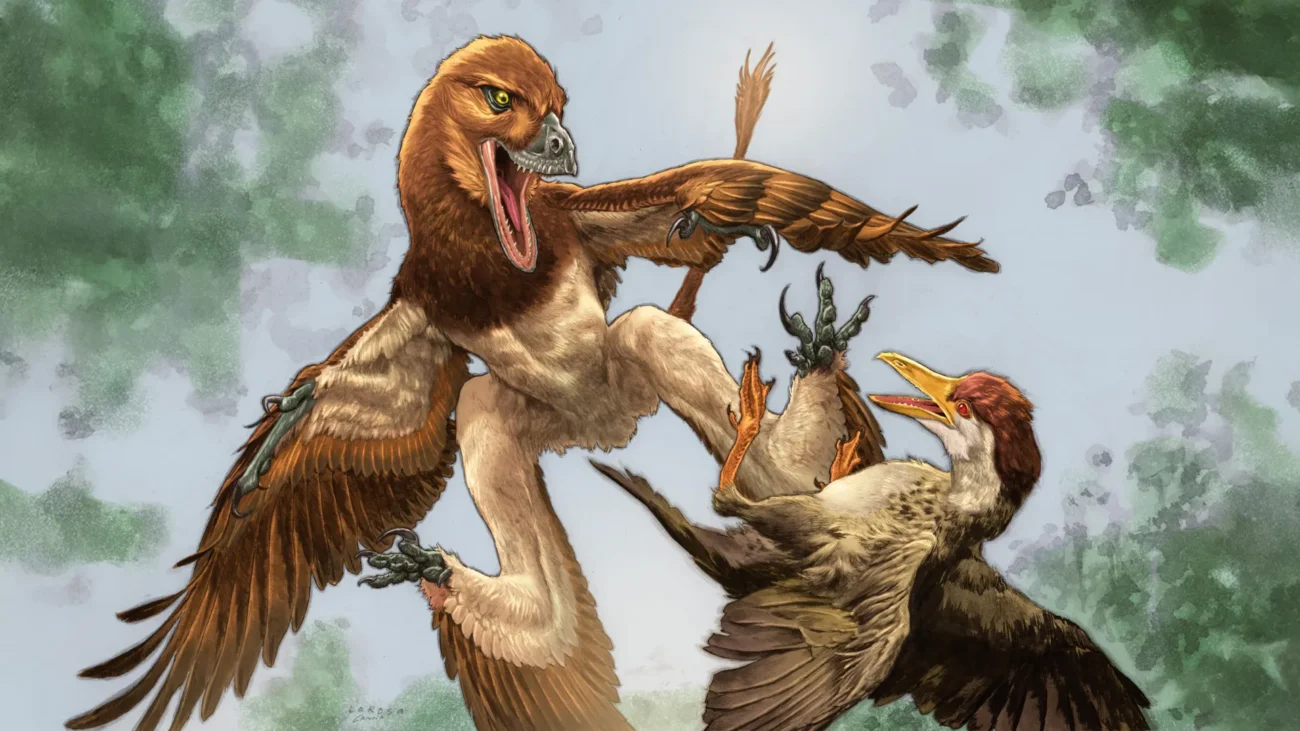
Northwestern China’s Changma Basin has long been a treasure trove for paleontologists, a remarkably preserved fossil site that has yielded hundreds of prehistoric bird remains. Among these avian fossils, scientists have frequently encountered peculiar clusters of shattered bird bones, compressed into dense, pellet-like masses that bear an uncanny resemblance to the regurgitated pellets of modern owls. For years, this enigmatic evidence has fueled speculation among researchers that a larger, non-avian predator was responsible for preying upon these ancient birds. However, until now, the identity of this elusive hunter remained a mystery, with no direct fossil evidence to confirm its existence.
This long-standing puzzle may finally be solved with the recent description of a newly discovered dinosaur species from the very same fossiliferous strata. In a comprehensive study published in the Annals of Carnegie Museum, a team of international paleontologists has unveiled Jianchangmaensis, a previously unknown feathered dinosaur that bears striking characteristics suggesting it was the culprit behind the peculiar bird bone accumulations.
A New Apex Predator in an Avian World
The Changma fossil site, renowned for its exceptionally preserved feathered dinosaurs and early birds, provides a unique window into the complex ecosystems of the Cretaceous period. While the site has yielded an abundance of avian fossils, demonstrating a diverse population of early birds, the absence of a clearly identifiable non-avian predator capable of creating such feeding assemblages has been a significant gap in our understanding of this ancient food web.
Jianchangmaensis has been classified as a dromaeosaur, a group of theropod dinosaurs that includes the famous Velociraptor. However, this new species belongs to a specific subgroup known as microraptors, which are generally characterized by their relatively small size and the presence of long feathers on both their forelimbs and hind limbs, leading to the moniker "four-winged dinosaurs."
"For years, paleontologists have been puzzled by these unusual concentrations of fragmented bird bones at the Changma site. We suspected a larger predator was at play, but definitive proof was elusive," stated Dr. Jingmai O’Connor, Associate Curator of Fossil Reptiles at the Field Museum in Chicago and senior author of the paper describing the new species. "This new microraptor, Jianchangmaensis, represents our most compelling candidate for this predator. It is the only non-avian dinosaur discovered at this particular locality that was a carnivore and significantly larger than the avian species found there."
The Anatomy of a Hunter: Four Wings and a Keen Eye
The distinguishing features of Jianchangmaensis are rooted in its skeletal anatomy, particularly in its arm and shoulder bones. While only a portion of the animal’s forelimb has been recovered, the morphology of these bones strongly indicates adaptations for a predatory lifestyle. The recovered piece of the upper arm bone, measuring approximately four inches, suggests an entire dinosaur with a wingspan of around four feet. This places Jianchangmaensis in a size category comparable to a modern barn owl, large enough to prey on the smaller to medium-sized birds that inhabited the Changma region.
Crucially, like other known microraptors, Jianchangmaensis is believed to have possessed extensive feathering on its limbs. This would have given it the appearance of having four wings – two on its forelimbs and two on its hind limbs. However, the scientific consensus is that these feathered limbs were not primarily adapted for powered flight in the manner of modern birds. Instead, researchers propose that Jianchangmaensis likely utilized these feathered appendages for gliding, much like a flying squirrel.
"The long feathers on both the arms and legs of microraptors like Jianchangmaensis would have created a remarkable aerodynamic surface," explained Dr. O’Connor. "While they probably couldn’t achieve sustained, flapping flight, they could have used these ‘wings’ to glide between trees or across open spaces, giving them an advantage in navigating their environment and ambushing prey."
The predatory strategy suggested by the bird bone pellets aligns with this gliding capability. A four-winged glider could potentially ambush birds from above or from concealed perches, efficiently capturing and consuming them. The shattered nature of the bird bones, similar to owl pellets, suggests a powerful digestive system capable of breaking down bone, a characteristic of many carnivorous theropods.
Unraveling the Changma Ecosystem: A Timeline of Discovery
The Changma Basin, located in China’s Gansu province, has been a focus of paleontological research for several decades. Initial discoveries in the late 20th century began to reveal the extraordinary preservation of feathered dinosaurs and early birds. These finds offered critical insights into the Mesozoic era, a time when birds were evolving from their dinosaurian ancestors.
- Late 20th Century: Early expeditions to the Changma site uncover significant bird fossils, hinting at a rich avian diversity. The presence of fragmented bird bone clusters is noted, but their origin remains a subject of speculation.
- Early 21st Century: Ongoing excavations and research at Changma yield a wealth of exceptionally preserved feathered dinosaurs, including numerous bird species. The peculiar bone clusters continue to be a point of scientific intrigue.
- Recent Years: The discovery and detailed analysis of Jianchangmaensis from the same fossil bed provide a potential breakthrough. Researchers meticulously compare its anatomy and ecological niche with the existing fossil evidence.
- Present Day: The publication of the study in the Annals of Carnegie Museum officially introduces Jianchangmaensis to the scientific community and proposes it as the likely predator responsible for the enigmatic bird bone masses.
The naming of the new species, Jianchangmaensis, is deeply rooted in its unique characteristics and discovery location. "Jian" is a reference to a winged creature from Chinese mythology, alluding to the dinosaur’s feathered appendages. The specific epithet, changmaensis, honors the Changma Basin, the geographical region where this significant fossil was unearthed.
Filling a Crucial Ecological Void
The discovery of Jianchangmaensis is not merely the identification of another dinosaur species; it is a pivotal moment in understanding the intricate ecological dynamics of the Changma fossil site. For years, the fossil record from Changma painted a picture of an avian-dominated environment, with a plethora of bird species thriving. However, the absence of a clearly defined predator within this avian-rich context left a significant void.
"The Changma site is celebrated for its fossil birds, and our team has recovered well over a hundred bird specimens from this locality," explained Dr. Matt Lamanna, corresponding author of the study and Carnegie Museum of Natural History’s Mary R. Dawson Curator of Vertebrate Paleontology and senior dinosaur researcher. "Jianchangmaensis is the only non-avian dinosaur specimen we’ve found here so far. Its presence dramatically enhances our understanding of the biological history of the Changma region and provides essential context for the ecological interactions involving the ancestors of today’s birds."
This new evidence suggests that while birds were abundant, they were not at the top of the food chain in this particular ecosystem. A specialized, non-avian predator like Jianchangmaensis exerted a significant influence on the avian populations, shaping their behavior and potentially contributing to the selective pressures that drove avian evolution.
Broader Implications for Understanding Avian Evolution
The implications of this discovery extend far beyond the confines of the Changma Basin. Understanding the predator-prey relationships between early birds and their non-avian dinosaur relatives is fundamental to comprehending the evolutionary trajectory that led to modern avian diversity.
Birds are the sole surviving lineage of dinosaurs, having weathered the cataclysmic asteroid impact that occurred approximately 66 million years ago, marking the end of the Cretaceous period. The survival and subsequent diversification of birds into the most successful group of land-dwelling vertebrates on Earth today is a testament to their remarkable adaptability.
"You cannot fully grasp the success of life on Earth today without examining its origins," emphasized Dr. O’Connor. "Birds are arguably the most successful group of land-dwelling vertebrate animals on the planet. By studying early birds and their close non-bird dinosaur relatives, we gain crucial insights into the unique traits and evolutionary pathways that made the surviving avian lineage so resilient and diverse."
The discovery of Jianchangmaensis offers a tangible example of the ecological pressures that early birds faced. It highlights that while birds were developing their own specialized adaptations, they were still prey for other predatory dinosaurs, even those within their broader evolutionary family tree. This dynamic interaction likely played a role in the refinement of avian flight, escape behaviors, and habitat selection.
Furthermore, the existence of a sophisticated predator like Jianchangmaensis helps scientists better delineate what set the avian lineage apart from their non-avian cousins. While many dromaeosaurs were agile predators, the specialized adaptations for powered flight that evolved in birds ultimately provided them with a unique advantage for survival and dispersal in the face of environmental challenges.
The research team, which included scientists from the Gansu Geological Museum, Carnegie Museum of Natural History, University of Nebraska State Museum, University of California Museum of Paleontology, Gansu Agricultural University, and the Institute of Vertebrate Paleontology and Paleoanthropology of the Chinese Academy of Sciences, is continuing to analyze the fossil material and explore the broader implications of this significant find. The ongoing exploration of sites like Changma promises to continue to illuminate the complex and fascinating story of dinosaur and bird evolution, offering ever-clearer glimpses into a world long past.

