


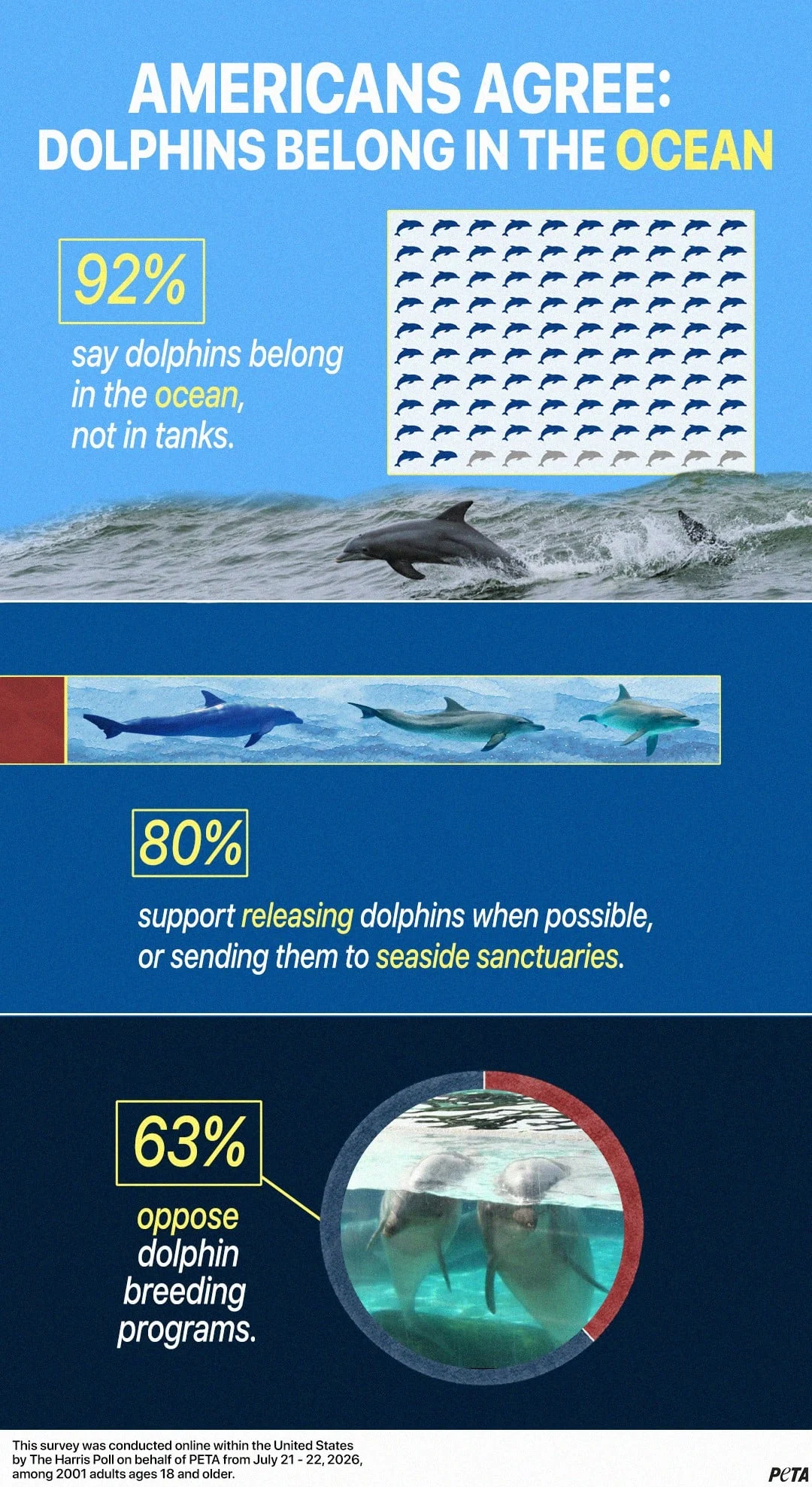
A comprehensive new national survey has revealed a profound shift in American public opinion regarding marine wildlife captivity, with an overwhelming majority of citizens stating that dolphins belong in the wild rather than in commercial entertainment facilities. Commissioned by People for the Ethical Treatment of Animals (PETA) and conducted by The Harris Poll, the survey gathered responses from 2,001 adults across the United States. The findings underscore a rapidly widening gap between modern ethical standards and the operational models of traditional marine parks, aquariums, and resort-style attractions that continue to feature captive cetaceans for public amusement.
According to the data, 92 percent of American adults believe that dolphins belong in the ocean rather than enclosed concrete tanks. Furthermore, 80 percent of respondents expressed support for releasing captive dolphins from marine parks and resorts whenever feasible, or alternatively transferring them to protected seaside sanctuaries where they can experience a semi-natural environment. These figures highlight a broader cultural evolution in how society views animal intelligence, welfare, and the ethics of keeping highly complex marine mammals in confined spaces for profit.
The Evolution of Public Awareness and Scientific Understanding
For decades, marine parks promoted themselves as educational centers, marketing live dolphin shows and interactive "swim-with" experiences as family-friendly entertainment that fostered a connection with nature. However, advances in marine biology, ethology, and animal psychology have fundamentally altered public perception. Scientists and animal welfare advocates have extensively documented the complex social structures, high cognitive capacities, and vast spatial needs of cetaceans. In the wild, dolphins swim dozens of miles daily, dive to significant depths, and maintain lifelong bonds within intricate, self-determined pods.
In stark contrast, captive dolphins in commercial facilities are typically housed in barren concrete tanks or chemically treated enclosures. Deprived of the sensory stimulation of the open ocean, these animals frequently exhibit stereotypic behaviors—repetitive, stress-induced actions resulting from chronic confinement and boredom. The public is increasingly recognizing that the artificial conditions of marine theme parks cannot meet the biological or psychological needs of these animals, rendering the traditional entertainment model indefensible to a vast majority of consumers.
The Current Landscape of Captivity in the United States
Despite shifting public attitudes, hundreds of dolphins remain confined across approximately 17 marine parks, resorts, and commercial aquariums spanning five U.S. states. Notable facilities housing captive cetaceans include Discovery Cove in Florida, Six Flags Discovery Kingdom in California, the Mississippi Aquarium, SeaWorld San Antonio in Texas, and Sea Life Park on the island of Oahu in Hawaii.
These institutions face mounting economic and social pressures as consumer demographics shift. While park operators historically relied on the novelty of live performances to drive ticket sales, the persistent disconnect between corporate practices and public sentiment has sparked sustained activism, legislative scrutiny, and calls for corporate restructuring. The survival of these business models increasingly relies on regulatory compliance and public relations campaigns aimed at defending animal management practices that a large majority of the population now rejects.
Global Momentum and the Rise of Seaside Sanctuaries
The movement away from captive marine entertainment is not confined to the United States. Internationally, nations have begun enacting strict legislative bans on the captivity of cetaceans for amusement purposes. Countries such as Canada, France, and Mexico have implemented sweeping prohibitions, reflecting a growing global consensus against the exploitation of marine mammals.
Domestically and internationally, the closure and transformation of legacy facilities point toward a changing industry standard. The high-profile closure of the Miami Seaquarium after more than five decades of operation serves as a prominent indicator of changing times. Concurrently, the development of seaside sanctuaries offers a viable, humane alternative to traditional captivity. Coastal sanctuaries provide enclosed, protected marine environments where dolphins and other cetaceans can experience natural tidal currents, varied marine life, and expanded spatial freedom while continuing to receive professional veterinary care and nutritional support.
Examples of this transition are emerging worldwide. Notable international milestones include the transfer of two beluga whales from a Chinese marine park to a dedicated sanctuary in Iceland, and the successful rehabilitation and release of three dolphins from cramped pools in Indonesia back into open ocean waters. Additionally, initiatives such as the Whale Sanctuary Project in Nova Scotia are actively developing large-scale coastal havens for displaced cetaceans, while the forthcoming San Paolo Dolphin Refuge in Taranto, Italy, demonstrates a growing European commitment to sanctuary-based management.
Corporate Responses and Activism
For years, animal advocacy organizations have targeted the marine entertainment sector through sustained public awareness campaigns, shareholder resolutions, and protests. High-profile figures and celebrity advocates—including Pamela Anderson, Hayden Panettiere, and Bella Thorne—have repeatedly lent their voices to campaigns urging consumers to boycott facilities that profit from animal confinement.
This relentless pressure has yielded tangible results within the industry. Following extensive campaigns led by PETA and allied organizations, major corporate players were forced to adapt. SeaWorld notably ended its controversial orca breeding program and discontinued the practice of trainers riding on the backs of dolphins during theatrical performances. Similarly, corporate hospitality brands have recalibrated their offerings; following direct engagement from animal welfare advocates, destinations such as Aulani, A Disney Resort & Spa in Hawaii, and Hawks Cay Resort in Florida officially terminated their interactive swim-with-dolphin programs.
Fact-Based Analysis of Broader Implications
The findings of the Harris Poll signal critical implications for the tourism and entertainment sectors. As consumer values shift toward sustainability and ethical treatment, businesses that rely on animal exploitation face severe reputational risks. The data suggests that younger demographics, in particular, view animal welfare as a core ethical component of travel and leisure choices.
For marine parks and aquariums, the long-term economic viability of maintaining live cetacean displays is increasingly precarious. Industry analysts note that facilities failing to transition toward conservation-focused models, rehabilitation, or sanctuary partnerships risk alienating core consumer bases. Conversely, institutions that pivot toward education, marine conservation, and rescue operations are better positioned to align with public expectations.
Methodology and Survey Reliability
The nationwide survey referenced in this report was administered online within the United States by The Harris Poll on behalf of PETA between July 21 and July 22, 2026. The study polled a nationally representative sample of 2,001 adults aged 18 and older. To ensure statistical reliability, the sampling precision of Harris online polls is measured using Bayesian credible intervals. For this specific research study, the gathered sample data maintains an accuracy rate of within plus or minus 2.7 percentage points at a 95 percent confidence level. Complete methodological details, including demographic weighting variables and specific subgroup sample sizes, remain accessible through PETA’s institutional resources.
As public awareness deepens and alternatives such as coastal sanctuaries prove operationally feasible, the pressure on American marine parks to phase out captivity intensifies. The message delivered by the American public is unequivocal: the future of marine mammal care lies in respecting their natural autonomy, ending commercial exploitation, and transitioning captive populations toward environments that prioritize their well-being above corporate entertainment.

