


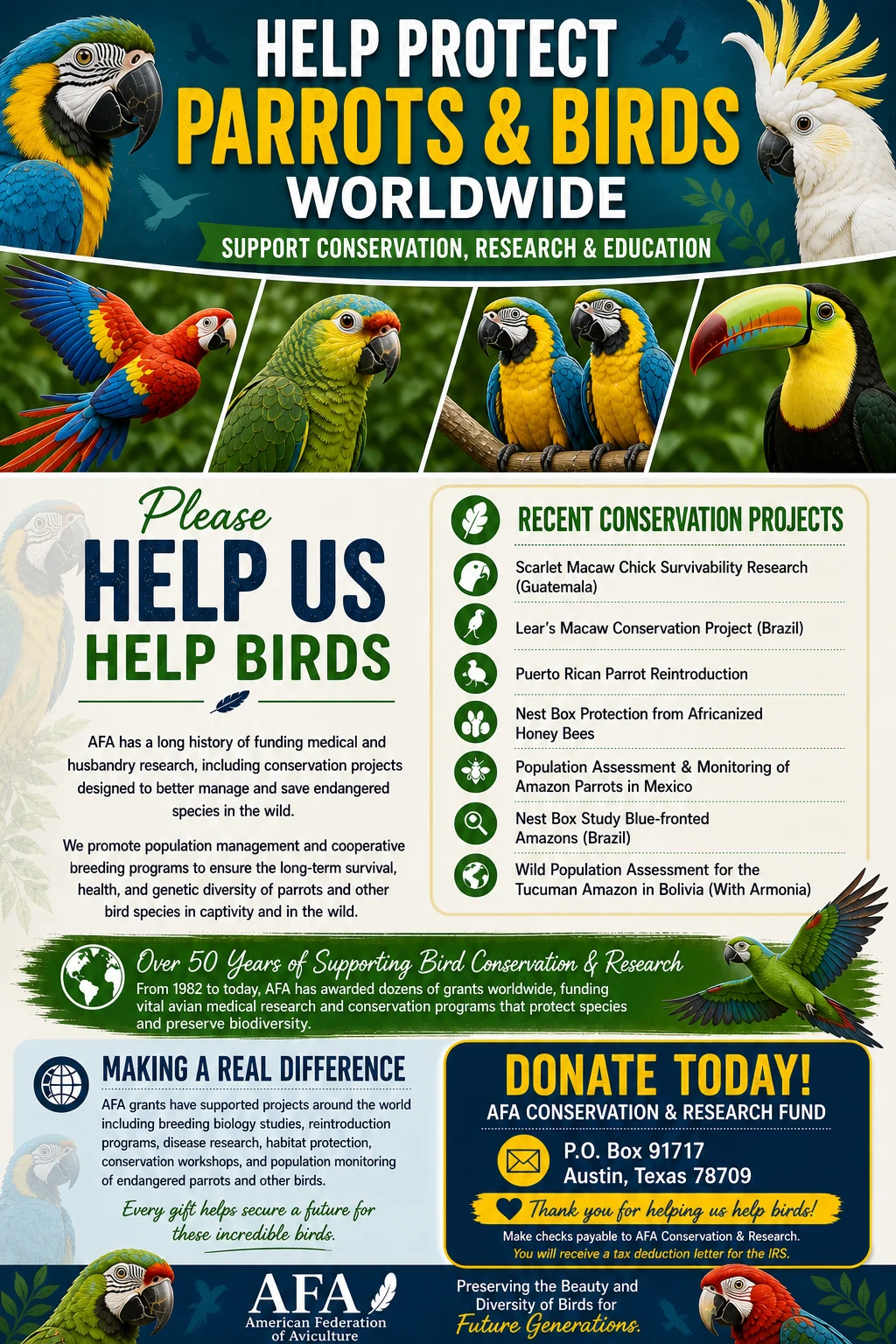
The American Federation of Aviculture (AFA), a premier non-profit educational organization dedicated to the advancement of aviculture and exotic bird conservation, has announced a series of strategic funding initiatives, legislative updates, and international collaborations for the 2024–2025 term. Grounded in a mission to promote sustainable captive breeding practices, scientific field research, and habitat preservation, the organization continues to bridge the gap between private bird stewardship and international wildlife protection.
Strategic Partnerships and Major Funding Contributions
Central to the AFA’s ongoing conservation efforts is its longstanding collaboration with Harrison’s Bird Foods, which recently demonstrated its commitment to wild parrot preservation by presenting the AFA with a $25,000 corporate contribution. This significant financial boost directly supports the AFA Conservation Committee’s small-grant program, designed to assist field biology initiatives operating within the native habitats of endangered psittacine species.
Aviculturists, researchers, and conservation organizations seeking small grants for wild parrot conservation projects are invited to submit project proposals and funding requests to the AFA office. In addition to corporate support, individuals and institutions can attain formal recognition as AFA Conservation Partners through contributions highlighted in the AFA Watchbird Journal and across the organization’s digital platforms.
Current Field Conservation Projects Supported by AFA
The AFA allocates membership contributions and corporate donations to several high-impact, international field projects targeting critical population declines and ecological threats:
- Chajul Biology Station (Natura Mexicana, Chiapas, Mexico): Serving as a primary conservation focus, the Chajul station works tirelessly to protect wild scarlet macaws in the Lacandon rain forest. Historically, severe poaching for domestic and international pet trades resulted in near-zero fledgling rates without active intervention. Station biologists monitor wild nests, identify hatchlings, and engage in targeted head-starting, successfully releasing more than 150 hand-reared and wild-hatched scarlet macaws back into their native canopy. The 2024 fundraising initiative targets $5000 to procure essential field equipment, including incubators, brooders, portable thermal units, digital gram scales, and veterinary medical supplies.
- Selva Maya Living Landscape Program (Wildlife Conservation Society, Guatemala): Active since 2002 within the Maya Biosphere Reserve, the WCS employs a combination of threat-based interventions and direct population enhancements. Researchers implement experimental methodologies to improve chick survivability, cementing the scarlet macaw as a flagship species for regional tropical forest preservation.
- Africanized Honey Bee Nest Box Mitigation Protocol: Led by Principal Investigator Caroline A. Efstathion, this project addresses a unique ecological conflict where invasive Africanized honey bees colonize artificial and natural avian nest boxes, displacing breeding parrots. The research has pioneered a "push-pull" methodology utilizing bird-safe permethrin repellents alongside pheromone-baited traps to divert scout bees toward more attractive, purpose-built apiary structures.
- Tambopata Macaw Project and Health Assessment (Tambopata Region, Peru): Co-investigated by J. Jill Heatley, Lizzie Ortiz-cam, and Donald Brightsmith, this comprehensive field study utilizes advanced i-STAT analyzers to evaluate real-time physiological baseline data—including electrolytes, venous blood gases, lactate, and ionized calcium—in free-flighted and nestling macaws. The project also examines complete blood counts and parasite loads while investigating the physiological motivations behind wild macaw clay-lick consumption.
- Lear’s Macaw Corn Subsidy Program (Bahia, Brazil): This initiative mitigates agricultural conflicts by providing subsidized corn to local farming communities whose crops are impacted by foraging wild Lear’s macaws, fostering local coexistence and species tolerance.
Historical Context and Institutional Evolution
The genesis of the American Federation of Aviculture is deeply intertwined with regulatory crises of the early 1970s. Following an outbreak of Exotic Newcastle Disease in California, state and federal authorities euthanized thousands of healthy exotic birds housed in private collections. This sweeping sanitary action catalyzed the introduction of restrictive state legislation aimed at curtailing or banning private exotic bird ownership.

In response, Southern California aviculturists and local bird clubs united to establish the AFA in March 1974. Incorporated in California with its administrative operations based in Austin, Texas, the organization evolved into an umbrella federation representing thousands of individual members, regional clubs, and zoological institutions worldwide. Over the decades, the AFA has distributed dozens of avian research grants, establishing itself as a scientific authority on captive husbandry, veterinary medicine, and legislative advocacy.
Grant Proposal Guidelines and Submission Criteria
The AFA Avian Conservation Grants program evaluates proposals annually, targeting projects that exhibit high likelihoods of success and practical contributions to avian knowledge. While typical grants are modest (generally $500 or less), the Conservation Committee occasionally reviews requests for larger funding allocations based on project scope.

Applicants must adhere to strict structural guidelines when submitting their proposals. Submissions should be concise, not exceeding five pages for core sections, and must include standardized project titles, objectives, methodologies, and anticipated conservation outcomes. Proposals must be submitted electronically to the AFA office or via postal mail no later than September 15 for consideration in the subsequent funding cycle. Detailed submission forms and guidelines are accessible via the official AFA web portal.
Navigating International Trade Regulations: CITES and the Wild Bird Conservation Act
As a recognized Non-Governmental Observer (NGO) at meetings of the Convention on International Trade in Endangered Species (CITES) Animals Committee, the AFA plays an active role in international policy discussions. The organization monitors the Federal Register and collaborates with the U.S. Fish and Wildlife Service (USFWS) to ensure that regulatory frameworks balance wildlife protection with sustainable avicultural stewardship.
The regulatory landscape governing the movement of exotic birds in the United States is defined primarily by two major federal statutes:
- The Wild Bird Conservation Act (WBCA) of 1992: Enacted to halt the mass importation of wild-caught birds for the pet trade, the WBCA effectively prohibits the commercial importation of all CITES-listed parrot species (family Psittacidae). However, the law provides two specific exemptions:
- Cooperative Breeding Programs (CBPs): Permitted under strict USFWS oversight, CBPs allow specialized avicultural groups to import limited numbers of underrepresented genetic stock to establish self-sustaining captive populations. The AFA has historically served as the official overseer for numerous successful CBPs, including those for the Red Siskin, Blue-headed Macaw, Javan Hill Mynah, and various conure and cardinal species. Current oversight includes the Blue-eyed Cockatoo (Ophthalmica) CBP, which has expanded to incorporate various black cockatoo species (Gang-gang, Red-tailed, White-tailed, Yellow-tailed, and Glossy Black cockatoos).
- The "Clean List" (WBCA-Exempt Species): Title 50, Part 15, Subsection 15.33 of the Code of Federal Regulations outlines species widely bred in captivity globally that are exempt from import moratoriums, provided they are not sourced from wild populations.
- The U.S. Endangered Species Act (ESA) of 1973: Administered to protect critically endangered native and exotic wildlife, the ESA regulates interstate commerce and international transport. While possession of legally acquired listed species generally does not require federal permits within state lines, commercial transactions, sales, or bartering across state boundaries necessitate specific permits, such as Interstate Commerce Permits or Captive-bred Wildlife Permits.
Implications for the Future of Aviculture and Conservation
The comprehensive framework maintained by the American Federation of Aviculture illustrates a modern conservation paradigm: one where field research, legislative compliance, and cooperative captive management operate in tandem. By securing corporate partnerships, funding boots-on-the-ground international field projects, and guiding aviculturists through complex international treaties like CITES and the WBCA, the AFA remains a vital cornerstone in the global effort to ensure the long-term survival and genetic health of avian wildlife for generations to come.

