


Major international travel platform Tripadvisor has officially updated its consumer-facing advisory infrastructure, placing stark animal welfare warning notices on the tourism directory pages of some of the world’s most historic and prominent horse racing venues. Prominent tracks now bearing the warning label include Churchill Downs in Kentucky, Del Mar Racing, Pimlico Race Course, Saratoga Race Course, Keeneland, Belmont Park in the United States, alongside international landmarks such as Ascot Racecourse in the United Kingdom and Tokyo Racecourse in Japan. The automated advisory notice explicitly informs prospective visitors that the targeted businesses currently fail to meet Tripadvisor’s institutional Animal Welfare Policy standards.
The policy update marks a significant escalation in corporate accountability measures within the global travel and tourism sector. Under the terms of the revised corporate guidelines, Tripadvisor strictly prohibits ticket sales through its proprietary platform and refuses to generate booking revenue from specific commercial experiences where domesticated animals are subjected to heightened risks of injury, trauma, or mortality in the name of sport or entertainment. This sweeping exclusion zone covers a broad spectrum of commercial animal exploitation ventures, encompassing the vast majority of regulated dog, horse, and camel racing operations, alongside traditional rodeo-style exhibitions. By implementing these measures, one of the world’s largest travel guidance and ticketing aggregators has formally aligned itself with international animal protection standards, signaling to millions of consumers that forcing animals to perform in high-speed racing environments is fundamentally incompatible with ethical tourism.
The Evolution of Corporate Policy and Consumer Travel Trends
The integration of these warning labels represents the culmination of a broader, decades-long shift in consumer expectations and corporate social responsibility. In recent years, public tolerance for entertainment models that rely on the confinement, physical strain, or exploitation of animals has declined precipitously. Mainstream travelers increasingly demonstrate a clear preference for ethical tourism, rejecting commercial entities such as captive marine parks holding orcas in confined tanks, traveling circuses utilizing performing wild cats, and sporting events that push physiological boundaries beyond safe thresholds.
Tripadvisor’s decision to target the global horse racing industry capitalizes on this growing cultural sentiment. Rather than acting as an independent arbiter of animal welfare, the platform is responding to mounting empirical evidence and widespread public concern regarding the structural safety of racing operations. Industry analysts note that travel platforms are uniquely positioned to influence consumer behavior; by introducing friction into the booking process and providing transparent disclosures right at the point of destination research, platforms like Tripadvisor effectively dismantle the sanitised marketing narratives historically projected by racetrack operators.
A Chronology of Activism and High-Profile Track Incidents
The mounting pressure on racetracks is not a sudden development but the result of sustained, multi-decade documentation efforts by animal welfare organizations, most notably People for the Ethical Treatment of Animals (PETA). For over twenty years, advocacy groups have systematically documented, investigated, and publicized the catastrophic physical tolls exacted on equine athletes within the commercial racing complex.
The modern scrutiny intensified dramatically following a watershed moment in May 2008, when the prized filly Eight Belles suffered a devastating breakdown, sustaining two fractured ankles immediately after crossing the finish line at the Kentucky Derby. The graphic nature of her euthanasia on the track in front of tens of thousands of spectators and a live national television audience pierced the glamorous veneer of the sport, forcing both regulators and the public to confront the inherent dangers of elite horse racing.
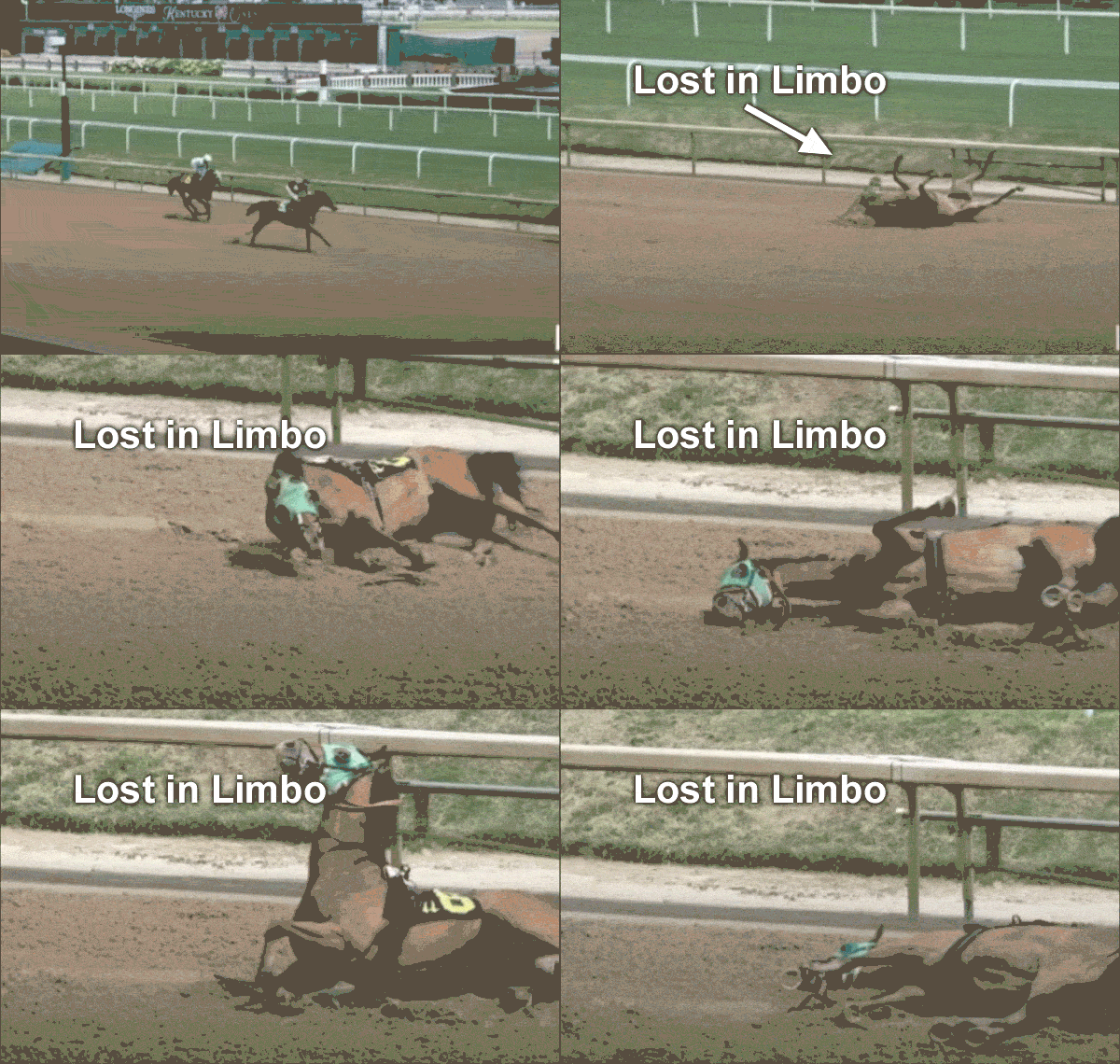
In the years following the Eight Belles incident, investigative groups expanded their surveillance of training and racing facilities across North America and beyond. Documented incidents accumulated steadily, transforming isolated tragedies into a recognized systemic crisis. A notable flashpoint occurred in 2023 during the weeks surrounding the Kentucky Derby festival at Churchill Downs, a period marred by an extraordinary cluster of fatalities that saw 12 horses die within a compressed timeframe. Among these casualties was the seven-year-old gelding Lost in Limbo, whose fatal collapse became the center of a public relations controversy when racing operators allegedly edited the horse’s fall out of official replay archives.
The pattern of transparency challenges continued into subsequent racing seasons. In early May, prior to the running of the Kentucky Derby, a PETA undercover investigator captured footage of a young colt, Vino Subito, sustaining a catastrophic injury on the track. The harrowing video footage quickly circulated across digital networks, generating more than five million views and casting further doubt on the self-regulatory capacity of traditional racing authorities. These recurring incidents have systematically eroded public trust, transforming every major racing festival into a focal point for ethical debate rather than purely athletic celebration.
Statistical Analysis of Equine Fatalities and Regulatory Oversight

Underpinning Tripadvisor’s policy enforcement are alarming mortality statistics compiled by independent researchers, animal advocacy groups, and official regulatory bodies. The Horseracing Integrity and Safety Authority (HISA), which assumed federal oversight responsibilities for a significant portion of the American thoroughbred racing industry, reported that 365 horses died either racing or training across 41 covered U.S. racetracks during a single recent calendar year. This aggregate figure translates to an average of one equine fatality every single day within the jurisdiction of a single regulatory body.
Independent animal welfare organizations contend that official statistics systematically undercount the true scope of mortality by excluding unsanctioned tracks, training centers, and off-site facilities where injured animals are frequently transported before euthanasia. Comprehensive industry estimates suggest that the actual total of racing-related equine deaths across all American tracks may be up to three times higher than official HISA figures indicate.
The physiological mechanics behind these statistics are well-documented by veterinary science. Thoroughbreds are bred primarily for explosive speed and competitive stamina, resulting in skeletal structures that are comparatively lightweight relative to their immense muscle mass and velocity. When pushed to maximum exertion—frequently compounded by the early introduction to training while skeletal systems are still maturing, the use of legal or illegal therapeutic medications to mask pain, and hard racing surfaces—the risk of catastrophic bone fractures, ligament ruptures, and fatal pulmonary hemorrhages increases exponentially. Once a horse suffers a severe limb fracture, the physiological limitations of equine veterinary medicine—specifically the animal’s inability to endure prolonged periods of immobilization required for bone healing without developing fatal laminitis in opposing limbs—frequently necessitate immediate euthanasia.
Official Responses and Industry Reactions
The implementation of Tripadvisor’s warning labels has provoked immediate and defensive reactions from traditional racing institutions and international governing bodies. Representatives of the British Horseracing Authority (BHA) reportedly reached out to Tripadvisor following the policy rollout, urging corporate leadership to reconsider the implementation of the labels and engaging in dialogue regarding the safety measures currently enforced across British courses. International racing bodies have consistently argued that modernizing track surfaces, increasing pre-race veterinary screenings, and implementing stricter medication controls are sufficient to safeguard animal welfare without the need for punitive consumer tourism advisories.
However, reactions from within the racing community itself have been mixed, with some industry insiders acknowledging that the writing is on the wall regarding public perception. Jonathan Stettin, a recognized racing analyst and industry insider, published a candid appraisal of the development, writing that Tripadvisor’s decision is not an isolated activist campaign, but a reflection of a broader societal shift. Stettin noted that if traditionalists believe grassroots organizations are the sole critics of the sport, they are dangerously misreading the cultural landscape, emphasizing that the application of a warning label by a multi-billion-dollar global travel platform signals a permanent institutional repositioning of the sport’s public image.
Implications for the Future of Commercial Horseracing
The integration of mandatory welfare warnings on major tourism platforms carries profound financial and operational implications for the global horse racing industry. Tourism represents a substantial revenue driver for high-profile racing festivals, which rely heavily on out-of-town visitors, international tourists, and corporate hospitality packages to fill grandstands and generate ancillary economic activity.
When a prospective traveler searches for local attractions in cities like Louisville, Saratoga Springs, or Tokyo and encounters an official corporate advisory warning that the venue fails to meet basic animal welfare standards, the psychological friction introduced into the booking journey can significantly depress ticket sales and tourist attendance. This digital bottleneck threatens to accelerate the financial pressures already facing regional tracks, many of which depend on fluctuating wagering handles and political subsidies to remain solvent.
Furthermore, the move by Tripadvisor establishes a powerful precedent for other major technology, media, and travel corporations. As environmental, social, and governance (ESG) frameworks become increasingly integrated into corporate decision-making, hospitality aggregators and ticketing platforms face mounting stakeholder pressure to audit their product offerings for ethical compliance. If additional travel networks, payment processors, and media sponsors follow Tripadvisor’s lead, the commercial viability of hosting large-scale spectator events reliant on animal exploitation will face unprecedented operational hurdles.
Ultimately, the ongoing conflict between traditional racing associations and animal welfare advocates highlights an irreconcilable divergence in values. While industry stakeholders emphasize historical tradition, economic contributions, and ongoing reform efforts, a growing global consensus views the inherent risks of injury and death to captive animals as an unacceptable price for public entertainment. As consumer expectations continue to evolve, the ability of the racing industry to maintain its cultural license to operate will depend less on public relations campaigns and more on whether it can fundamentally reform its practices or reconcile itself to permanent marginalization within the modern tourism economy.

