


For generations, the foundational dogma of vertebrate paleontology rested on a simple, immutable premise: dinosaur fossils are rocks. According to this long-held scientific consensus, the immense pressures of fossilization—a process known as diagenesis—gradually replace all original organic components with inorganic minerals over millions of years. Soft tissues, proteins, and cellular structures were thought to be utterly incompatible with deep time, destined to degrade completely within thousands, or at most a few hundred thousand, years after an organism’s demise.
However, a groundbreaking study published in the journal Analytical Chemistry under the title "Evidence for Endogenous Collagen in Edmontosaurus Fossil Bone" is upending this bedrock assumption. Spearheaded by a multidisciplinary team of researchers from the University of Liverpool, in collaboration with institutions including the University of California, Los Angeles (UCLA), the new investigation provides robust, multi-layered evidence that fragments of original organic molecules, including the structural protein collagen, can survive inside dinosaur bones dating back approximately 66 million years.
This monumental discovery does not merely push the boundaries of biochemistry; it injects definitive empirical data into a fierce, decades-long academic schism that has deeply divided the paleontological community since the early 2000s. By bridging the gap between paleontology and advanced molecular proteomics, the study offers a powerful refutation of the contamination hypothesis that has dogged earlier claims of soft tissue preservation, paving the way for a revolutionary approach to studying prehistoric life from the inside out.
The Anatomy of a Discovery: Inside the Hell Creek Edmontosaurus
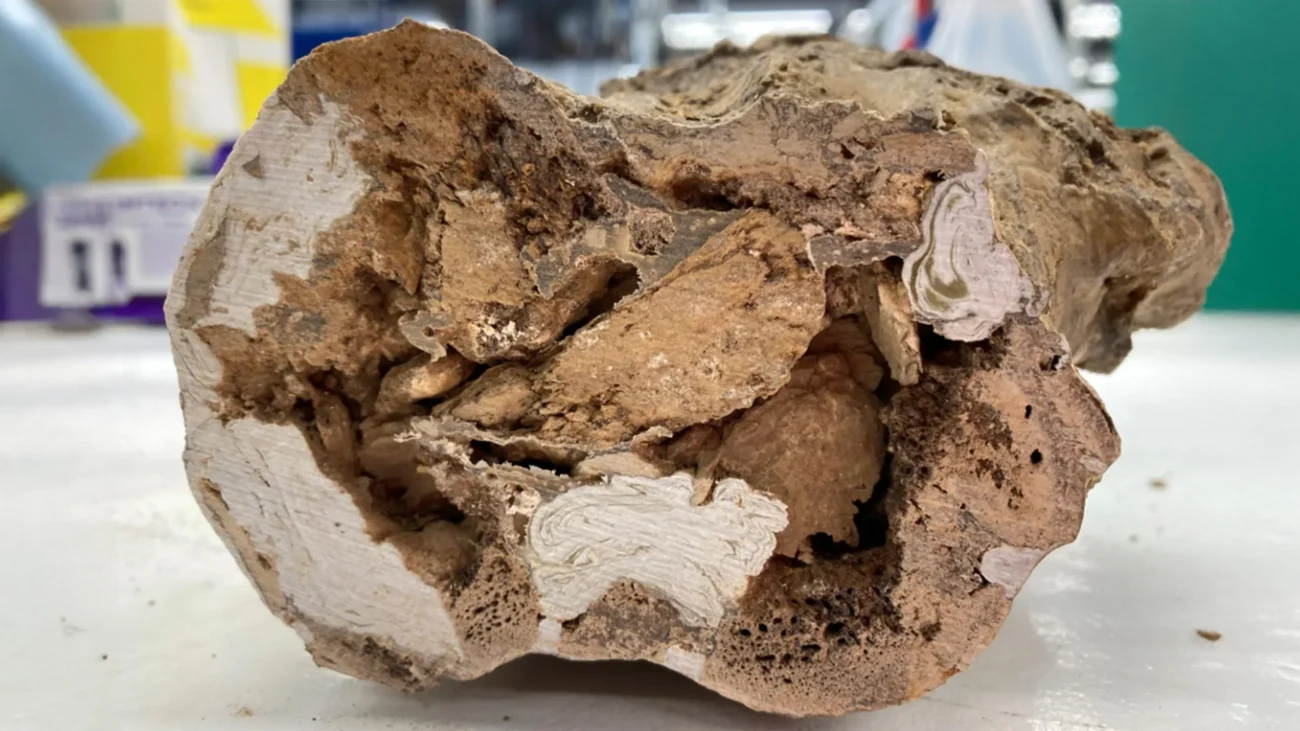
At the heart of this landmark research is a 22-kilogram fossilized sacrum—part of the pelvic region—belonging to an Edmontosaurus, a massive duck-billed herbivorous dinosaur that roamed the swampy coastal plains of North America alongside apex predators like Tyrannosaurus rex during the closing chapters of the Cretaceous Period. The specimen was unearthed from the world-famous Hell Creek Formation in South Dakota, a geological repository renowned for yielding exceptionally well-preserved Late Cretaceous fauna.
Edmontosaurus has long been a subject of fascination for paleo-biologists. Over the past century, paleontologists working in the Hell Creek and related formations have occasionally recovered so-called "dinosaur mummies"—specimens of Edmontosaurus exhibiting not just skeletal remains, but extraordinarily detailed impressions of skin, ligaments, and muscle tissue preserved in stone. Yet, while external soft tissue impressions have provided valuable morphological clues, recovering internal biomolecules from bones of this antiquity has remained the ultimate frontier.
To extract definitive answers from the South Dakota sacrum, the research team deployed an arsenal of high-precision analytical techniques designed to identify organic signatures at the molecular level. Moving far beyond traditional optical microscopy, the scientists utilized advanced protein sequencing methods alongside multiple variants of mass spectrometry. These techniques allowed the team to map the precise molecular composition of minute samples extracted from the interior matrix of the fossilized bone, minimizing the risk of handling or environmental interference.
Crucially, researchers at UCLA isolated hydroxyproline, a specialized amino acid that is heavily concentrated in collagen and exceedingly rare in the surrounding geological environment or typical microbial contaminants. Because collagen is the primary structural protein found in vertebrate bone—providing the flexible framework upon which mineral crystals deposit—its identification serves as a chemical fingerprint of bone tissue itself. The presence of degraded collagen fragments, verified through rigorous mass spectrometry, provided the smoking gun the team needed.
Professor Steve Taylor, chair of the Mass Spectrometry Research Group at the University of Liverpool’s Department of Electrical Engineering & Electronics and a senior contributor to the study, emphasized the definitive nature of the findings. "This research shows beyond doubt that organic biomolecules, such as proteins like collagen, appear to be present in some fossils," Taylor stated. "Our results have far-reaching implications. Firstly, it refutes the hypothesis that any organics found in fossils must result from contamination."
A Contentious History: Two Decades of Scientific Debate
To fully appreciate the gravity of the Liverpool-led study, one must understand the tumultuous history of molecular paleontology. For more than twenty years, claims of preserved soft tissues, blood vessels, and proteins in dinosaur fossils have been met with profound skepticism, intense scrutiny, and, at times, outright dismissal by mainstream geochemists and paleontologists.
The modern chapter of this controversy opened in 2005, when pioneering paleontologist Dr. Mary Schweitzer and her colleagues at North Carolina State University announced a stunning discovery: they had recovered stretchy, transparent blood vessel-like structures and flexible matrix from the femur of a 68-million-year-old Tyrannosaurus rex from Montana’s Hell Creek Formation. Subsequent studies by Schweitzer’s team and other researchers claimed to identify cellular structures, microscopic residues resembling red blood cells, and putative fragments of collagen in additional dinosaur specimens, including hadrosaurs.
However, these announcements triggered an immediate and fierce counter-offensive from the broader scientific community. Critics argued that the reported soft tissues were not original dinosaur biology at all, but rather "biofilms"—complex colonies of modern bacteria and fungi that had colonized the microscopic pore spaces of the porous fossil bone long after burial. Other skeptics pointed to potential laboratory cross-contamination during sample preparation, suggesting that modern proteins or reagents could easily mimic ancient biomolecules under less-than-stringent analytical protocols.
For years, the debate remained locked in a stalemate. While proponents argued that dismissing the finds ignored physical evidence, critics maintained that thermodynamic models of protein decay made the long-term survival of large biomolecules across millions of years theoretically impossible. Collagen breaks down via hydrolysis and thermal degradation over geological timescales; under standard conditions, scientists calculated that proteins should completely disintegrate within a few million years at most.
The 2025 study published in Analytical Chemistry breaks this methodological stalemate through an uncompromising reliance on multi-instrument validation. By combining high-resolution microscopy, rigorous chemical spot-testing, and definitive protein sequencing on the same Edmontosaurus specimen, the research team successfully neutralized the standard criticisms of contamination and biofilm artifact. By independently confirming the molecular architecture of the protein fragments using orthogonal analytical methods, the authors have shifted the burden of proof back to the skeptics.
The Enigma of Molecular Longevity: How Do Proteins Survive?
The confirmation of endogenous collagen in a 66-million-year-old fossil reopens one of the most baffling questions in modern geobiology: by what precise chemical and physical mechanisms do organic molecules manage to evade complete destruction across tens of millions of years?
Standard biochemistry dictates that organic bonds are inherently fragile, subject to continuous degradation driven by thermal energy, aqueous hydrolysis, and microbial activity. Yet, nature frequently defies standard thermodynamic models under exceptional conditions. Researchers investigating the preservation of fossil biomolecules are increasingly focusing on the intimate relationship between mineral crystals and organic matrices within bone.
Bone is a natural composite material, consisting of an organic framework of collagen fibers stiffened by an inorganic mineral component known as hydroxyapatite. Recent geochemical modeling suggests that when bone is buried rapidly in specific types of sedimentary environments—such as the silica-rich, reducing environments characteristic of ancient floodplain deposits like the Hell Creek Formation—a complex protective micro-environment can form.
In these scenarios, mineral crystallization may effectively encapsulate microscopic pockets of organic molecules, shielding them from circulating groundwater, oxygen, and hydrolytic enzymes. Furthermore, iron interactions have been proposed as a natural cross-linking agent; free iron ions released during the breakdown of hemoglobin can generate free radicals that cross-link and stabilize proteins, essentially "tanning" the organic molecules and rendering them far more resistant to decay.
The Edmontosaurus fossil record offers a unique testing ground for these hypotheses. Because these duck-billed dinosaurs were frequently buried intact in settings that favored rapid mineral precipitation, their tissues were prime candidates for exceptional preservation. As paleontology continues to uncover more examples of preserved integument, scales, and soft tissue structures in hadrosaurs, researchers are realizing that exceptional preservation may not be a one-in-a-billion anomaly, but rather a rare yet recurring phenomenon waiting to be properly unlocked.
Broader Impacts and Implications for Evolutionary Science
The ramifications of confirming authentic dinosaur proteins extend far beyond academic validation; they promise to fundamentally transform how paleontologists study the history of life on Earth.
For centuries, paleontology has been a science constrained almost entirely by morphology—the study of form and structure based on hard bones, teeth, and occasional impressions. While skeletal anatomy is remarkably informative, it has significant limitations. Closely related species often evolve similar skeletal structures through convergent evolution, and fragmentary remains frequently obscure taxonomic relationships, leaving significant gaps in evolutionary trees.
If robust protein sequences can be reliably recovered from dinosaur fossils, researchers can begin to apply molecular phylogenetics—the study of evolutionary relationships using genetic and protein sequences—to extinct dinosaurs. Because amino acid sequences are dictated by genetic code, recovering even partial protein fragments from dinosaurs allows scientists to build molecular family trees, comparing ancient proteins directly against those of modern birds, reptiles, and mammals. This molecular data could resolve long-standing debates regarding dinosaur physiology, metabolism, and the precise evolutionary branching points that led to modern avian lineages.
Moreover, preserved molecular traces could unlock unprecedented windows into the daily biological reality of prehistoric animals. Proteins carry chemical signatures related to diet, growth rates, age-related physiological stress, and systemic diseases. By analyzing these ancient molecular archives, future paleontologists may be able to determine the biological sex of specific fossil specimens, track metabolic shifts during growth cycles, or identify ancient pathogens that afflicted Cretaceous fauna.
Revisiting the Archives of Natural History
The paradigm shift catalyzed by the Liverpool study also suggests that the answers to some of paleontology’s greatest mysteries may already be sitting quietly in the climate-controlled drawers of natural history museums around the world.
Highlighting the practical downstream applications of his team’s work, Professor Taylor noted that the scientific community may now need to systematically re-examine fossil collections amassed over the past century. Standard cross-polarized light microscopy images and histological thin-sections prepared by researchers decades ago—long before modern mass spectrometry was conceived—may contain overlooked, hidden evidence of preserved bone collagen.
"These images may reveal intact patches of bone collagen, potentially offering a ready-made trove of fossil candidates for further protein analysis," Taylor explained. "This could unlock new insights into dinosaurs, for example revealing connections between dinosaur species that remain unknown."
This perspective transforms historical museum collections from static displays of petrified bones into dynamic, untapped libraries of ancient biomolecular data. Curators and researchers can now apply non-destructive or minimally destructive screening techniques to legacy specimens, testing whether molecular preservation is a widespread characteristic of specific fossilization regimes.
Conclusion: Redefining the Fossil Record
The confirmation of original collagen in a 66-million-year-old Edmontosaurus bone marks a watershed moment in the history of geosciences. By dismantling the dogmatic view that fossils are entirely devoid of their original biological constituents, this study bridges the historical chasm between morphology and molecular biology.
As researchers continue to refine mass spectrometry techniques, explore the chemical kinetics of deep-time protein preservation, and re-evaluate legacy fossil collections, the definition of what a fossil actually is is undergoing a profound evolution. No longer viewed simply as sterile stone replicas or silent stone monuments to extinct ecosystems, exceptional fossils are increasingly revealing themselves to be molecular time capsules—fragile, resilient vaults holding delicate echoes of prehistoric life that refuse to be entirely erased by time.

