


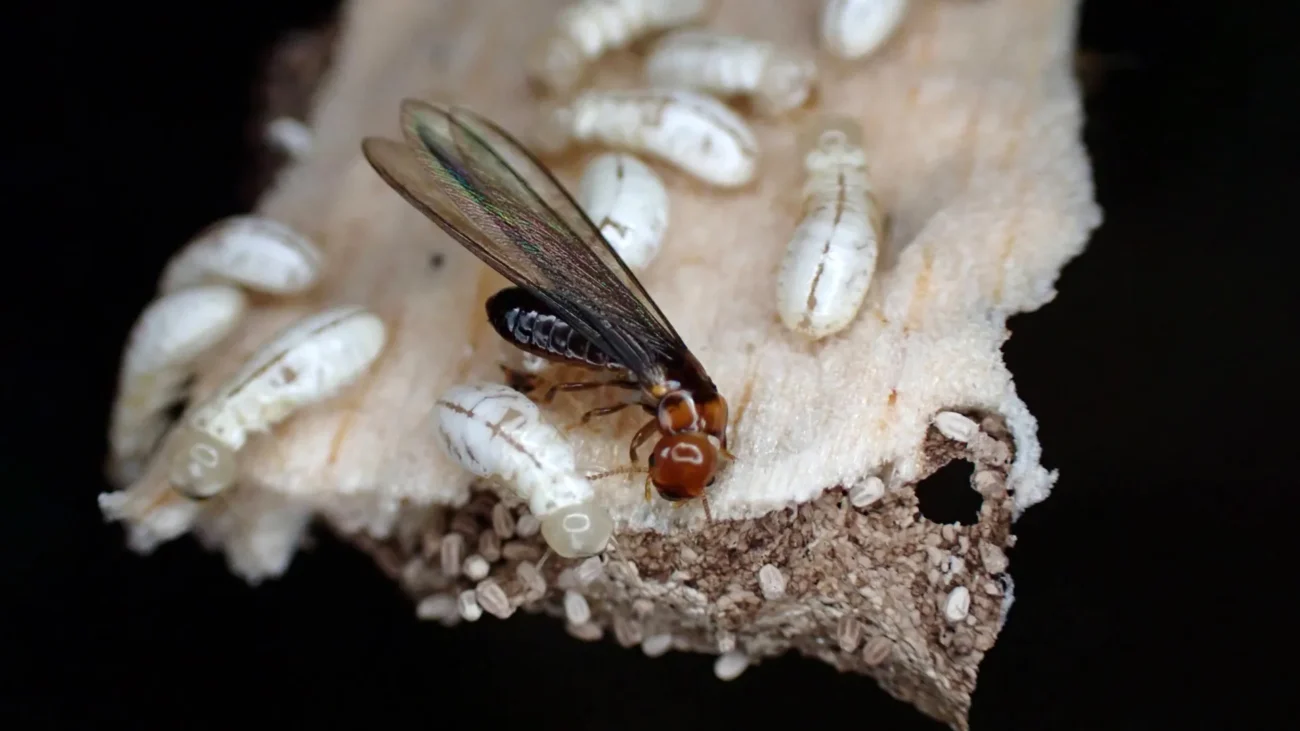
Drywood termites have long posed a formidable challenge to homeowners and structural engineers alike due to their remarkable ability to remain concealed within the very materials they consume. Unlike subterranean termites, which require constant moisture from the soil and construct visible mud tubes to travel back and forth, drywood termites live entirely within the confines of beams, framing, structural lumber, and antique furniture. They slowly carve out complex internal galleries as colonies mature, leaving the outer shell of the wood seemingly intact. This elusive existence allows infestations to go completely unnoticed for years until significant structural damage has already occurred, complicating both detection and eradication efforts.
However, recent scientific breakthroughs out of the University of California, Riverside (UCR) are shifting the paradigm of pest management. By capitalizing on the fundamental biology, social habits, and microscopic traces left behind by western drywood termites, entomologists are developing precision-targeted strategies that could eventually offer homeowners viable alternatives to disruptive whole-structure fumigations.
Unveiling a Chitin-Targeted Vulnerability
The core of the UCR breakthrough lies in exploiting an unavoidable biological requirement for all growing insects: the need to molt. Published in the Journal of Economic Entomology, a pivotal 2025 study led by doctoral student and corresponding author Nicholas Poulos, alongside senior author and entomology professor Dong-Hwan Choe, demonstrated that the insect growth regulator bistrifluron can eliminate western drywood termites with extraordinary efficiency.
Bistrifluron belongs to a class of chemical compounds known as chitin synthesis inhibitors. Unlike conventional, fast-acting neurotoxins that strike down insects immediately, bistrifluron targets the formation of chitin—a durable, natural polysaccharide that forms the backbone of insect exoskeletons. While humans and other mammals possess internal skeletal systems, insects rely entirely on their rigid outer armor for physical protection and as sturdy attachment points for their muscles.
For a growing drywood termite, this protective covering cannot stretch indefinitely. Throughout their life cycle, these insects must molt approximately seven times, shedding their old, restrictive exoskeleton and replacing it with a larger one. Bistrifluron transforms this mandatory biological process into a fatal trap.
"Once the termites reach a certain stage, they have to molt. They cannot avoid that," Professor Choe explained. "With a lethal dose of this chemical, they’ll try to shed their old exoskeleton but won’t have a new one ready to protect them."
In controlled laboratory trials, the results were striking. When termites were given a choice between treated and untreated wood, bistrifluron produced a 95.7 percent mortality rate. When subjects faced continuous, uninterrupted exposure to treated wood, mortality rates climbed to approximately 99 percent. Furthermore, the chemical profile offers a distinct environmental advantage over legacy treatments. Because chitin is fundamentally unique to invertebrates and fungi, bistrifluron is highly specific to insects and poses no harm to humans or other mammals, marking a significant step forward in eco-friendly pest control design.
The Power of Delayed Action and Social Translocation
One of the most counterintuitive yet critical findings of the UCR research is that bistrifluron does not kill immediately. Initially, researchers observed declines in overall colony activity and feeding habits as the insects marched steadily toward their scheduled molt, only to experience catastrophic failure during the shedding process.
Rather than being a drawback, this delayed action is precisely what makes the compound so effective against social insects. A fast-acting poison would quickly kill any termite that comes into direct contact with it, effectively neutralizing the threat before the chemical could be shared. A slow-acting growth regulator, however, grants contaminated individuals ample time to travel back into the heart of the colony and interact with their nestmates.
Termites are exceptionally cooperative creatures that routinely share food and vital nutrients through mutual grooming and trophallaxis. To track how substances move through a colony, the UCR team utilized colored food dyes during their experiments. The results revealed that within 24 to 48 hours, material ingested or encountered by a small fraction of the colony had successfully reached previously unexposed nestmates.
The implications of this social transference are profound. In laboratory trials, when a mere 5 percent of a termite group was initially exposed to bistrifluron, the entire colony reached 100 percent mortality by day 90. Groups where 50 percent of the population was exposed exhibited a similarly devastating survival collapse.
This mechanism is further reinforced by unique behaviors documented by the UCR research team. In 2026, researchers published detailed imagery and video capturing western drywood termites performing proctodeal trophallaxis—a specialized feeding behavior wherein one individual receives nutritional material and vital gut microbes directly from another’s hindgut. While this intense cooperation is normally the primary driver of colony survival and wood digestion, pest management specialists can now weaponize this behavior to drive localized treatments deep into otherwise inaccessible nesting sites.
Luring Termites Toward Precise Interventions
Bistrifluron is only one component of a broader, multi-pronged initiative at UCR aimed at refining targeted pest eradication. Recognizing that even the best chemical agents are useless if pests fail to encounter them, the laboratory has simultaneously investigated the role of natural chemical attractants.
In previous work highlighted in 2024, researchers explored pinene, a naturally occurring fragrant compound emitted by many trees. To a western drywood termite burrowing deep within structural lumber, the scent of pinene acts as an environmental beacon, signaling an attractive feeding ground.
By strategically combining pinene with localized insecticide applications—such as aqueous fipronil—researchers dramatically enhanced treatment efficacy. While standard insecticide applications alone yielded roughly 70 percent mortality rates, the addition of pinene elevated those rates to over 95 percent by actively drawing termites away from hidden clusters and directly into localized poison deposits.
This concept moved closer to commercial viability with a University of California patent application filed in April 2025 and published later that October. The application details the inclusion of alpha-pinene or beta-pinene into localized insecticide injection protocols for western drywood termites. If successfully commercialized, this method could allow pest control technicians to space treatment holes significantly farther apart, cutting down on labor costs and reducing the overall volume of chemical agents required to achieve total colony eradication.
Tackling Practical Obstacles: Application and Detection
Despite promising laboratory data, significant hurdles remain before these innovations can be widely deployed in residential settings. In the experimental phase, researchers dissolved bistrifluron in acetone, allowing the solvent to evaporate before introducing the insects. While ideal for controlled laboratory settings, acetone’s high flammability and potent chemical odor render it unsuitable for routine household applications.
"We are working to make it more feasible for practical application in real-life scenarios," noted Poulos, emphasizing that formulation chemistry is the necessary next step to bridge the gap between academic discovery and commercial pest management.
Beyond chemical formulation, effective termite control has always hinged on accurate diagnosis. Technicians must answer a deceptively simple question: Are termites currently active in this structure?
Drywood termites routinely eject tiny, hard, hexagonal fecal pellets from their galleries, creating piles that immediately alert homeowners to a potential infestation. However, these pellets can persist inside wall voids and framing for years after a colony has naturally died out or been eradicated. Relying solely on the presence of droppings often leads to unnecessary, costly, and disruptive treatments.
Addressing this diagnostic bottleneck, subsequent research by the UCR team investigated the microscopic biome of termite droppings. Poulos and his colleagues analyzed fresh fecal pellets alongside samples aged for three months, six months, and one year. Their findings revealed an extraordinary decline in bacterial DNA as the pellets aged. In samples derived from termites feeding on natural hardwoods and Douglas fir—a common framing material—bacterial signatures dropped by as much as 190-fold over a 12-month period.
Furthermore, researchers identified five specific bacterial families consistently present in fresh Douglas fir-derived pellets that vanished entirely after predetermined aging milestones. These discoveries lay the foundation for developing rapid diagnostic tools, such as microbial assays, that would allow pest control professionals to verify active infestations before applying localized treatments like bistrifluron.
Global Implications and the Future of Pest Control
The urgency driving these research efforts extends far beyond California. While the western drywood termite (Incisitermes minor) is native to the southwestern United States and northwestern Mexico, global trade and the movement of lumber, antique furniture, and wooden packaging materials have facilitated its spread to far-flung regions. Established introduced populations have already been documented in Hawaii, Florida, New York, parts of Canada, China, Japan, South Korea, and Australia.
As global climate patterns shift and international trade continues to expand, these resilient insects find hospitable microclimates in increasingly diverse territories. Because their entire life cycle unfolds in total seclusion behind walls and inside foundational beams, preventing their transnational spread remains an extraordinary logistical challenge.
For decades, structural fumigation—tenting an entire building and pumping it full of gas—has remained the gold standard for heavy infestations. While undeniably effective at reaching every corner of a structure, fumigation carries notable drawbacks: residents must temporarily relocate, food items must be meticulously sealed or removed, the process is expensive, and it leaves behind zero residual protection against future infestations arriving days or months later.
The collective findings emerging from UCR suggest a fundamental shift in how the pest control industry may operate in the coming decades. By pairing microbial diagnostic tools to confirm active infestations with eco-friendly chitin synthesis inhibitors like bistrifluron, and enhancing localized bait stations with natural attractants like pinene, science is moving away from broad-spectrum disruption and toward precision biology.
While laboratory trials must still be scaled and translated into robust, commercially viable residential products, the trajectory is clear. For an insect species that has perfected the art of hiding in plain sight, researchers are steadily dismantling the biological shields that kept them safe for centuries.

