


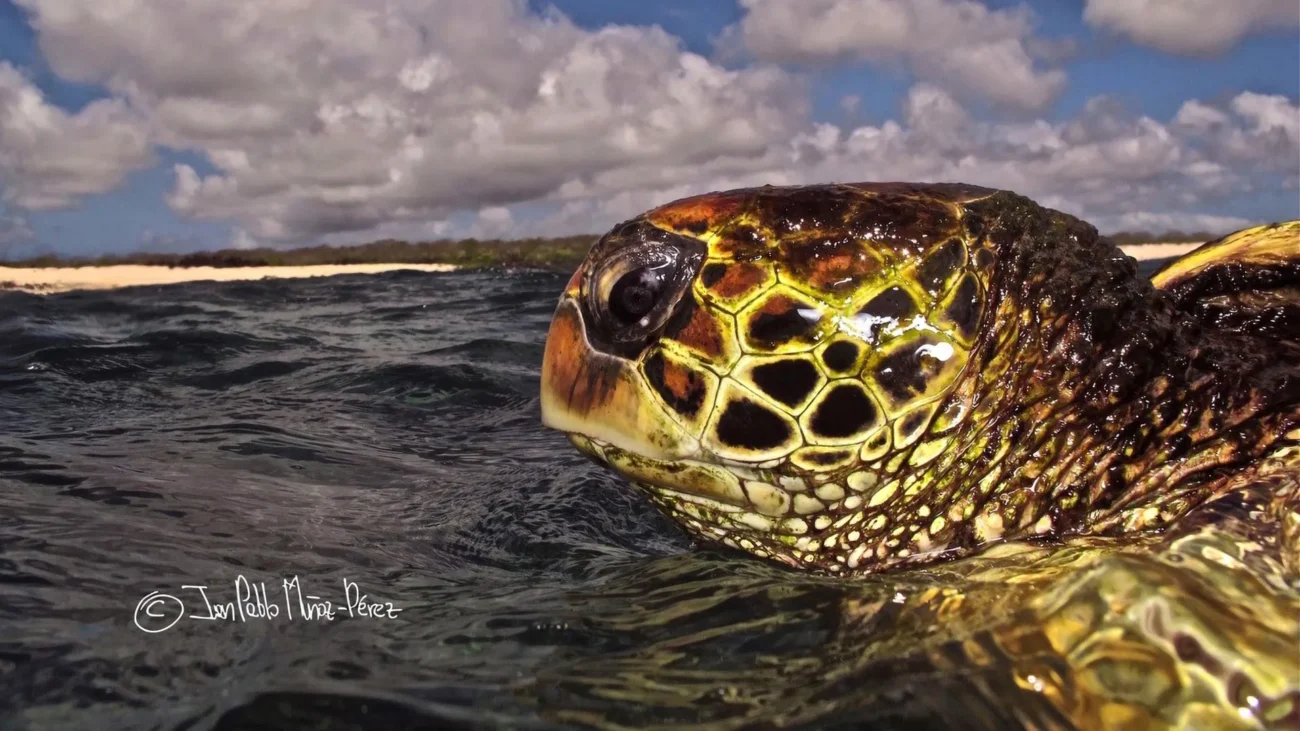
For centuries, sea turtles have captured the imagination of marine biologists and oceanographers alike due to their legendary, epic transoceanic migrations. These ancient mariners are widely celebrated for navigating thousands of miles across vast, open expanses of the world’s oceans, utilizing a sophisticated biological compass that relies on the Earth’s geomagnetic field, the position of the sun, and shifting ocean currents. They endure these exhausting journeys primarily to forage in nutrient-rich waters before returning with astonishing precision to the exact beaches where they hatched decades prior to reproduce.
However, a groundbreaking three-year study published in the journal Frontiers in Amphibian and Reptile Science has upended these long-held assumptions regarding one specific population. Researchers tracking "yellow-morph" green sea turtles in the Galápagos Islands discovered a startling behavioral anomaly: rather than undertaking massive, ocean-crossing voyages, these particular animals are remarkably homebound, spending the vast majority of their time navigating the shallow coastal waters of a single island or a tightly clustered local archipelago.
The findings not only challenge the universality of sea turtle migration paradigms but also provide critical insights that could fundamentally reshape marine conservation strategies within the 198,000-square-kilometer Galápagos Marine Reserve.
Two Distinct Forms in a Unique Evolutionary Melting Pot
To understand the magnitude of this discovery, it is essential to examine the unique biology and taxonomy of the green sea turtle (Chelonia mydas). Among the seven extant species of sea turtles, adults of this species stand out for their predominantly vegetarian diet. While juveniles begin life as opportunistic omnivores—consuming a mix of small marine invertebrates and plant matter—they undergo a distinct dietary shift as they mature, transitioning into herbivores that feed primarily on seagrasses, marine algae, and macroalgae.
Within this species, scientists recognize two genetically distinct forms, or morphs, that frequent the Pacific Ocean:
- Yellow-Morph Green Sea Turtles: Typically distributed across the tropical and subtropical regions of the western Pacific.
- Black-Morph Green Sea Turtles: Predominantly found in the eastern Pacific, ranging west of the Americas and south of Southern California.
The volcanic isolation of the Galápagos archipelago serves as a unique ecological intersection. It is the only known location on Earth where these two genetically distinct forms inhabit the exact same marine waters. Here, yellow and black morphs mingle freely in shallow coastal zones, grazing side-by-side on the same varieties of benthic vegetation.
Despite their overlapping habitats and shared dietary preferences, the two morphs are not identical. Researchers have observed that juvenile yellow morphs exhibit significantly faster growth rates than their black-morph counterparts. This physiological divergence hints at underlying metabolic or genetic differences that marine scientists are only beginning to decode and understand.
Chronology of the Galápagos Tracking Project
To pierce the veil of mystery surrounding the elusive yellow morphs, an international team of researchers—led by Dr. John W. Rowe, a professor of biology at Alma College in the United States, and co-author Dr. Juan Pablo Muñoz Pérez of the Universidad San Francisco de Quito in Ecuador—embarked on a comprehensive telemetry project.
The investigative timeline unfolded across several distinct phases:
- 2015 Field Expedition: In an effort to map spatial ecology and habitat utilization, researchers carefully captured nine adult yellow-morph green sea turtles in shallow coastal waters surrounding four distinct islands within the Galápagos archipelago. The cohort comprised seven males and two females.
- Tagging and Telemetry Deployment: Each turtle was assigned a unique research nickname and fitted with advanced electronic satellite transmitters. These tracking devices were secured to the carapace, designed to relay precise spatial coordinates via the low-orbit Argos satellite network whenever the animals surfaced for air.
- The Monitoring Window (2015–2018): The tracked individuals were monitored continuously for varying durations, with the longest continuous tracking dataset extending up to 418 days. Individual tracking timelines naturally concluded when tags eventually detached due to natural wear or stopped transmitting signals.
- Data Synthesis and Analysis: Spanning a three-year observation period, the spatial data was collated to evaluate home ranges, inter-island movement patterns, and adherence to the boundaries of the expansive Galápagos Marine Reserve.
Revealing Data: Homebodies in an Ocean of Wanderers
The results of the telemetry tracking produced data that consistently surprised the research team. Conventional wisdom dictated that these animals would eventually embark on pelagic journeys away from the islands. Instead, the satellite transmissions painted a picture of localized residency.
None of the nine satellite-tagged yellow-morph turtles left the boundaries of the Galápagos Marine Reserve during the multi-year study. Instead, they demonstrated a profound affinity for shallow coastal habitats. While occasional foraging forays took individuals as far as 25 kilometers offshore, the vast majority of their time was spent lingering in the nearshore shallows where benthic algae thrive.
The spatial distribution of the cohort varied by individual, highlighting diverse behavioral personalities within the population:
- Site-Specific Fidelity: Five of the nine turtles spent nearly the entirety of the tracking period anchored to the waters surrounding a single island.
- Inter-Island Commuters: Turtles named Bernardo and Sara regularly transited between the marine corridors of Isabela and San Cristóbal islands. Meanwhile, Leandro was tracked moving between the shores of Isabela and Española.
- The Explorer: The most mobile individual of the cohort was an adult female named Ainoa. Initially tagged near San Cristóbal, Ainoa subsequently journeyed to Santa Cruz before ultimately establishing temporary residency near Isabela.
Furthermore, the research team identified a subtle seasonal rhythm governing these movements. Displacements and transit between different islands occurred exclusively during the cooler oceanic period, which spans from April through October. On average, each individual utilized an expansive home range covering approximately 1,498 square kilometers, though the absolute size of these territories fluctuated considerably from animal to animal.
Expert Analysis and Official Perspectives
The empirical findings have forced scientists to re-evaluate the life-history models traditionally applied to Pacific sea turtles. Dr. John W. Rowe emphasized the unexpected nature of the behavioral data during the study’s release.
"Here we show that ‘yellow-morph’ green sea turtles—one of two genetically distinct forms—occupy individual foraging areas which span one or more islands in the Galápagos," Dr. Rowe stated. "We expected them to migrate to distant beaches in the western Pacific to reproduce, yet interestingly, none of our satellite-tagged turtles even left the Galápagos Marine Reserve over the three years of our study."
Despite these robust local datasets, the researchers remain cautious about generalizing their findings to encompass the entirety of a turtle’s life cycle. They note that the study captured a specific temporal window, and longer migrations could potentially occur during life stages or seasonal phases not covered by the three-year tracking project.
This caveat applies particularly to female yellow morphs. Because female yellow-morph green sea turtles have never been documented nesting on the sandy beaches of the Galápagos, scientists infer that they must eventually undertake monumental reproductive migrations.
Co-author Dr. Juan Pablo Muñoz Pérez elaborated on this ecological dichotomy: "Since female yellow-morph green sea turtles are not known to lay eggs on the beaches of the Galápagos, we believe that they will eventually leave the area to return to their natal beaches in the western Pacific. In contrast, some female black-morph green turtles do nest in the Galápagos: depending on the individual, those may be year-round residents in the archipelago, travel to other nearby oceanic islands, or even to feeding grounds off Central and South America."
Broader Conservation Implications and Future Policy
The revelation that yellow-morph green sea turtles rely heavily on interconnected, multi-island home ranges carries profound implications for conservation management and marine spatial planning.
For decades, conservation frameworks in archipelago environments have often focused on establishing isolated marine protected areas around single, high-density nesting or feeding hotspots. However, the Galápagos tracking data demonstrates that individual turtles frequently commute across deep channels between distinct islands to access their preferred foraging grounds. Consequently, protecting a single localized feeding zone is entirely insufficient to safeguard these populations.
Environmental policymakers and conservationists are now urged to adopt an integrated, network-based approach to marine preservation. This strategy necessitates maintaining high habitat quality across entire marine corridors, rather than treating individual island ecosystems as isolated ecological units.
"Since individual turtles may rely on waters around multiple islands, the quality of habitat that is available for foraging should be maintained intact across all islands, and not allowed to degrade anywhere," Dr. Rowe warned.
As human pressures—including commercial maritime traffic, climate-induced shifts in ocean temperatures, and coastal degradation—continue to mount across the globe’s oceans, understanding the fine-scale movements of marine megafauna is more critical than ever. The sedentary secrets uncovered in the Galápagos serve as a powerful reminder that nature continually defies our broad generalizations, requiring localized, empirical science to ensure the survival of our planet’s most iconic migratory species.

