


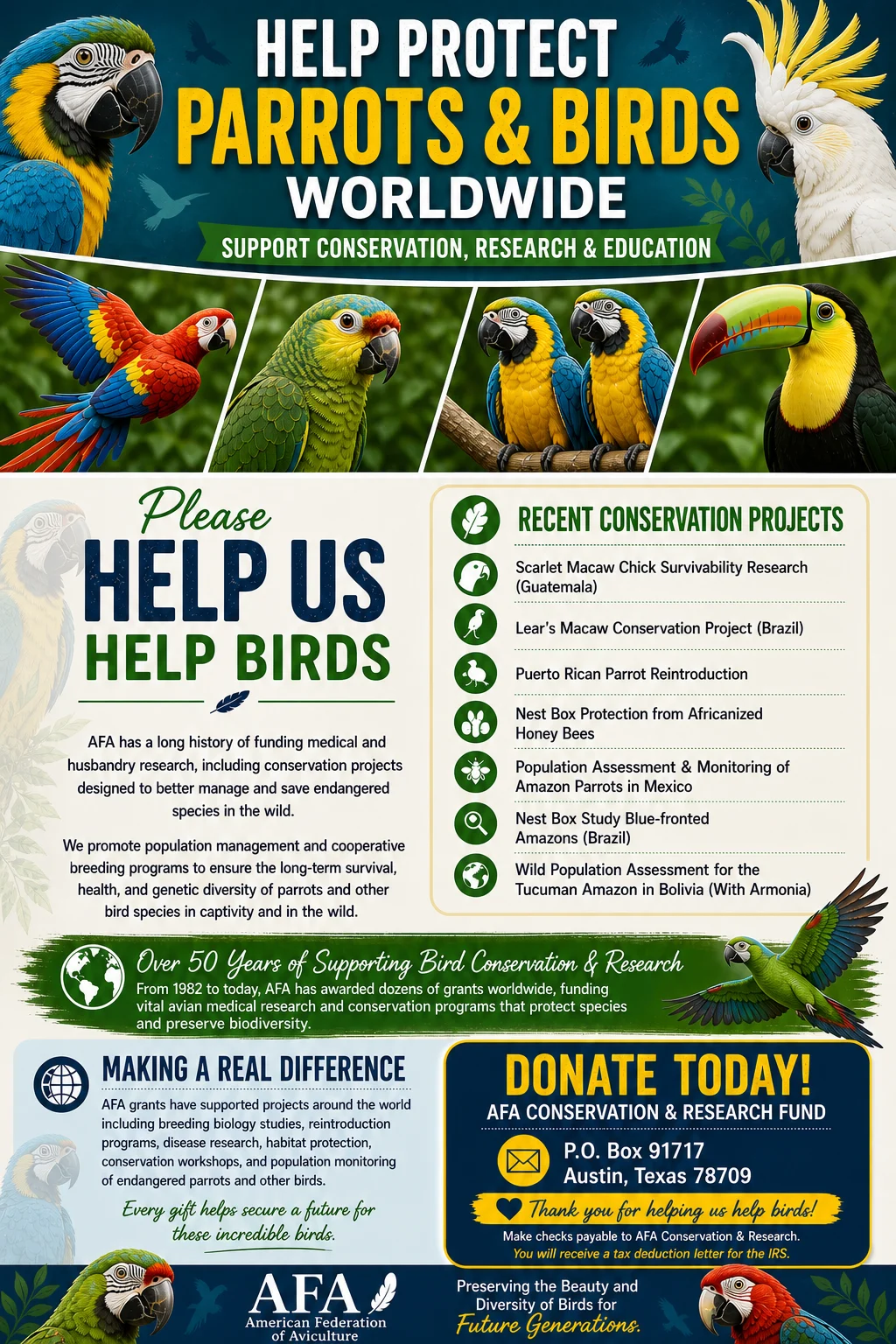
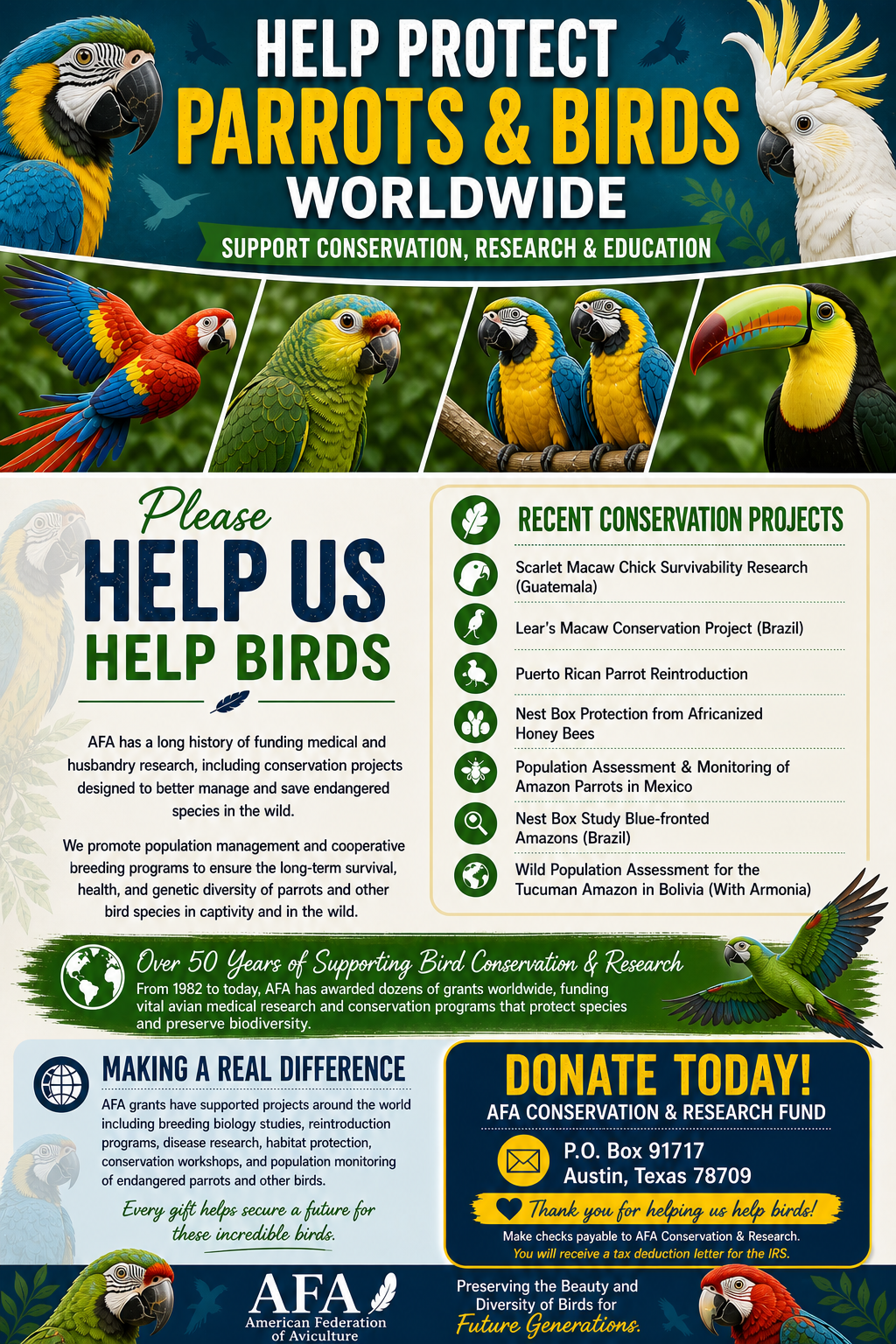
The American Federation of Aviculture (AFA), a prominent non-profit educational organization incorporated in California with its administrative headquarters in Austin, Texas, continues to expand its multifaceted conservation, research, and regulatory oversight initiatives. Established in March 1974 in response to restrictive state legislation prompted by an Exotic Newcastle Disease outbreak that led to the euthanization of thousands of healthy birds in California, the AFA has evolved into an international avicultural umbrella organization. Today, it unites individual members worldwide alongside numerous affiliated bird clubs representing thousands of aviculturists. Through targeted financial grants, strategic corporate partnerships, Cooperative Breeding Programs (CBPs), and active engagement with international trade frameworks, the organization remains dedicated to ensuring the long-term, self-sustaining populations of exotic birds both in captivity and within their native wild habitats.
Financial Backing and Strategic Conservation Partnerships
A cornerstone of the AFA’s current conservation strategy is its ongoing collaboration with Harrison’s Bird Foods, a leading avian nutrition company. In a major boost to field conservation efforts, representatives of Harrison’s Bird Foods formally presented AFA Chief Financial Officer Janice Lang with a $25,000 contribution to support wild parrot conservation projects. This generous funding underpins the AFA’s small grant program, which directly assists field research, habitat preservation, and species recovery initiatives taking place in native ecosystems.
The AFA Conservation Committee reviews project inquiries and grant proposals annually to ensure alignment with the organization’s foundational mission: to promote the advancement of aviculture through educational programs supporting improved breeding and husbandry practices, optimized living conditions for exotic birds, active conservation, scientific research, and legislative awareness. Individuals or organizations seeking small grants for wild parrot conservation projects are invited to submit their project information and funding requests to the AFA office via email at [email protected]. Furthermore, entities interested in becoming recognized AFA Conservation Partners—with acknowledgments featured in the AFA Watchbird Journal and on the organization’s official website—may contact Rick Jordan through the designated administrative email.
Chronology of Field Conservation and Research Projects
The AFA’s financial support and member contributions directly sustain several high-impact field biology and conservation projects globally. These initiatives target critical ecological challenges, ranging from nest poaching and habitat degradation to invasive species and physiological health assessments.
Chajul Biology Station, Natura Mexicana (Chajul, Mexico)
Serving as the official AFA Conservation Project, the Chajul Biology Station operates within the Lacandon rain forest of southern Mexico to protect wild scarlet macaws (Ara macao). Historically, rampant poaching for local and international wildlife trade drove nest production of wild scarlet macaws in this region near a zero percent fledgling rate without active intervention. Station biologists actively monitor wild nests, identify hatchlings, and engage in head-starting programs that involve rearing and subsequently releasing wild-hatched scarlet macaws back into their native forest canopy. The program has achieved high success rates, successfully fledging over 150 scarlet macaws into the wild. To sustain these efforts, station biologists rely on specialized field equipment, including stationary and portable incubators, brooders, gram scales, and various medical supplies. The fundraising objective focuses on procuring these vital resources to maintain high survival rates for fledgling populations.
Selva Maya Living Landscape Program, Wildlife Conservation Society (Guatemala)
Since 2002, the Wildlife Conservation Society (WCS) has worked within the Maya Biosphere Reserve to evaluate the conservation status of scarlet macaws and mitigate primary threats to their native habitat. Recognizing scarlet macaws as one of the top five landscape species of the Selva Maya Living Landscape Program, WCS implements a combination of threat-based interventions and direct population enhancements. Recent initiatives involve experimental techniques designed to boost recruitment rates by directly increasing chick survivability in the wild.
Invasive Species Mitigation: Africanized Honey Bee Defense Protocol
Habitat loss frequently intersects with biological competition, notably through the colonization of natural and artificial parrot nest boxes by Africanized honey bees (Apis mellifera scutellata). Principal Investigator Caroline A. Efstathion has developed an innovative "push-pull" prevention protocol to mitigate this threat. The method repels scouting bees from avian nest boxes using a bird-safe insecticide, permethrin, while simultaneously drawing them toward pheromone-baited traps. By deploying alternative nesting structures optimized for honey bee preferences—featuring small entrance openings, bottom entrances, and south-facing orientations—coupled with Nasonov pheromone attractants, researchers successfully divert swarms away from vulnerable psittacine nests. Supported primarily through donations, this protocol aims to establish standardized management practices that can be adopted globally by conservationists without ongoing external assistance.
Physiological and Veterinary Research in the Tambopata Region (Peru)
Understanding the foundational health parameters of free-flighted and nestling parrots is vital for both field conservation and veterinary medicine. Principal Investigators J. Jill Heatley, Lizzie Ortiz-cam, and Donald Brightsmith conduct comprehensive health evaluations of wild macaws and parrots within the Tambopata Region of Peru. Utilizing field-side i-STAT analyzers, researchers gather critical physiological baseline data, including electrolytes, venous blood gases, lactate, and ionized calcium for growing nestlings and adult birds. Simultaneously, complete blood counts, differential white blood cell determinations, and parasite evaluations are performed.
This research sheds light on ecological mysteries, such as the underlying motivations for parrots consuming mineral-rich clay at natural licks, theorized to provide essential electrolytes or neutralize dietary toxins. While basic blood gas and electrolyte data have been compiled, current fundraising efforts target the employment of a dedicated, trained student worker to analyze over 1,000 blood smear slides transported from Tambopata, enabling the finalization of comprehensive white blood cell differentials.

Specialized International Subsidy and Ecological Monitoring Programs
In addition to direct medical and habitat interventions, the AFA continues its long-standing support for specialized regional programs:
- Lear’s Macaw Corn Subsidy Program: Partnering with local agricultural operations in Brazil to provide corn subsidies to farms experiencing crop depredation by wild Lear’s macaws (Anodorhynchus leari), thereby mitigating human-wildlife conflict and discouraging retaliatory actions against the endangered birds.
- Tambopata Macaw Project: Providing continuous funding to collect extensive nutritional, nesting, behavioral, and ecological data on macaw populations within the Tambopata National Reserve.
Regulatory Frameworks: CITES, the Wild Bird Conservation Act, and the Endangered Species Act
Operating at the intersection of international trade, domestic legislation, and avicultural practice, the AFA maintains rigorous oversight committees to navigate complex legal structures governing exotic birds.
The Convention on International Trade in Endangered Species (CITES)
The AFA CITES Committee actively monitors and participates in CITES Conferences of the Parties and Animals Committee meetings. Recognized by the U.S. Fish and Wildlife Service (USFWS) and international bodies through non-governmental observer (NGO) status, the AFA provides vital ground-level avicultural data to govern the international trade of wildlife. CITES categorizes species across three appendices based on threat levels: Appendix I includes species threatened with extinction, prohibiting commercial international trade; Appendix II includes species not necessarily threatened with extinction but subject to strict trade controls to prevent incompatible utilization; and Appendix III includes species protected in at least one country that has requested international cooperation in controlling trade.

The Wild Bird Conservation Act (WBCA) of 1992
Signed into law on October 23, 1992, the WBCA imposed a moratorium on the commercial importation of most wild-caught exotic birds into the United States, effectively halting the mass importation of psittacines for the pet trade. While initially covering CITES Appendix I and II species, subsequent legal challenges extended restrictions to all CITES-listed parrots.
To prevent the total stagnation of genetic diversity within domestic aviculture, the WBCA incorporates two explicit exemptions:
- Cooperative Breeding Programs (CBPs): Avicultural groups or clubs may design structured breeding programs approved by the USFWS to import limited numbers of restricted species as breeding stock. These programs require strict adherence to genetic management protocols, a prohibition on commercial resale of imported foundation stock, and mandatory biannual status reports submitted to the USFWS. Historically and presently, the AFA has served as the official overseer for numerous USFWS-approved CBPs, including the Red Siskin, Blue-headed Macaw, Javan Hill Mynah, Pyrrhura Conure, Red-crested Cardinal, and the current Blue-eyed Cockatoo CBP (which encompasses several black cockatoo species such as the Gang-gang, Red-tailed Black, Yellow-tailed Black, and Glossy Black cockatoos).
- The "Clean List" (WBCA Exempt Species): Title 50, Part 15, Subsection 15.33 of the Code of Federal Regulations maintains a specific list of captive-bred exotic bird species—such as Budgerigars, Cockatiels, Peach-faced Lovebirds, and specific rosellas and parakeets—that are widely established in global aviculture and may be imported without CBP restrictions, provided they are documented as captive-bred and not wild-harvested.
The U.S. Endangered Species Act (ESA) of 1973
Enacted on December 28, 1973, under President Richard Nixon, the ESA protects critically endangered domestic and exotic species from extinction resulting from habitat loss and commercial exploitation. For aviculturists within the United States, possessing legally acquired ESA-listed exotic bird species generally does not require a federal permit unless individuals engage in interstate commerce (buying, selling, or bartering across state lines). For interstate commercial transactions involving listed species, aviculturists must secure specific federal authorizations, such as an Interstate Commerce Permit or a Captive-bred Wildlife (CBW) registration from the USFWS. Even-trades of offspring between breeders across state lines are exempt from permit requirements provided appropriate documentation accompanies the transfer. However, state-level regulations may impose stricter controls, with several states incorporating federal ESA lists into their internal restricted species statutes.
Implications and Future Outlook
The comprehensive scope of the American Federation of Aviculture illustrates a balanced approach to modern aviculture, intertwining rigorous regulatory compliance with proactive field conservation. By channeling financial resources from corporate partners like Harrison’s Bird Foods into targeted field projects—ranging from scarlet macaw nest protection in Mexico and anti-bee protocols to physiological assessments in Peru—the AFA bridges the gap between captive bird management and wild population recovery. As international trade regulations and domestic environmental laws continue to evolve, the AFA’s active engagement ensures that aviculturists remain informed, compliant participants in the global preservation of avian biodiversity.

