


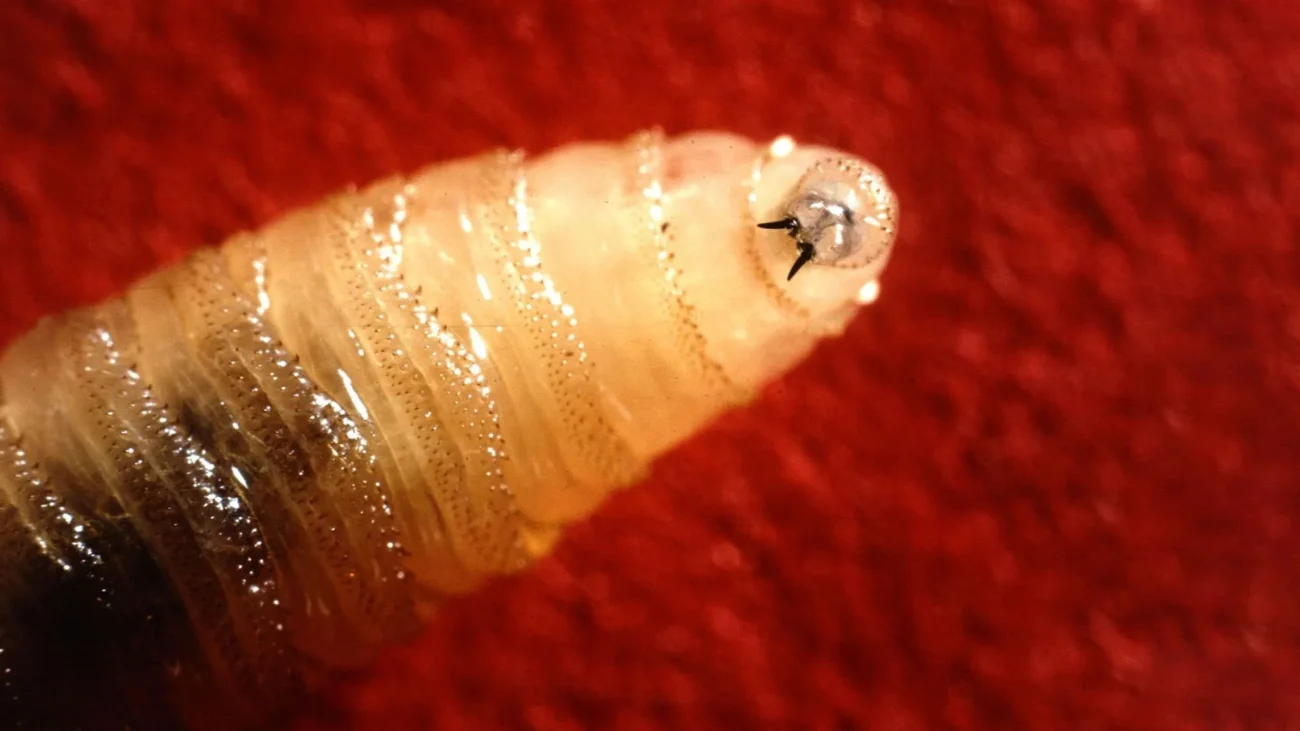
In the 1950s, the New World screwworm (Cochliomyia hominivorax) stood as one of the most devastating biological threats to American agriculture. Across the American Southwest alone, this parasitic pest inflicted staggering annual losses ranging from $50 million to $100 million—figures that would equal hundreds of millions of dollars today. The damage was not merely economic; it represented a profound welfare crisis for livestock producers, rural communities, and wildlife populations as millions of cattle, sheep, and other warm-blooded animals suffered from severe, often fatal, parasitic infestations.
This historic crisis prompted a massive, decades-long eradication campaign that eventually pushed the screwworm’s range thousands of miles south, ultimately establishing a secure biological barrier in Panama. For generations, U.S. livestock producers operated free from the constant shadow of the flesh-eating fly.
Now, decades later, that hard-won victory is under siege. The New World screwworm has steadily marched north, crossing international borders and officially reestablishing a presence in parts of Texas and New Mexico. This modern return has triggered alarm bells across agricultural, veterinary, and public health sectors. While livestock remain the primary economic concern, the parasite poses a documented hazard to native wildlife, domestic pets, and, in rare instances, human beings.
In response to this rapidly escalating threat, researchers at the University of California San Diego (UC San Diego), working in close collaboration with the County of San Diego Health and Human Services Agency (HHSA) Public Health Services, have engineered an advanced, data-driven tracking tool. Designed to forecast where the parasite might strike next, this innovative digital dashboard represents a critical first line of defense in an era of shifting ecological and climatic realities.
The Anatomy of a Biological Threat
To understand the urgency driving public health officials, one must examine the unique and aggressive biology of the New World screwworm. Unlike the vast majority of fly larvae, or maggots, which feed exclusively on dead, decaying, or necrotic organic matter, the screwworm larva is an obligate parasite of living tissue.
The life cycle begins when an adult female fly, seeking a host, deposits her eggs along the edges of open wounds, cuts, or natural mucous membranes of warm-blooded mammals and birds. Within a relatively short window, the eggs hatch into voracious larvae that immediately burrow directly into healthy, living flesh. As the parasites feed, they secrete enzymes that liquefy tissue, deepening and widening the wound. This process not only causes excruciating pain and systemic shock to the host but also creates an open entryway for secondary bacterial and fungal infections.
Without rapid veterinary or medical intervention, severe infestations can quickly turn fatal, particularly for young livestock, newborn calves, and vulnerable wildlife. While human infections remain historically rare, they are entirely possible if an adult female fly deposits eggs near an open human cut or a mucosal opening. Once embedded, the larvae must be manually and meticulously extracted by medical professionals to halt tissue destruction.
The pest’s capacity for rapid geographic expansion compounds the danger. Adult flies are remarkably strong fliers capable of covering significant distances in search of hosts and breeding grounds. Furthermore, the modern globalized movement of livestock, domestic pets, and exotic animals can inadvertently transport the parasite across state and international lines, bypassing traditional geographic boundaries.
A Race Against Time: Developing the Screwworm Risk Dashboard
Recognizing that traditional public health surveillance systems often move too slowly to contain fast-moving vector-borne threats, local health authorities turned to the academic sector for a technological solution.
"Our County public health partners alerted us to the need for better situational awareness of New World screwworm," explained Dr. Eliah Aronoff-Spencer, a professor of medicine at the UC San Diego School of Medicine and an affiliate member of the UC San Diego Design Lab and Qualcomm Institute. "We built a dashboard to generate regional risk profiles. This is just one example of how we are responding to County needs with a focus on real-world issues. It’s a model that has brought us great success, like the Tijuana River Crisis Environmental Dashboard."
The newly developed tracking dashboard serves as a sophisticated aggregation engine. It synthesizes multiple streams of complex data, including officially confirmed veterinary detections, local environmental and climatic conditions that favor the fly’s survival and reproduction, and real-time reports harvested from the global news media.
Currently, access to the dashboard is restricted to authorized public health officials, agricultural regulators, and project partners directly involved in containment efforts. However, developers have expressed an intention to eventually roll out a modified, public-facing iteration to keep rural communities and livestock owners informed.
A particularly novel feature of the UC San Diego tool is its integration of media monitoring. While traditional public health reporting requires laboratory confirmation—a process that routinely consumes days or weeks—news reports and local media dispatches often capture anomalous events, unconfirmed local sightings, or early-stage warnings long before official databases are updated.
Dr. Seema Shah, medical director of the Epidemiology and Immunization Services Branch for the County of San Diego’s Public Health Services Department, highlighted the inclusion of media intelligence as a major leap forward. "Traditional reporting mechanisms for public health are often delayed," Dr. Shah noted. "Lab confirmation can take days or weeks. By incorporating media reports, we can identify potential threats sooner and stay one step ahead."
This proactive posture is echoed by Dr. Mark Beatty, assistant medical director for the County’s Epidemiology and Immunization Services Branch. "The tool gives you a sense of where you might expect to see cases next," Dr. Beatty said. "That’s helpful in determining how we should be preparing. Is the threat imminent, or do we have six months? We’re in a very concerning phase right now, and the tool backs that up."
Dr. Beatty acknowledged that the speed of the pest’s northern migration caught experts off guard. "We knew in 2023 that New World screwworm was going to move northward, but I wasn’t expecting it to move as fast as it has," he admitted. "Although the source of the infections in the U.S. is still under investigation, the fact that it’s in the U.S. is 100% clear. Once it entered Texas, we quickly saw an increase in detections. It’s in a place where it used to live, so it’s not surprising it’s taking a hold again."
Historical Precedent: Reviving the Sterile Insect Technique
The return of the screwworm is alarming, but it is not an insurmountable crisis. The United States possesses a proven, highly successful blueprint for defeating the parasite.
During the mid-20th century, agricultural scientists developed one of the most monumental biological control campaigns in human history: the sterile insect technique (SIT). Recognizing that female screwworm flies mate only once or twice in their lifespans, researchers mass-reared millions of male screwworm flies in laboratories and sterilized them using gamma radiation. These sterile males were then dispersed by air over infested regions.
When wild female flies mated with the sterile laboratory-reared males, the resulting eggs failed to hatch. By continuously flooding the wild population with sterile insects, scientists dramatically drove down reproductive rates until the wild population collapsed entirely, driving the pest out of the United States and far to the south.
Today, federal agricultural authorities are reviving and modernizing this classic strategy. The U.S. Department of Agriculture (USDA) is spearheading a comprehensive eradication campaign that integrates aerial releases of sterile flies, targeted chemical pesticide applications, and strict animal quarantines designed to halt the transit of potentially infested livestock.
Simultaneously, federal regulators are reviewing applications for the deployment of a genetically modified, all-male strain of screwworm currently undergoing rigorous field testing. Concurrently, academic teams at UC San Diego are engineering next-generation biotechnological and genetic tools to enhance future eradication capabilities.
Dr. Emily Trumbull, a veterinarian and lead for the Epidemiology Unit’s One Health Program within the California Department of Food and Agriculture, emphasized the critical importance of cross-sector collaboration in stopping the spread. "We are working closely with the California Department of Food and Agriculture to connect local veterinarians with screwworm resources for surveillance in our region," Dr. Trumbull stated. "The flies can affect any warm-blooded animal, so working together with veterinarians serving livestock, pets and wildlife is critical for identifying suspect cases and preventing cases in people. The dashboard takes into account environmental factors that can help us understand how the risk to our local region is changing before the fly arrives. That’s why the dashboard is valuable."
A New Paradigm in Public Health Engineering
The creation of the screwworm tracking dashboard is part of a broader, federally backed initiative known as Resilient Shield. Operating as a core facility under the Centers for Disease Control and Prevention’s (CDC) newly established Insight Net network—which unites 13 specialized facilities devoted to disease modeling and threat forecasting—Resilient Shield was founded on a pragmatic premise: public health agencies should define their most urgent, real-world problems, and academic researchers should immediately build scalable, customized digital tools to solve them.
"In public health, we always know our most urgent priorities, but too often we don’t have the immediate resources or in-house technical solutions to achieve them," Dr. Shah observed. "The screwworm is a perfect example. It is a critical threat, but it is an issue our academic partners might never have prioritized without our direct ticket. This partnership solves our immediate problem while providing shareable, open reference designs that demonstrate exactly how public health, academia, and industry can successfully work together."
Rather than forcing academic institutions to speculate on what public health departments might need, the Resilient Shield framework allows state and local agencies to submit direct requests for technological assistance. Alongside San Diego County, key partners in the network include the California Department of Public Health, the Navajo Nation, and various regional organizations across the United States.
This collaborative model has already proven its mettle across multiple domains. The very first project submitted to the center involved tracking influenza patterns, co-led by Resilient Shield co-principal investigator Ruy Ribeiro at the Los Alamos National Laboratory. For the screwworm initiative, Dr. Aronoff-Spencer partnered closely with mathematical epidemiologist Dr. Natasha Martin, professor of medicine and vice chief in the Division of Infectious Diseases and Global Public Health at the UC San Diego School of Medicine.
Furthermore, Resilient Shield has constructed a modular, highly scalable resource hub in partnership with major technology leaders such as Google and MITRE. This platform integrates diverse data types—ranging from human healthcare records and agricultural databases to meteorological forecasts, environmental sensors, and social media listening feeds. When a novel public health threat emerges, researchers can rapidly assemble bespoke digital toolkits, ranging from public-facing awareness portals and secure computing environments to advanced epidemiological simulation engines and automated artificial intelligence agents.
"Our central innovation is the true convergence of partner priorities with scalable engineering," Dr. Aronoff-Spencer concluded. "We do not build in a vacuum. Our infrastructure is built directly on the priorities dictated by our partners. In addition, because our platform is built on an open, modular architecture, every solution we develop strengthens the system and makes it more adaptable for the next public health challenge."
As the New World screwworm continues to press northward, the convergence of historical pest-control methodologies with cutting-edge, real-time digital surveillance offers renewed hope for protecting American livestock, wildlife, and public health from a devastating biological throwback.

