


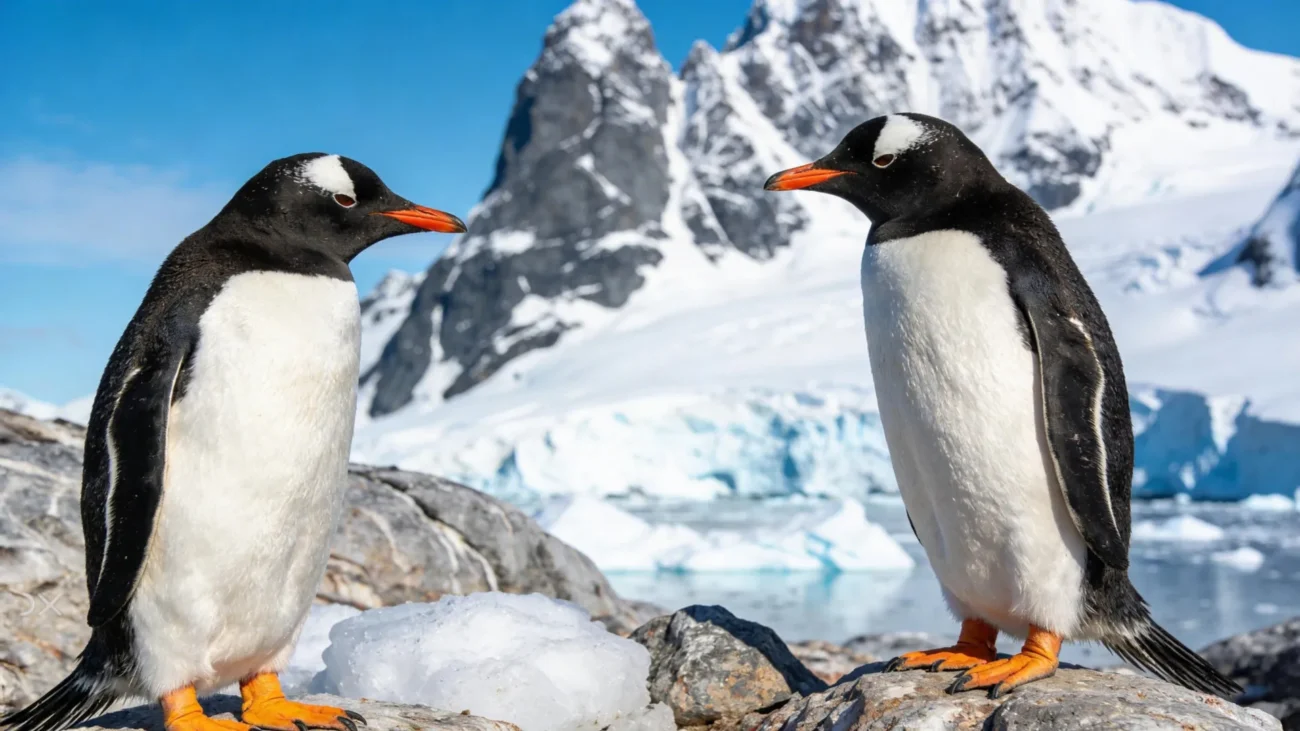
For generations, the gentoo penguin was understood by the scientific community as a single, widely distributed species, easily identifiable by its striking white crown stripe, bright orange-red bill, and classic tuxedo-like plumage. However, a landmark international genomic study published in the journal Communications Biology has upended a century of taxonomic debate. By sequencing the whole genomes of gentoo penguins spanning nearly their entire geographic range, researchers have determined that what was once considered one species is actually four distinct species, including one entirely new to science that has managed to escape formal recognition until now.
This discovery marks the first time in more than a century that a new penguin species has been formally identified and named. Led by an international consortium of scientists—spearheaded by researchers in Chile and the University of California, Berkeley—the study relied on advanced genetic sequencing to untangle the evolutionary history of the gentoo lineage. The findings not only resolve a decades-long scientific controversy regarding the classification of these charismatic seabirds but also carry profound implications for their conservation as global climate change increasingly alters the fragile ecosystems of the Antarctic and sub-Antarctic regions.
A Century of Taxonomic Debate and the Path to Discovery
The debate surrounding the taxonomy of gentoo penguins dates back decades, with previous researchers periodically proposing as many as six distinct subspecies based primarily on regional variations in body size and subtle physical differences. Yet, without a universal consensus or comprehensive genetic data, the scientific community remained divided. The new study successfully resolves this uncertainty by assembling whole-genome sequences from 64 individual penguins across 10 distinct breeding colonies, providing an unprecedented look at the genetic architecture of the populations.
The research team, which included biologists from Australia, Spain, Venezuela, South Africa, the United Kingdom, France, Argentina, Monaco, and Brazil, compared not only genetic markers but also physical and behavioral traits. These included coloration, vocalizations, breeding schedules, diets, and foraging behaviors. Daly Noll, a graduate student at the University of Chile in Santiago and the paper’s first author, led the genomic analysis, examining thousands of genetic variations known as single nucleotide polymorphisms (SNPs) across a broad swath of the genome.
This rigorous, integrative approach allowed the researchers to confirm that the gentoo penguin complex is divided into four separate evolutionary lineages that diverged approximately 300,000 to 500,000 years ago. Among these is a previously unrecognized cryptic species—meaning it is physically nearly indistinguishable from its relatives yet genetically isolated and distinct—which inhabits the remote Kerguelen Islands, nearly 2,000 miles from any permanently inhabited landmass. The researchers formally named this newly minted species the southeastern gentoo penguin, or Pygoscelis kerguelensis.
The four recognized lineages are now categorized as follows:
- Pygoscelis kerguelensis (Southeastern lineage): Inhabiting the Kerguelen and likely Heard Islands near the Antarctic Polar Front.
- Pygoscelis taeniata (Eastern lineage): Found north of the Polar Front on the Crozet, Marion, and Macquarie Islands, thriving in warmer, saltier waters.
- Pygoscelis papua (Northern lineage): Restricted primarily to the Falkland/Malvinas and Martillo Islands in South America.
- Pygoscelis ellsworthi (Southern lineage): The most numerous lineage, inhabiting the Antarctic Peninsula, coastal Antarctica, and South Georgia Island.
Evolutionary History and the Role of Dietary Flexibility
To understand how these distinct species emerged, the researchers looked at the broader evolutionary timeline of the penguin family. Previous work published by co-senior authors Rauri Bowie and Juliana Vianna indicated that penguins originated near Australia and New Zealand approximately 22 million years ago. Over millions of years, lineages such as Emperor and King penguins split from the rest of the family, with Emperors adapting specifically to the harsh conditions of Antarctica and Kings taking up residence in sub-Antarctic environments.
Approximately 12 million years ago, the intensification of the Antarctic circumpolar current facilitated the spread of other penguin groups across the Southern Hemisphere. These birds eventually colonized isolated islands and archipelagoes, reaching as far north as Africa and South America. For gentoo penguins, geographic isolation combined with a unique ecological trait to drive speciation: dietary flexibility.
Unlike many of their penguin relatives—such as Adélie and Emperor penguins, which rely heavily on krill—gentoos are opportunistic and flexible feeders. They consume a wide variety of prey, including fish, squid, cuttlefish, and krill. Because they are not forced to undertake massive foraging migrations to find specific food sources, they tend to remain close to their breeding colonies year after year and faithfully return to the same nesting sites.
Over hundreds of thousands of years, this site fidelity and geographic isolation, reinforced by the physical barrier of the Antarctic Polar Front—a major oceanic boundary where water temperature and salinity shift abruptly—prevented interbreeding between distant populations. Natural selection subsequently acted upon these isolated groups, leading to distinct genetic adaptations tailored to their specific local environments.
Local Genetic Adaptations Across Diverse Environments
The genomic analysis provided a fascinating window into how each gentoo species has genetically optimized for survival in its respective habitat. The southern gentoo (Pygoscelis ellsworthi), which currently thrives in the extreme cold of Antarctica, demonstrated genetic enrichment associated with heat production, fat and lipid storage, and light perception. Scientists believe the adaptations in light perception are critical for helping the birds navigate the dramatic seasonal shifts in daylight and the intense glare of sunlight reflecting off snow and ice.
In contrast, the eastern gentoo (Pygoscelis taeniata), residing in the warmer waters north of the Polar Front, exhibited a genomic profile rich in genes linked to efficient carbohydrate metabolism and enhanced diving performance. These include genes associated with oxygen transport, blood vessel formation, lung development, and mitochondrial activity. These traits likely allow the eastern lineage to remain submerged for longer periods while foraging in marine environments with lower overall biological productivity.
Meanwhile, the northern gentoo (Pygoscelis papua) of South America showed genetic enhancements tied to digestion, heart contraction, and muscle excitation. Researchers suggest these physiological adjustments support the sustained physical activity and muscular endurance required for prolonged underwater hunting in their specific regional waters.
Climate Change and Vulnerability of Island Populations
While the southern gentoo is currently benefiting from changing conditions along the Antarctic Peninsula—where it is expanding its range—the future looks considerably more precarious for its sub-Antarctic relatives. Using predictive climate models to project suitable habitats for the year 2050 under a moderate climate change scenario, the research team determined that the island-dwelling gentoo species face severe risks of habitat loss.
Unlike Antarctic species that can shift their ranges southward as sea ice recedes, sub-Antarctic penguins living on isolated island chains have nowhere to go. If warming oceans and shifting ecosystems degrade their current habitats, these endemic populations could find themselves entirely stranded with no viable neighboring islands to colonize.
Dr. Juliana Vianna, professor of ecosystems and environment at Andrés Bello National University in Santiago, Chile, and a senior author of the study, emphasized the urgency of the findings. "In Antarctica, of course, other species, not the gentoo, are threatened by climate change," Vianna noted. "But the gentoo is of most concern in the sub-Antarctic region," an area governed by a patchwork of international jurisdictions, including Chile, South Africa, France, the Netherlands, Australia, and New Zealand.
"It’s very important that conservation institutions in all the different countries involved recognize and take appropriate action to save these three gentoo penguin species," Vianna added. Beyond climate change, these isolated populations face compounding anthropogenic threats, including warming oceans, habitat destruction, predation by introduced species like rats and dogs, commercial fisheries competition, and accidental entanglement in fishing nets.
Implications for Broad Conservation Strategies
The recognition of four distinct species rather than a single generalized group fundamentally alters conservation policy and resource allocation. Because legal protections and conservation status assessments typically operate at the species level, the newly elevated species—particularly the southeastern gentoo (Pygoscelis kerguelensis) and the vulnerable island lineages—can now be evaluated as independent conservation units requiring tailored management plans.
Furthermore, the extensive genomic dataset compiled by the international research team offers value far beyond traditional taxonomy. Dr. Rauri Bowie, a curator in UC Berkeley’s Museum of Vertebrate Zoology and co-senior author of the study, highlighted the broader utility of whole-genome sequencing in modern wildlife management. Vianna and her colleagues are already utilizing the genomic architecture of these penguin populations to investigate genetic markers associated with natural resistance and survival against avian influenza, a devastating pathogen currently impacting global bird and mammal populations.
By identifying specific genetic traits linked to disease vulnerability or resilience, conservationists can better forecast which colonies are at the highest risk of catastrophic decline. As mounting environmental pressures continue to reshape the Southern Hemisphere, the integration of cutting-edge genomics and traditional field biology will be essential to ensuring the survival of these newly defined penguin species for the next century and beyond.

