


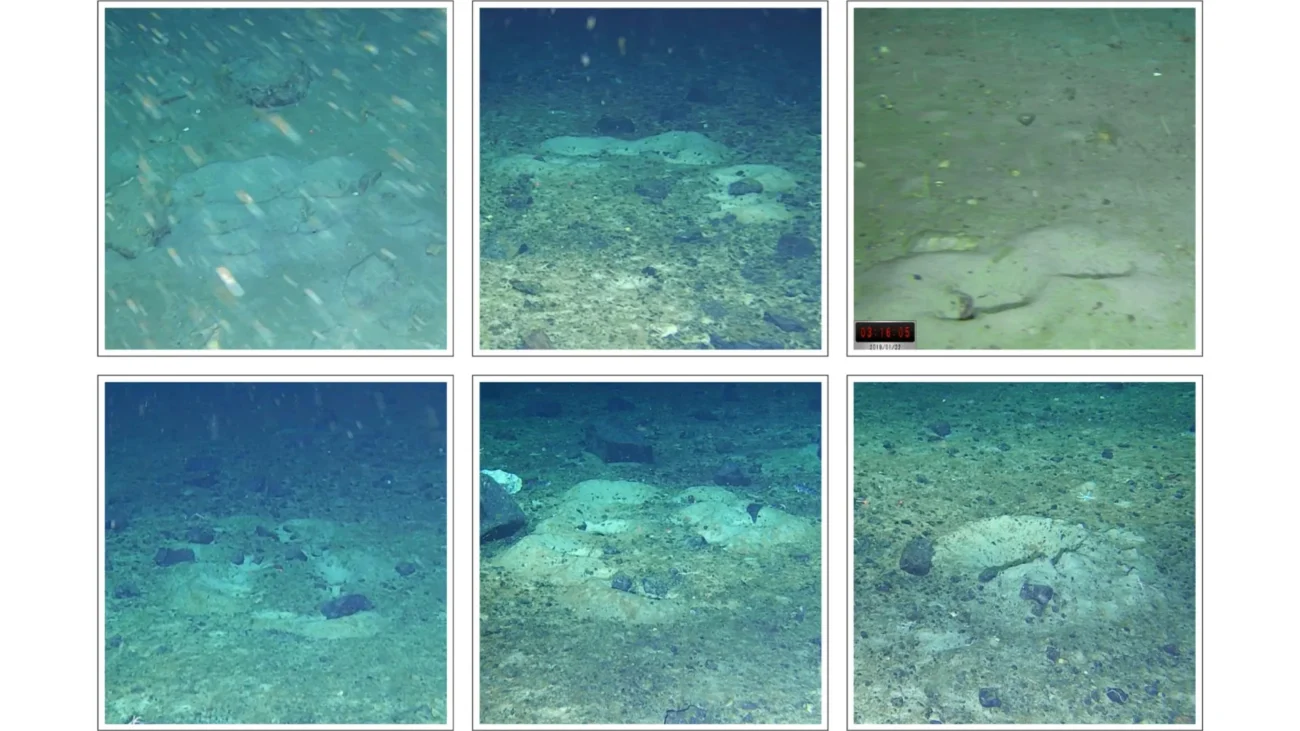
In a remarkable discovery that underscores the profound impact of climate change and the hidden wonders of Earth’s most remote regions, scientists have uncovered vast, meticulously arranged fields of fish nests in a previously inaccessible area of Antarctica’s western Weddell Sea. Concealed for centuries beneath approximately 200 meters of solid ice, these intricate structures offer unprecedented insights into the survival strategies of Antarctic marine life and highlight the urgent need for conservation in this vulnerable ecosystem.
The extraordinary find was made possible by the dramatic calving of the A68 iceberg in 2017. This colossal ice formation, measuring an astonishing 5,800 square kilometers—an area larger than the nation of Delaware—broke away from the Larsen C Ice Shelf, effectively peeling back a curtain that had long shielded a significant section of the seafloor from human observation. The subsequent opening of this icy expanse provided a unique, albeit concerning, window for scientific exploration into an environment that had been sealed off from the outside world for an indeterminate but likely very long period.
A Glimpse Beneath the Ice: The Discovery of Organized Nests
Utilizing a remotely operated vehicle (ROV) equipped with high-definition cameras, researchers from the Weddell Sea Expedition of 2019 encountered a landscape of unparalleled geometric order. Across the seafloor, they observed more than a thousand distinct circular depressions, each identified as a carefully constructed fish nest. What set these nests apart was not merely their abundance but their apparent deliberate arrangement and meticulous maintenance.
Each nest was notably free of the fine layer of plankton debris that blanketed the surrounding sediment. This stark contrast created a striking visual pattern of clean, circular zones against a backdrop of otherwise uniform seabed. Images captured by the ROV revealed a diverse array of formations: solitary nests stood isolated in the lower right portion of the surveyed area, while others clustered together in dense groupings in the upper left. Still more were arranged in elegant, curved lines across the central expanse of the seafloor. This sophisticated organization suggests a level of planning and collective behavior previously undocumented in such extreme conditions.
The Weddell Sea Expedition: A Dual Mission of Exploration and Preservation
The Weddell Sea Expedition of 2019 was conceived with two primary, ambitious objectives. The first was to conduct a comprehensive scientific survey of the waters surrounding the Larsen C Ice Shelf, an area of critical importance for understanding Antarctic ice dynamics and their global implications. The second, and perhaps more romantically charged, objective was to locate the wreck of Sir Ernest Shackleton’s ship, the Endurance, which was famously crushed by ice and sank in the Weddell Sea in 1915 during his Imperial Trans-Antarctic Expedition.
Scientists involved in the expedition were acutely aware of the pivotal role played by Antarctica’s floating ice shelves. These immense formations act as natural buttresses, acting as crucial barriers that significantly slow the flow of glaciers from the continent’s interior into the ocean. When these ice shelves thin, fragment, or disintegrate—a process increasingly accelerated by global warming—this stabilizing effect diminishes. Consequently, land ice can accelerate its movement towards the sea, contributing directly to rising global sea levels.
The calving of iceberg A68, therefore, represented a rare and scientifically invaluable opportunity. It allowed researchers to access and study a section of the seabed that had been isolated for millennia, offering a real-time glimpse into how this pristine environment was responding to unprecedented environmental changes. The expedition aimed to gather baseline data on the biodiversity, geology, and oceanography of this newly exposed region, providing crucial information for future monitoring and conservation efforts.
Navigating the Icy Frontier: Technological Challenges and Triumphs
Operating aboard the South African polar research vessel SA Agulhas II, the expedition team deployed a suite of advanced underwater technologies. These included autonomous underwater vehicles (AUVs) capable of extended independent exploration and a remotely operated vehicle (ROV) for direct visual observation and sampling. The researchers faced the formidable challenge of navigating the same treacherous, dense sea ice that had sealed the fate of Shackleton’s Endurance over a century prior.
Despite their technological prowess and the expertise of the crew, the pack ice in 2019 proved too formidable to allow for the discovery of the Endurance. However, the experience gained in maneuvering through these extreme conditions and operating sophisticated underwater equipment proved invaluable. This hard-won knowledge and technological refinement paved the way for the subsequent Endurance22 expedition, which, in March 2022, achieved the remarkable feat of locating the remarkably preserved wreck of the Endurance resting at a depth of 3,008 meters in the Weddell Sea.
The Architects of the Nests: Unveiling the Yellowfin Notie
The mystery of the organized nests was eventually unraveled, revealing the ingenious architects behind this underwater spectacle: a species of Antarctic rockcod known scientifically as the yellowfin notie, Lindbergichthys nudifrons. These small, unassuming fish have demonstrated a sophisticated survival strategy centered around their breeding behavior.
Researchers believe that each circular nest was meticulously tended by a parent fish, likely a male, whose primary role was to guard the precious clutch of eggs from potential predators. The sheer density and organized arrangement of these nests suggest a collective defense mechanism. Scientists have theorized that these dense groupings exemplify the "selfish herd" concept, a principle in evolutionary biology where individuals seek safety by congregating, with those in the center being shielded by their neighbors on the periphery. The presence of solitary nests, often observed along the edges of the larger aggregations, is thought to indicate the presence of larger, more dominant individuals capable of defending their territory and offspring independently. This remarkable interplay of cooperation and competition appears to maximize the reproductive success and overall survival rate of the yellowfin notie colony.
Conservation Implications: A Fragile Marine Ecosystem Under Threat
The discovery of these extensive and organized fish nests holds significant implications beyond mere scientific curiosity. It provides compelling evidence that the surveyed region represents a Vulnerable Marine Ecosystem (VME). Such ecosystems are characterized by their unique habitats, slow recovery rates, and the presence of ecologically important species that are highly susceptible to disturbance. The Weddell Sea, with its extreme conditions and long periods of ice cover, has fostered specialized biodiversity, and the yellowfin notie breeding grounds are a prime example of this specialized adaptation.
This finding corroborates and strengthens earlier research. For instance, a study by Purser et al. (2022) had already identified one of the world’s largest known fish breeding colonies within the Weddell Sea, further emphasizing the region’s ecological significance. The newly discovered organized nests add a critical layer of understanding to the complexity and scale of these underwater nurseries.
The accumulating evidence from such discoveries significantly bolsters the argument for the designation of the Weddell Sea as a Marine Protected Area (MPA). Establishing an MPA in this region would provide essential legal and practical safeguards for its unique wildlife, which includes iconic Antarctic species such as penguins, seals, and whales, as well as the less visible but equally crucial organisms that form the foundation of the Antarctic food web. Protecting these areas is not merely an act of conservation for aesthetic reasons; it is a strategic imperative to maintain the health and resilience of the global ocean ecosystem.
The discovery of the organized yellowfin notie nests serves as a powerful and timely reminder. It demonstrates that even in Earth’s most challenging and seemingly barren environments, life not only persists but finds ingenious ways to organize, adapt, and thrive. This resilience, however, is not impervious to human-induced environmental pressures. As ice shelves continue to recede and ocean temperatures rise, the future of these extraordinary underwater communities hangs precariously in the balance, underscoring the urgent need for global action to mitigate climate change and protect these invaluable natural wonders. The data gathered from this expedition will be instrumental in informing conservation strategies and advocating for robust protection measures for the Weddell Sea, ensuring that these hidden nurseries continue to sustain Antarctic biodiversity for generations to come.

