


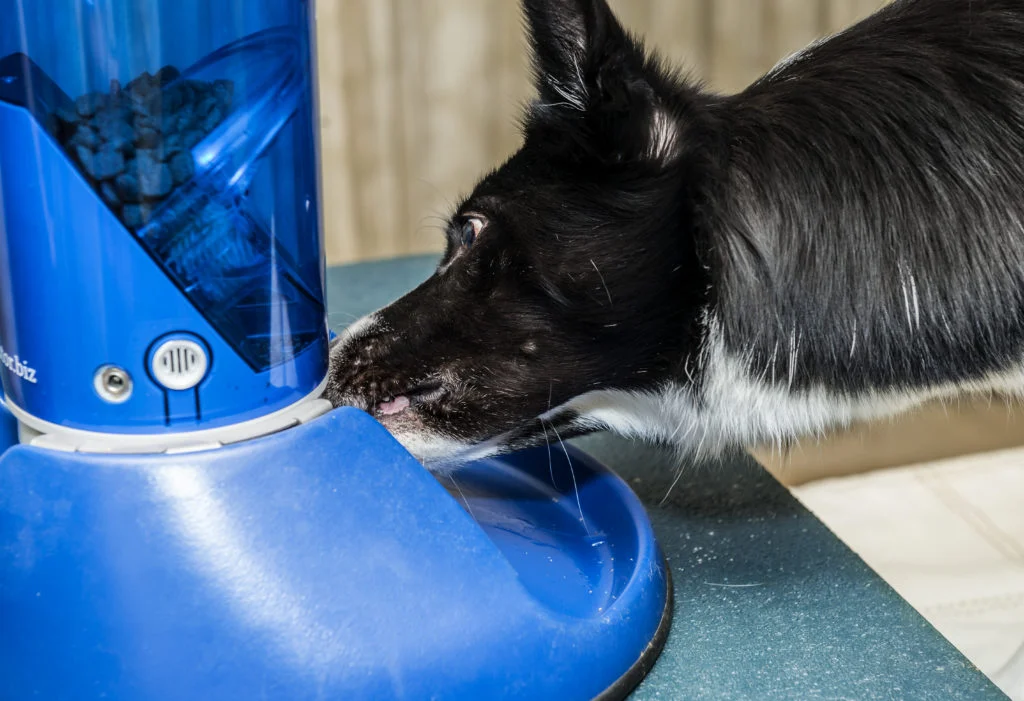
In the realm of modern canine training, the strategic deployment of remote feeding devices, such as the Pet Tutor, has revolutionized the way owners and trainers approach reinforcement. However, a common and often counterintuitive challenge arises: how to prevent dogs from developing an unhealthy obsession with the feeder itself, mistaking it for a puzzle toy rather than a simple delivery system for rewards. Dr. Deborah Jones, Ph.D., a distinguished expert in animal behavior and training with over 25 years of experience, advocates for a foundational approach that instills in dogs the understanding that maintaining a physical distance from the feeder is not only acceptable but desirable, and ultimately, more rewarding. This methodology aims to ensure that a dog’s focus remains on the desired behavior that triggers reinforcement, rather than on direct interaction with the feeding apparatus.
The Evolution of Canine Reinforcement Technology
The advent of remote feeders like the Pet Tutor marks a significant advancement in positive reinforcement training. Historically, treats were delivered manually, which could sometimes inadvertently create associations between the handler’s hand or presence and the reward, potentially distracting from the intended behavioral cue. Remote feeders offer a cleaner, more precise delivery of reinforcement, allowing trainers to mark a desired behavior (e.g., with a clicker or verbal marker) and immediately follow with a treat dispensed from a distance. This separation of trainer, marker, and reward delivery minimizes the risk of cue contamination and enhances the dog’s ability to discriminate between behaviors and their consequences.
However, this innovative technology also introduces a new set of behavioral considerations. Dogs are naturally curious and often driven by foraging instincts. Many are accustomed to puzzle toys that require physical manipulation—pushing, nudging, rolling, or chewing—to release treats. When introduced to a remote feeder, a dog might mistakenly apply these learned behaviors, attempting to interact directly with the device in the belief that such actions will yield food. This misinterpretation can quickly lead to an undesirable fixation on the feeder, transforming it from a neutral delivery mechanism into a focal point of anxiety or obsessive interaction.
Understanding Feeder Fixation: Behavioral Insights
Feeder obsession, as Dr. Jones highlights, stems from a dog’s natural drive to acquire resources. If a dog learns that proximity to or direct interaction with the feeder sometimes results in food, an intermittent reinforcement schedule is inadvertently established. This can lead to persistent attempts to manipulate the device, even when such actions are not directly reinforced. From a behavioral science perspective, the feeder itself can become a conditioned stimulus, eliciting an eager, sometimes frantic, response. This can manifest as barking at the feeder, pawing at it, nudging it with the nose, or even attempting to climb onto or into it, as observed with Dr. Jones’s own dog, Star.
Such fixation is problematic for several reasons:
- Distraction from Learning: A dog overly focused on the feeder cannot concentrate on the trainer’s cues or the specific behaviors being taught. Their cognitive resources are diverted to anticipating and attempting to manipulate the reward source.
- Increased Frustration and Anxiety: When direct interaction with the feeder does not consistently yield rewards, it can lead to frustration, which may manifest as whining, barking, or even aggressive displays towards the device or handler. This undermines the positive, low-stress environment essential for effective training.
- Compromised Reinforcement Contingency: The goal of positive reinforcement is to strengthen a desired behavior by immediately following it with a reward. If the dog is constantly interacting with the feeder, it becomes challenging to clearly link a specific, cued behavior with the subsequent treat delivery, weakening the learning process.
- Safety Concerns: In some cases, aggressive physical interaction with the feeder could damage the device or, in rare instances, lead to injury for the dog.
Dr. Deborah Jones’s Strategic Introduction: A Phased Approach
Recognizing these potential pitfalls, Dr. Deborah Jones developed a systematic approach to introduce the Pet Tutor, ensuring that dogs understand it as a neutral, distant delivery system. Her method prioritizes establishing a clear boundary between the dog, the feeder, and the reinforcement.
Phase 1: Establishing Distance and Passive Delivery
The initial steps focus on minimizing direct physical interaction and redirecting the dog’s attention to the ground as the primary treat delivery point.
- Elevate and Orient the Feeder: The first crucial step involves elevating the Pet Tutor and positioning it so that treats fall directly onto the floor, rather than into an attached bowl. This immediately prevents the dog from sticking its nose or paws into the device. Elevation also makes it physically difficult for the dog to interact with the feeder as if it were a puzzle toy. By removing the bowl, the immediate association of "food receptacle" is shifted away from the device itself.
- Initial Treat Delivery to the Floor: Begin by activating the feeder to release treats directly onto the floor. If the dog struggles to locate them, gently guide their attention to where the treats land. This establishes a new expectation: food appears on the ground, not from the device via interaction. This subtle shift is fundamental in shaping the dog’s perception of the feeder.
Phase 2: Reinforcing "Away" Behavior
Once the dog understands that treats appear on the floor, the next critical phase involves actively reinforcing any movement away from the feeder. This is where the counterintuitive aspect of the training truly comes into play.
- Watch for Subtle Retreats: The trainer’s role is to observe the dog keenly. The moment the dog exhibits even a slight movement away from the feeder—a subtle shift of weight, a step back, or turning its head away—the feeder is activated, and a treat is dispensed onto the floor. This precision is vital. The dog learns that backing away, rather than approaching, triggers the reward.
- Gradual Reinforcement of Distance: Continuously reinforce successive approximations of moving further away. Initially, a mere inch might be rewarded. As the dog understands the contingency, gradually increase the distance required for reinforcement. This systematic shaping helps the dog generalize the concept of "away" and builds confidence in the new expectation. This phase addresses the dog’s inherent drive to gravitate towards the source of food. By consistently rewarding movement away from the source, the trainer actively re-conditions this natural inclination.
Phase 3: Introducing a Station for Focused Engagement
With the dog consistently maintaining a comfortable distance from the feeder, the training progresses to incorporating a "station"—a designated mat or bed—as the new focal point for desired behaviors.
- Introducing a Mat or Bed: Place a mat or bed a short distance from the feeder. This station provides a clear target for the dog, further reinforcing the idea that specific behaviors performed away from the feeder lead to rewards.
- Reinforcing Movement Towards and Onto the Station: Begin by reinforcing any movement towards the mat, then stepping onto it, and eventually, settling onto it. This might involve luring initially, but the ultimate goal is for the dog to independently choose to go to the mat.
- Reinforcing Stationing at a Distance: Once the dog reliably goes to and settles on the mat, increase the duration for which they remain on the mat, and eventually, the distance of the mat from the feeder. Reinforcement (treats from the Pet Tutor) is delivered while the dog is on the mat, reinforcing the desired stationing behavior.
Chronology of Learning and Reinforcement: A Summary
Dr. Jones’s methodology can be summarized as a nine-step chronological progression designed to systematically reshape the dog’s interaction with the remote feeder:
- Feeder Orientation: Position the Pet Tutor to drop treats onto the floor, not into a bowl.
- Feeder Elevation: Raise the feeder to prevent direct physical manipulation.
- Floor Delivery: Initiate treat releases onto the floor, demonstrating the new reward location.
- First Retreats: Watch for and immediately reinforce any slight movement away from the feeder.
- Increased Distance: Continue reinforcing progressively greater distances from the feeder.
- Introduce Station: Place a mat or bed at a short distance.
- Station Engagement: Reinforce movement towards and stepping onto the mat.
- Station Settling: Reinforce going to and laying on the mat at a distance.
- Behavioral Payoff: Solidify the understanding that behaviors performed away from the feeder lead to reinforcement.
This structured progression ensures that the dog develops a clear understanding: the Pet Tutor is merely a tool that dispenses rewards when the desired behavior is performed, not a toy to be manipulated or a source to be guarded.
Case Study: Star’s Transformation
The example of Star, Dr. Jones’s own dog, vividly illustrates the efficacy of this approach. Star’s history of extreme feeder fixation, to the point of attempting to "climb inside" the device during grooming sessions, presented a significant challenge. This behavior indicates a deeply ingrained association between the feeder and direct physical interaction as the means to obtain reinforcement. By implementing the described method, especially by making the feeder inaccessible and deliberately reinforcing backing away, Dr. Jones successfully re-patterned Star’s behavior. The video footage of Star expertly catching treats in mid-air demonstrates not only her agility but also her new-found focus on the behavior (waiting, then reacting to the treat trajectory) rather than the device. This shift is a testament to the power of precise reinforcement and the systematic breaking of undesirable behavioral chains. Star’s ability to learn to move away from the source of food, a seemingly counterintuitive action for a dog, highlights the profound impact of this training strategy.
Broader Implications and Benefits
The successful implementation of Dr. Jones’s "Step AWAY from the Feeder!" strategy yields numerous long-term benefits for both the dog and the training process:
- Enhanced Focus and Learning: By removing the feeder as a source of distraction or obsession, dogs can dedicate their full attention to the cues, tasks, and behaviors being taught. This leads to faster learning and more reliable performance.
- Reduced Stress and Frustration: A dog that understands the clear contingencies of reinforcement, and doesn’t feel the need to "work" the feeder, experiences less anxiety and frustration during training sessions. This fosters a more positive and enjoyable learning environment.
- Improved Stimulus Control: The dog learns that the feeder is a neutral stimulus, and its activation is contingent upon their own behavior, not their interaction with the device. This strengthens stimulus control, where specific cues reliably elicit specific behaviors.
- Foundation for Advanced Training: Establishing a clear understanding of remote reinforcement and the concept of "stationing" provides an excellent foundation for more complex behaviors. It allows the Pet Tutor to be seamlessly integrated into various training scenarios, from basic obedience to advanced agility or service dog tasks.
- Stronger Human-Animal Bond: When training is clear, consistent, and low-stress, it strengthens the bond between owner and dog. The dog learns to trust the training process and its handler, knowing that desired behaviors will be reliably rewarded without the need for frantic self-initiation.
- Versatility of the Pet Tutor: Once this foundational understanding is established, the Pet Tutor becomes an incredibly versatile tool for various applications:
- Behavior Modification: Helping dogs overcome separation anxiety, fear of specific objects, or reactivity by pairing positive experiences (treats) with previously aversive stimuli.
- Independent Practice: Allowing dogs to practice behaviors independently, such as staying on a mat during dinner, with remote reinforcement.
- Complex Chains: Reinforcing long chains of behaviors without the handler needing to be in close proximity for every reward.
- Environmental Enrichment: Providing mental stimulation in a structured, reinforcing way.
Expert Consensus and Future Directions
The principles espoused by Dr. Deborah Jones align with broader consensus in the professional dog training community, particularly among those who adhere to force-free, positive reinforcement methodologies. Certified Professional Dog Trainers (CPDT-KA/KPA-CTP) and Certified Applied Animal Behaviorists (CAAB) consistently emphasize the importance of clear communication, precise timing, and avoiding inadvertently reinforcing undesirable behaviors. The proactive approach to feeder introduction, as outlined by Dr. Jones, is increasingly recognized as a best practice for maximizing the utility of remote feeders.
Looking ahead, as technology continues to integrate into animal care, the sophistication of remote training tools is likely to grow. However, the fundamental principles of behavioral science—classical and operant conditioning—will remain paramount. The challenge will always be to ensure that technology serves to enhance, rather than complicate, the communication between humans and their animal companions. Dr. Jones’s work exemplifies how thoughtful application of these principles can optimize the benefits of innovative tools like the Pet Tutor, creating well-adjusted, focused, and happy canine learners ready to excel in a multitude of training situations. Her contributions, as evidenced by her extensive publishing, teaching, and training background, continue to shape effective and humane animal training practices globally, particularly through platforms like Fenzi Dog Sports Academy.
By diligently following this structured introduction, dog owners and trainers can effectively establish the Pet Tutor as a powerful, neutral ally in their training endeavors, rather than a source of potential frustration or fixation. This foundational work ensures that the smart training feeder itself is simply the delivery system, allowing the true focus to remain on the dog’s behavior and the enriching process of learning.

