



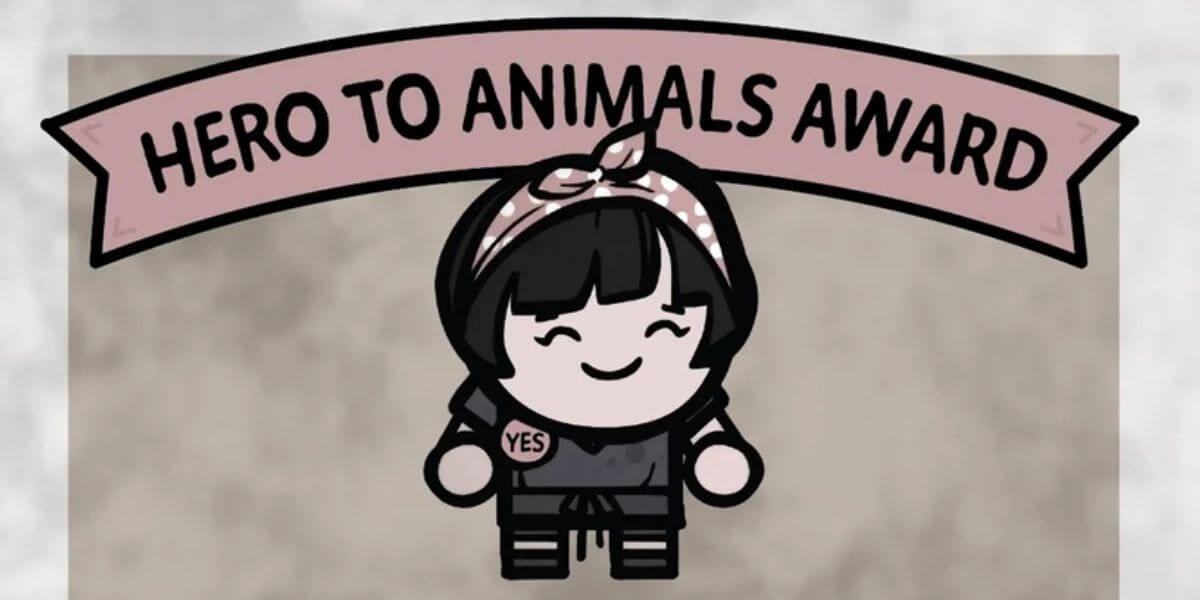
The animal rights organization People for the Ethical Treatment of Animals (PETA) has officially announced that it is conferring its prestigious Hero to Animals Award upon Tracy Newkirk, a prominent non-playable character (NPC) in the 2026 video game Mewgenics. The decision marks a rare instance of a virtual entity being recognized for advocacy work within a digital environment, highlighting the growing intersection between interactive media and social justice movements. Tracy Newkirk, who manages the P-Mart in the game’s Boon County setting, has gained significant attention for her vocal opposition to the commodification of animals and her insistence on using language that reflects the inherent dignity of living beings.
In the chaotic and often dark world of Mewgenics—a rogue-like tactical simulation developed by Edmund McMillen and his team—players engage in the breeding, mutation, and battling of cats. While the game’s core mechanics involve treating felines as assets to be managed and optimized for combat, Tracy Newkirk serves as a moral anchor and a pedagogical force. According to PETA’s official statement, the award recognizes Tracy’s "unwavering commitment to challenging speciesism" and her role in educating players about the ethical responsibilities humans hold toward their "animal companions."
The Role of Tracy Newkirk in Mewgenics
Mewgenics is characterized by its grotesque aesthetic and complex systems where cats are subjected to various biological experiments and hazardous adventures. Within this framework, Tracy Newkirk operates the P-Mart, a central hub for players. Unlike other characters who view the feline population as mere inventory, Tracy utilizes her platform to challenge the player’s perspective. She famously declares her mission is to "educate the ignorant," frequently correcting those who use the term "pet"—a word she describes as a product of a "bigoted speciesist agenda."
Tracy’s advocacy extends beyond mere semantics. In the narrative of Boon County, she is portrayed as the only ethical recipient for cats that players can no longer care for, contrasting sharply with darker in-game figures like Baby Jack or Dr. Beanies, whose treatment of animals is depicted as exploitative or cruel. By positioning Tracy as the "ethical option," the game’s developers have integrated a critique of animal exploitation directly into the gameplay loop. PETA representatives noted that Tracy’s presence forces players to confront the "moral dilemma" inherent in breeding animals for human entertainment, even within a fictionalized setting.
A History of Satire and Collaboration
The recognition of Tracy Newkirk is the latest chapter in a long and complex relationship between PETA and the development team led by Edmund McMillen. This relationship dates back to 2010, following the release of the indie hit Super Meat Boy. In response to that game’s themes, PETA launched a parody titled Super Tofu Boy, intended to highlight the cruelty associated with the industrial meat industry.
The interaction between the two parties was notably different from typical corporate-activist clashes. McMillen famously embraced the parody, stating at the time that being parodied by PETA was a "major high point" in his career. The developers eventually added Super Tofu Boy as an unlockable character in the original Super Meat Boy game. While the portrayal was not entirely flattering to PETA’s message, it established a precedent for dialogue through digital media.
The creation of Tracy Newkirk appears to be a sophisticated evolution of this dynamic. Her full name, revealed in the game’s credits, is a clear nod to PETA’s leadership: President Tracy Reiman and Founder Ingrid Newkirk. Although PETA has clarified that there is no formal relation between the character and their executives, the organization acknowledged the likely inspiration, praising the developers for embedding such a strong animal rights message in a high-profile release.
Addressing the Ethics of Breeding and Commodification
PETA’s decision to honor a digital character is rooted in the real-world implications of the themes explored in Mewgenics. The organization uses the award to draw attention to the "homeless animal crisis," citing statistics that highlight the dangers of breeding and the pet trade. According to industry data, millions of cats enter animal shelters across the United States every year. Of these, a significant percentage are euthanized because there are not enough permanent homes available.
PETA argues that by allowing players to breed cats for "fun" or "loot," Mewgenics inadvertently mirrors the real-world issues of puppy mills and "designer" cat breeding. However, they credit the game’s developers for including Tracy as a counter-voice. Edmund McMillen himself has expressed a nuanced view on the game’s mechanics, acknowledging the "questionable moral dilemma" of breeding animals that may suffer or have shortened lifespans due to human-imposed traits.
In a recent interview, McMillen noted that the game is designed to make players feel the weight of their decisions. "It’s weird to experience the moral dilemma of breeding these creatures that aren’t going to live as long because of what you’re doing, just because they look fun for our own enjoyment," McMillen stated. This sentiment aligns with PETA’s stance that animals should be viewed as individuals with their own rights rather than commodities.
Real-World Implications of Feline Welfare
The advocacy represented by Tracy Newkirk resonates with current feline welfare statistics and the ongoing debate over the management of domestic and feral cat populations.
- The Overpopulation Crisis: Data from the American Society for the Prevention of Cruelty to Animals (ASPCA) suggests that approximately 3.2 million cats enter U.S. animal shelters annually. While adoption rates have improved, the birth of new kittens through intentional breeding directly reduces the chances for shelter cats to find "forever homes."
- The Dangers of Free-Roaming: PETA uses the context of Mewgenics’ hazardous world to highlight real-world dangers. In the game, cats face bugs and rats; in reality, outdoor cats face threats from vehicles, contagious diseases (such as feline leukemia and FIV), and human cruelty. Studies indicate that indoor cats live significantly longer lives—often up to 15-20 years—compared to the 2-5 year average for those left to fend for themselves outdoors.
- The Speciesism Argument: Tracy’s use of the term "speciesism" refers to the human-supremacist belief that all other animal species are inferior. PETA’s advocacy through the Hero to Animals Award aims to normalize the idea that animals deserve basic rights, such as freedom from exploitation and the right to bodily integrity.
Industry Reactions and Broader Impact
The gaming industry has seen an increasing trend of "ethical gameplay" options, where players are rewarded for non-violent or compassionate choices. The inclusion of Tracy Newkirk in Mewgenics is seen by analysts as a peak example of "subversive education." By rewarding Tracy, PETA is effectively endorsing a specific way of interacting with digital media that prioritizes empathy over optimization.
Gaming critics have noted that Tracy has become a fan favorite not just for her supplies, but for her distinct personality. Her refusal to stay silent when she sees animals treated as inventory has sparked discussions on gaming forums about the ethics of "pet sims." Some players have reported changing their playstyle to align more with Tracy’s philosophy, opting for the "rescue" mechanics over the "breeding" mechanics when possible.
PETA’s Hero to Animals Award is typically reserved for individuals who have performed life-saving acts or dedicated their lives to animal protection. Previous recipients include celebrities, local activists, and occasionally law enforcement officers. By extending this honor to Tracy Newkirk, PETA is signaling that the battle for animal rights has moved into the digital frontier, where the values of the next generation of activists are being shaped.
Conclusion and Call to Action
The "Hero to Animals" certificate is currently being sent to the development team at Team Meat to be symbolically presented to Tracy. In its concluding remarks regarding the award, PETA urged Mewgenics players and the general public to "be more like Tracy." The organization emphasized that while the game is a work of fiction, the suffering caused by the pet trade and animal breeding is very real.
"Tracy Newkirk is a reminder that we must always speak up for those who cannot speak for themselves," a PETA spokesperson said. "Whether in the streets of Boon County or in our own neighborhoods, the message remains the same: Adoption is the only compassionate option. Never buy an animal, and always treat your animal companions with the respect they deserve as individuals."
As Mewgenics continues to grow in popularity, the legacy of Tracy Newkirk serves as a testament to the power of character-driven storytelling to influence social attitudes. By challenging the "speciesist agenda" one player at a time, this digital advocate has secured her place in the history of animal rights activism, proving that even in a world filled with bugs and loot, there is always room for compassion.

