


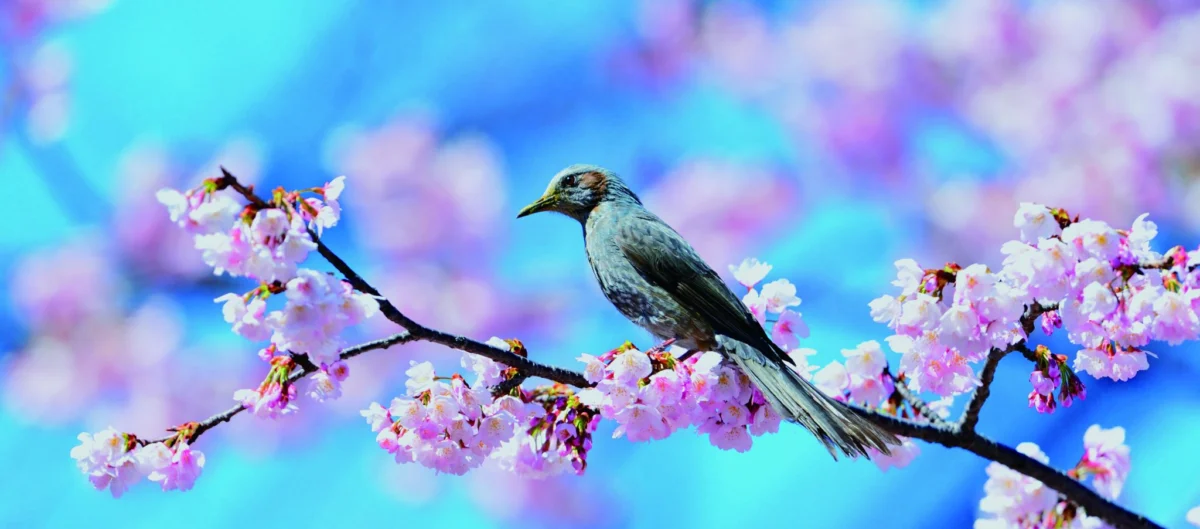
As the lingering chill of winter recedes and the gentle caress of spring returns, a familiar avian presence graces the Japanese landscape. HIH Princess Takamado, renowned for her dedication to ornithology and conservation, offers a compelling invitation to look beyond the commonplace and appreciate the Brown-eared Bulbul (Hypsipetes amaurotis). Through a curated selection of her striking photographs and insightful commentary, originally featured in Fujingahou Magazine’s April 2026 issue, Princess Takamado highlights the often-overlooked beauty and ecological significance of this ubiquitous bird. This extended report delves into her observations, providing broader context and analysis of the Brown-eared Bulbul’s place in Japan’s natural and urban environments, and its potential future as distinct species.
A Bird of the People, Often Overlooked
The Brown-eared Bulbul, known in Japan as the hiyodori, derives its onomatopoeic name from its distinctive calls, a repetitive "hee-yo, hee-yo." For many Japanese, it is as recognizable as the sparrow and the crow, an integral part of the everyday soundscape. Princess Takamado, however, notes a curious paradox: despite its familiarity, the bird often receives a dismissive reception. "At first glance, it may appear plain, but when you look closely, you discover it has a rather charming appearance," she observes. Yet, within birding circles and casual conversation alike, one might encounter the sentiment, "Oh… it’s just a Brown-eared Bulbul," underscoring a widespread tendency to overlook the ordinary.
This underappreciation, Princess Takamado suggests, may stem from the bulbul’s assertive nature. They are known for their strong territorial instincts, actively defending prime feeding spots on camellias and cherry blossoms from other avian visitors. Their loud, piercing calls, while a signal of their presence, can also be perceived as disruptive, shattering the tranquility of their surroundings. These traits, coupled with their sheer abundance, have unfortunately contributed to them being "not very well loved among Japanese people," according to the Princess.
A Global Fascination with a Local Resident
In stark contrast to its domestic perception, the Brown-eared Bulbul holds a significant appeal for international birdwatchers visiting Japan. Princess Takamado points to its relatively restricted distribution as a key factor in this global fascination. Primarily inhabiting East Asia, with Japan serving as its main stronghold, the species represents a sought-after sighting for many foreign ornithologists and tourists. This limited range elevates the Brown-eared Bulbul from a mere common bird to a unique representative of Japan’s avifauna for those seeking to observe endemic or near-endemic species.

Adapting to the Urban Tapestry: A Tale of Resilience
Princess Takamado’s observations paint a fascinating picture of the Brown-eared Bulbul’s remarkable adaptability, particularly its successful integration into Japan’s increasingly urbanized landscapes. She recalls a childhood in central Tokyo where the bird’s boisterous calls were notably absent from the abundant greenery surrounding her family home. This contrasts sharply with their current ubiquity in urban areas, a phenomenon she attributes to shifts in land use and environmental management.
Historically, the Brown-eared Bulbul’s primary habitat was satoyama – the secondary woodlands traditionally managed by local communities, typically found at elevations between 400 to 1,000 meters. They would descend to lower plains during the winter months. The expansion of "greening" initiatives in urban and suburban spaces, involving the increased planting of trees and vegetation in parks, residential areas, and along roadways, has created a more hospitable environment for these birds. This ecological transformation has effectively blurred the lines between their traditional rural habitat and the modern urban environment.
Furthermore, the Brown-eared Bulbul’s omnivorous diet has been a significant advantage in their urban migration. Their opportunistic feeding habits allow them to thrive on a diverse array of food sources available year-round. Beyond the nectar of camellias, plum, and apricot blossoms, they consume willow buds and young leaves, insects, and the berries of ornamental street trees like nandina and pyracantha. Their resourcefulness extends to their ability to drink sap from damaged branches and to forage for ripened fruits such as persimmons, mandarins, grapes, and apples, as well as leafy vegetables like cabbage and Chinese cabbage found in suburban gardens and farms. This dietary flexibility ensures they are never short of sustenance, a crucial element for survival in a human-dominated landscape.
Their nesting behavior also reflects a remarkable ability to adapt. Brown-eared Bulbuls readily build nests in city parks, residential gardens, and even on private property. Their nest construction materials are not limited to traditional twigs and plant fibers; they have demonstrated a pragmatic use of human-introduced materials such as vinyl and plastic, showcasing their ingenuity and resilience in utilizing readily available resources within their altered habitat.
A Glimpse into Avian Dynamics: Territoriality and Cooperation
Princess Takamado offers a personal anecdote that beautifully illustrates the Brown-eared Bulbul’s assertive nature and the complex dynamics within bird communities. She recounts how, upon entering her garden, a bulbul’s loud alarm call would invariably send other birds scattering from the birdbath. This territorial vigilance, while potentially seen as aggressive, serves a protective function.

Her experience with a feeding table during winter further highlights the bulbul’s tenacity. On occasions when the feeder was empty, a Brown-eared Bulbul would persistently tap against the large glass window of her sunroom, a clear signal of its expectation and need. Upon replenishing the food, other birds could then partake, leading Princess Takamado to perceive this interaction as a "small act of mutual support among the birds." This observation suggests that while the bulbul may be territorial, its actions can indirectly benefit other species by ensuring the consistent availability of resources, or at least by being a vocal indicator of feeding opportunities.
The Intricate Tapestry of Subspecies: A Glimpse into Future Conservation Concerns
The Brown-eared Bulbul’s geographic spread across the Japanese archipelago is extensive, encompassing Hokkaido to Kyushu and the Izu Islands. It also includes resident populations on island regions such as Ogasawara, Amami, and Okinawa. This broad distribution has led to the classification of eight distinct subspecies, each exhibiting unique morphological characteristics and coloration.
These subspecies can be further grouped into three larger categories, leading to an intriguing scientific prospect: the potential reclassification of these groups into three separate species. While the Brown-eared Bulbul as a whole is not currently considered globally threatened, this potential speciation carries significant conservation implications. The smaller island populations, if designated as distinct species, could face a heightened risk of endangerment, necessitating targeted conservation efforts.
Timeline of Observation and Adaptation:
- Pre-1950s: Brown-eared Bulbuls primarily inhabited satoyama forests at higher elevations, descending to lower plains in winter. Urban areas had significantly fewer individuals and their calls were less prevalent.
- Mid-20th Century Onwards: Urban greening initiatives gain momentum. Increased planting of trees and shrubs in cities creates new habitats. Brown-eared Bulbuls begin to expand their range into urban and suburban areas.
- Late 20th Century – Early 21st Century: The species becomes a common, year-round resident in urban environments across Japan. Their diet diversifies to include readily available urban food sources. Nesting materials adapt to include human-made items.
- Present Day (2026): Brown-eared Bulbuls are a familiar, albeit often overlooked, presence in urban Japan. International birders recognize their unique status due to their limited distribution. Scientific research explores the possibility of classifying existing subspecies into distinct species, raising potential future conservation concerns.
Data and Analysis: Understanding Population Dynamics and Distribution
The Brown-eared Bulbul’s adaptability is not merely anecdotal; it is supported by ecological data. Studies on urban bird populations in Japan have consistently shown the hiyodori to be one of the most abundant species, particularly in areas with extensive green spaces. For instance, analyses of bird counts in Tokyo’s metropolitan parks often place the Brown-eared Bulbul among the top five most frequently observed species throughout the year.

Their dietary breadth can be quantified. Research indicates that their diet comprises approximately 60% fruits and berries, 30% insects and other invertebrates, and 10% nectar and plant matter. This omnivorous strategy allows them to exploit ephemeral food sources and adapt to seasonal variations in food availability, a critical advantage in unpredictable urban environments.
The subspecies differentiation is based on subtle yet consistent variations in plumage, size, and vocalizations. For example, the Hokkaido subspecies (H. a. amaurotis) is generally larger and has a paler overall coloration compared to some southern subspecies. The possibility of speciation is supported by genetic studies that reveal distinct evolutionary lineages among these geographically isolated populations, particularly those on remote islands. Should these populations be formally recognized as separate species, their conservation status would be reassessed under international guidelines, such as those of the IUCN Red List. This could lead to immediate conservation actions, including habitat protection and population monitoring, particularly for island-bound subspecies.
A Royal Call for Reappraisal and Appreciation
In her concluding remarks, Princess Takamado issues a heartfelt plea for a shift in perspective. She urges individuals to move beyond the dismissive label of "just a Brown-eared Bulbul" and instead to observe and appreciate its "handsome appearance and acrobatic movements." This sentiment underscores the importance of recognizing the intrinsic value of all species, regardless of their perceived commonness.
The Brown-eared Bulbul, with its resilience, adaptability, and unique place in the Japanese ecosystem, serves as a powerful reminder that beauty and ecological significance can be found in the most familiar of places. As climate change continues to alter seasonal patterns, as Princess Takamado keenly observes, the ability of species like the Brown-eared Bulbul to adapt and thrive becomes even more critical. Her photographs and words are not just an ornithological observation but an invitation to foster a deeper connection with the natural world that surrounds us, encouraging a more mindful and appreciative engagement with the avian life that shares our planet. The future of its distinct subspecies may depend on this very shift in human perception and action.

