


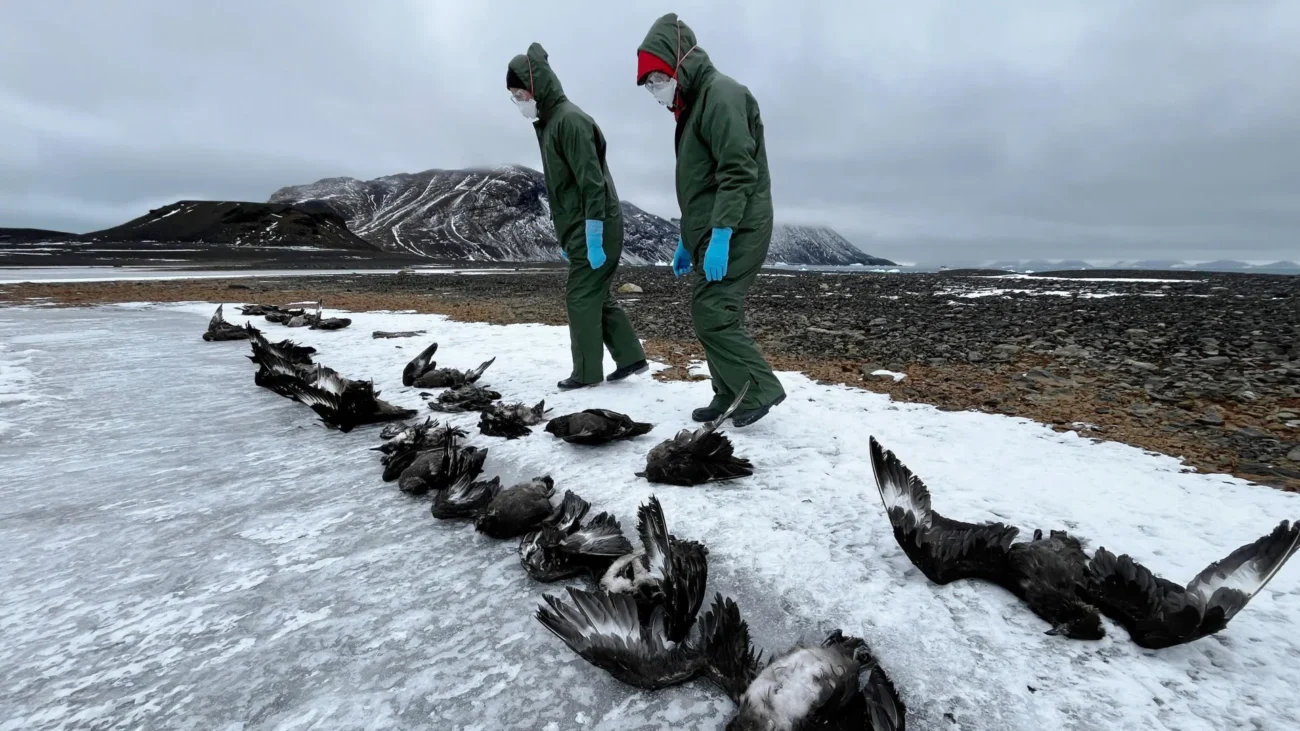
The pristine Antarctic continent, long considered a sanctuary for unique and vulnerable wildlife, is now confronting a significant ecological crisis. Over the austral summers of 2023 and 2024, more than 50 skuas succumbed to the highly pathogenic avian influenza virus H5N1. This grim discovery, detailed in a recent study published in Scientific Reports, marks the first confirmed instance of a wildlife die-off directly attributable to this virulent strain of avian flu on the Antarctic mainland. The research, a collaborative effort spearheaded by Erasmus MC in The Netherlands and the University of California, Davis, sheds critical light on the virus’s relentless march across the globe and its devastating impact on even the most remote ecosystems.
The Scavenging Seabird Under Siege
Skuas, robust brown seabirds closely related to gulls, are apex predators and opportunistic scavengers within the Antarctic ecosystem. Their ecological role, vital for cleaning up carcasses and nutrient cycling, may ironically be contributing to their heightened vulnerability to H5N1. Researchers posit that their scavenging behavior, which involves frequent close contact with decaying matter and potentially infected carcasses, could be a primary vector for the virus’s transmission across the vast and interconnected Antarctic landscape.
Prior to this definitive study, concerns about H5N1’s presence in Antarctica had been mounting. In early 2024, scientists had detected the virus in a kelp gull and two skuas found deceased in January and February. However, definitive proof linking the virus to mortality events remained elusive until the comprehensive investigation undertaken by the research team.
"We knew there were animals with the infection, but this is the first study to show they died of the viral infection," stated co-senior author Ralph Vanstreels, a wildlife veterinarian affiliated with the UC Davis One Health Institute within the Weill School of Veterinary Medicine. "It’s an important distinction in the early days of an outbreak." This clarification is crucial for understanding the true scope of the epidemic and for informing urgent conservation and biosecurity measures.
An Expedition into the Unknown: Investigating Antarctic Bird Flu
In response to these early indications and the escalating global concern surrounding H5N1, a dedicated research expedition was launched in March 2024. The team strategically timed their arrival for the period immediately following the breeding season for skuas and penguins, a critical window for observing potential impacts on these populations. Their comprehensive survey spanned ten diverse sites, encompassing the South Shetland Islands, the northern Weddell Sea, and the Antarctic Peninsula, regions known for their rich biodiversity and high concentrations of breeding seabirds.
During their fieldwork, scientists meticulously documented and examined any sick or deceased wildlife encountered. A rigorous protocol was followed, involving the collection of tissue and environmental samples, alongside thorough necropsies to ascertain the precise cause of death. While gentoo penguins, Adélie penguins, and Antarctic fur seals were also examined, H5N1 was not identified as the primary cause of mortality in these species during the expedition.
"As the expedition progressed, it became obvious quickly that skuas were a major victim," Vanstreels observed, highlighting the conspicuous and alarming toll the virus was taking on this particular avian group.
The presence of H5N1 was definitively confirmed in skuas at three distinct locations: Hope Bay, Devil Island, and Beak Island. Beak Island, in particular, bore witness to a significant die-off event among south polar skuas, underscoring the localized but devastating impact of the virus.
"We diagnosed high pathogenicity avian influenza as the cause of death for nearly all of the dead skuas we found at Beak Island," reported first author Matteo Iervolino, a Ph.D. candidate at Erasmus MC. "There, I could really see with my eyes the impact this virus can have on these populations." His firsthand account vividly illustrates the severity of the unfolding crisis.
Vanstreels further described the grim reality faced by infected birds, characterizing the situation as a "crisis in animal suffering." The H5N1 virus exerts a profound neurological assault, inducing severe symptoms such as contorted necks, abnormal body stretching, disorientation, and a loss of coordination that can lead to birds swimming or walking in circles, colliding with obstacles, or even falling from the sky. The researchers emphasize that human activities, from global trade and travel to agricultural practices, have played a pivotal role in the virus’s emergence and subsequent global dissemination, and therefore, human action is also paramount in mitigating its spread.
The Global Trajectory of H5N1: A Pandemic in Slow Motion
The history of H5N1 is a stark reminder of the interconnectedness of global health and the potential for zoonotic diseases to cross species barriers. The virus was first identified in 1996 on a domestic goose farm in Southeast China. For several years, it circulated largely unchecked within poultry populations, creating a reservoir from which it eventually spilled over into wild bird populations.
This spillover event initiated a relentless global odyssey. The virus systematically spread across Europe, the Middle East, and Africa, before crossing the Atlantic to North and South America. By early 2024, its inexorable march had reached the shores of Antarctica, bringing its devastating impact to a continent previously thought to be largely insulated from such threats.
The same strain of H5N1 now plaguing Antarctic skuas had previously inflicted catastrophic losses on marine mammal populations in Argentina, including large numbers of elephant seals and sea lions. Globally, the virus has decimated poultry stocks, leading to the deaths of over 400 million birds. Its adaptability has also been a cause for grave concern, with documented infections in a diverse range of mammals, including dairy cows, mink, foxes, bears, otters, and numerous other wild mammals and birds, highlighting its broad host range and alarming zoonotic potential.
The implications for human health are equally sobering. While human cases of H5N1 are relatively rare, approximately 1,000 reported cases worldwide have resulted in a mortality rate of around 50%, underscoring the virus’s inherent lethality in humans.
"We let the virus slip out through our fingers when it first emerged in the poultry industry," reflected corresponding senior author Thijs Kuiken, a professor at Erasmus MC. "Once it got into wild bird populations, we lost ability to control this virus. Now it’s established in wild bird populations in all the continental regions of the world except Oceania." This statement serves as a critical warning about the challenges of containment once a virus becomes deeply entrenched in wildlife.
Amplifying the Alarm: Calls for Enhanced Antarctic Surveillance
The arrival of avian influenza in Antarctica adds another formidable layer of stress to an already imperiled ecosystem. Antarctic wildlife contend with a multitude of pressing challenges, including the pervasive impacts of climate change, the increasing pressures of growing tourism, the threat of invasive species, the depletion of fish stocks through overfishing, and the pervasive issue of pollution. The introduction of H5N1 presents a new and potentially devastating ecological pressure that could exacerbate existing vulnerabilities.
The study’s authors strongly advocate for the urgent implementation of enhanced surveillance and monitoring programs across Antarctica. Such measures are deemed essential for early detection, rapid response, and ultimately, for reducing the risk of further widespread transmission and devastating population declines.
A significant complication in assessing the true impact of the H5N1 outbreak is the scarcity of up-to-date population data for many Antarctic species. The last comprehensive census of Antarctic skuas, for instance, was conducted in the 1980s, at which time researchers estimated approximately 800 breeding pairs. Without contemporary population figures, it remains challenging to accurately quantify the significance of the loss of 50 or more birds and to project the long-term ramifications for skua populations.
"Everything points toward this virus spreading further," Kuiken cautioned. "If nobody is watching, we won’t know what is happening." This sentiment underscores the critical need for sustained scientific inquiry and investment in Antarctic research to keep pace with emerging threats.
The groundbreaking research was facilitated by the HPAI Australis Expedition, which received crucial funding from the International Association of Antarctica Tour Operators (IAATO) and Ocean Expeditions. The study itself was further supported by grants from the European Union, the Consejo Superior de Investigaciones Científicas (CSIC), and PTI Global Health, highlighting a multi-faceted commitment to understanding and addressing this urgent environmental crisis. The scientific community and conservation organizations are now keenly watching Antarctica, hoping that proactive measures can be implemented to safeguard its unique biodiversity from the relentless advance of avian influenza.

