


Thousands of years ago, on the Caribbean island of Hispaniola, a dramatic natural drama played out within the confines of a dark cave. A giant barn owl, a formidable predator, carried its prey – a rodent known as a hutia – back to its lair. The meal was swift, and only the remnants of the unfortunate hutia remained. Unbeknownst to the owl, and indeed to any observer of the time, this scene marked the beginning of an extraordinary ecological interaction that would be preserved for millennia. The story, pieced together by paleontologists, reveals how the skeletal remains of this ancient meal provided a novel and invaluable nesting resource for a species of burrowing bee, fundamentally altering our understanding of fossilization and ancient animal behavior.
The initial encounter within the cave likely occurred tens of thousands of years ago. The specific species of giant barn owl, Tyto ostelaris, was a large avian predator that inhabited Caribbean islands during the Pleistocene and Holocene epochs. These owls, considerably larger than their modern counterparts, were apex predators capable of taking down substantial prey. The hutia, a diverse group of rodents endemic to the Caribbean, included species that could grow to the size of a large rabbit, making them a substantial meal for these owls. The Cueva de Mono, located in the southern Dominican Republic, appears to have served as a long-term feeding roost for these owls. Over generations, the consistent deposition of prey remains within the cave created a unique microenvironment.
The Genesis of a Fossilized Nursery
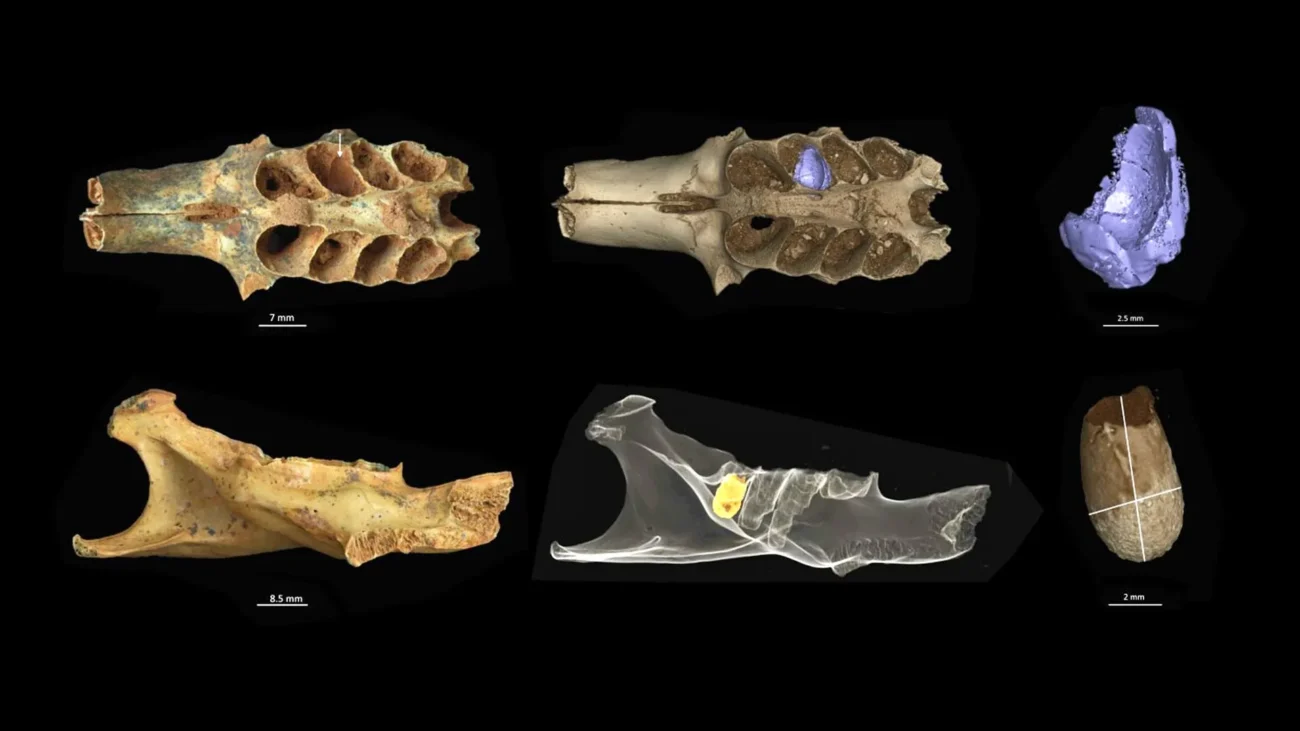
The narrative begins with the owl bringing the hutia into the cave. The remains of the rodent, including its jawbone, would have been left behind after the owl consumed the flesh. It is within these skeletal remains, specifically the alveoli – the bony sockets that held the hutia’s teeth – that the subsequent chapter of this story unfolds. These small, hollow spaces, crucial for anchoring teeth, remained intact even after the teeth themselves had decayed or been lost.
Much later, and on a much smaller scale, a burrowing bee arrived at the scene. These bees, unlike their social counterparts that build elaborate hives, are solitary. They are industrious excavators, seeking out suitable locations to dig individual burrows for their nests, where they lay eggs and provision them with pollen and nectar. The cave, with its accumulated clay-rich silt, presented an initially attractive prospect for nest building. The bee began to excavate, seeking the appropriate depth and substrate.
However, its digging was interrupted when it encountered the fossilized remains of the hutia. This encounter proved serendipitous. The size and shape of the hutia’s tooth sockets, the alveoli, proved to be an almost perfect fit for the bee’s nesting requirements. Instead of continuing to excavate through the more challenging silt, the bee discovered a ready-made cavity.
Uncovering a Remarkable Ichnofossil
The preservation of this interaction is a testament to the power of ichnofossils – traces of past biological activity. While the hutia itself fossilized, the subsequent use of its skeletal remains by the bees created a secondary layer of fossil evidence. This remarkable find was brought to light by the meticulous work of Lazaro Viñola Lopez, who was then a doctoral student at the Florida Museum of Natural History.
Lopez was conducting fieldwork at Cueva de Mono, focusing on the hutia species found there, which he noted was rare elsewhere on the island. During his excavation, he unearthed thousands of hutia fossils, reinforcing the idea that the cave had been a significant feeding site for giant barn owls. His approach, however, diverged from the standard paleontological practice of immediately cleaning sediment from fossil cavities.
"Usually, when collecting fossils, you get all the sediment out of the alveoli while cleaning the specimen," Lopez explained in a statement. "But I was particularly interested in this species of hutia, which was rarely found elsewhere on the island. In the Cueva de Mono… he uncovered thousands of fossils from what appeared to be the same species."
Lopez’s curiosity led him to inspect the fossils more closely. He observed a particular cavity within a hutia jawbone that stood out. Unlike the rough, porous texture of bone, this cavity possessed a remarkably smooth inner surface. This anomaly piqued his interest, prompting further investigation.
From Wasps to Bees: A Case of Mistaken Identity
Initially, Lopez theorized that these smooth-walled cavities might be evidence of wasp nests. He recalled a similar discovery made in Montana in 2014, where wasp cocoons were found intermingled with fossilized dinosaur material. At that time, he and his colleagues had concluded that the smooth, hardened structures were indeed wasp nests, likely constructed from a mixture of chewed plant material and saliva.
He shared his hypothesis with fellow doctoral student Mitchell Riegler, who initially expressed skepticism. Riegler recalled, "I was like, Lazaro, that’s a niche project, and I have a lot of other things to do." The idea of documenting wasp nests in hutia mandibles was put on hold.
The project was revived when Riegler took on a personal challenge to write a scientific paper within a week, a friendly competition with a former advisor. During this intensive writing period, Lopez and Riegler revisited the puzzling fossilized cavities. Their initial belief that they were observing wasp nests began to crumble as they delved deeper into research on ichnofossils.
Wasp nests, they learned, are typically characterized by rough, irregular internal walls formed from processed plant matter. The smooth, polished interiors of the structures found in the hutia jaws did not align with this characteristic. Further research led them to consider another possibility: bees.
"Bees, however, often coat their nests with a waxy secretion that creates a waterproof, polished interior," Riegler explained. This detail was the crucial clue. The smooth surfaces strongly suggested that they were not dealing with wasp nests but rather with the meticulously crafted abodes of bees.
A Rare and Unprecedented Behavior
The correction of their initial assumption elevated the significance of their discovery. The use of pre-existing fossilized cavities by burrowing bees as nesting sites, without any modification to the cavity itself, represented a rare and unprecedented behavior in the fossil record. While there is one other known instance of burrowing bees nesting within a cave, it did not involve the occupation of fossil structures. A previous report documented bees drilling into human bones, a behavior distinct from the passive occupation of natural cavities observed in Cueva de Mono.
Recognizing the profound implications of their findings, the research team shifted gears, slowing down their analysis and broadening their scope. They consulted with contemporary bee specialists and conducted an extensive review of scientific literature. Lopez even returned to Cueva de Mono to conduct further geological surveys, examining the cave’s stratigraphy to better understand the environmental conditions that might have led to this unique behavior.
During their research, the cave faced a significant threat. A development plan aimed to convert the land, including the cave, into a septic tank. Fortunately, conservation efforts ultimately halted this destructive proposal. However, the team recognized the urgency and conducted a rapid "rescue mission" to recover as many fossils as possible before any potential damage could occur. "We had to go on a rescue mission and get as many fossils out as possible, and we got a lot of them," Lopez stated, highlighting the critical nature of their intervention.
Nests Found Across Multiple Fossil Types
The comprehensive study that followed revealed that the bees’ unusual nesting behavior was not confined to the hutia jawbones. The research team discovered these meticulously constructed bee nests embedded within a variety of fossilized remains within Cueva de Mono.
In one remarkable instance, a nest was found nestled within the pulp cavity of a sloth tooth. These large, herbivorous mammals, once indigenous to the Caribbean, had disappeared from the region following human arrival. Another nest was identified within a hutia vertebra, occupying the space that would have once housed the spinal cord.
Advanced imaging techniques, including CT scans, provided further insights into the nesting patterns. These scans revealed that some cavities contained multiple layers of nests, stacked one inside another like Russian dolls. This indicated that if a previously occupied cavity was found empty, certain bee species would reuse it, effectively creating a layered history of nesting within a single fossil structure. In one striking example, six distinct nests were found meticulously arranged within a single hutia alveolus.
Environmental Pressures Driving Adaptive Behavior
The researchers proposed a compelling environmental explanation for this unique nesting strategy. The region surrounding Cueva de Mono is characterized by karst topography – a landscape of sharp, eroded limestone formations. This type of terrain typically lacks stable, deep soil suitable for burrowing insects.
"The area we were collecting in is karst, so it’s made of sharp, edgy limestone, and it’s lost all of its natural soils," Riegler explained. "I actually fell on it at one point, so I can tell you all about it." Any soil that does accumulate on the surface is often quickly washed away, frequently accumulating in cave environments. These deposits within caves, while often limited in depth, may have represented some of the only viable nesting conditions available for burrowing bees in this challenging landscape.
The fossilized remains, providing stable, pre-formed cavities, offered an ideal solution to the lack of suitable soil. The bees effectively exploited this ancient resource, turning the skeletal remnants of past prey into nurseries for future generations.
A Cave of Untold Stories
The ongoing research into the fossils recovered from Cueva de Mono promises further revelations. The team is continuing to analyze the diverse array of specimens, with additional findings anticipated in future publications.
The study, published in the prestigious journal Proceedings of the Royal Society B, offers a compelling testament to the adaptability of life and the intricate, often unexpected, connections that can form within ecosystems. In this case, a cave that once served as a predator’s larder transformed into a crucial refuge for a different kind of life, demonstrating how even the remnants of death can be repurposed to foster new life. The Cueva de Mono, it seems, still holds many stories waiting to be uncovered, each one a chapter in the ongoing narrative of life’s resilience and ingenuity.

