


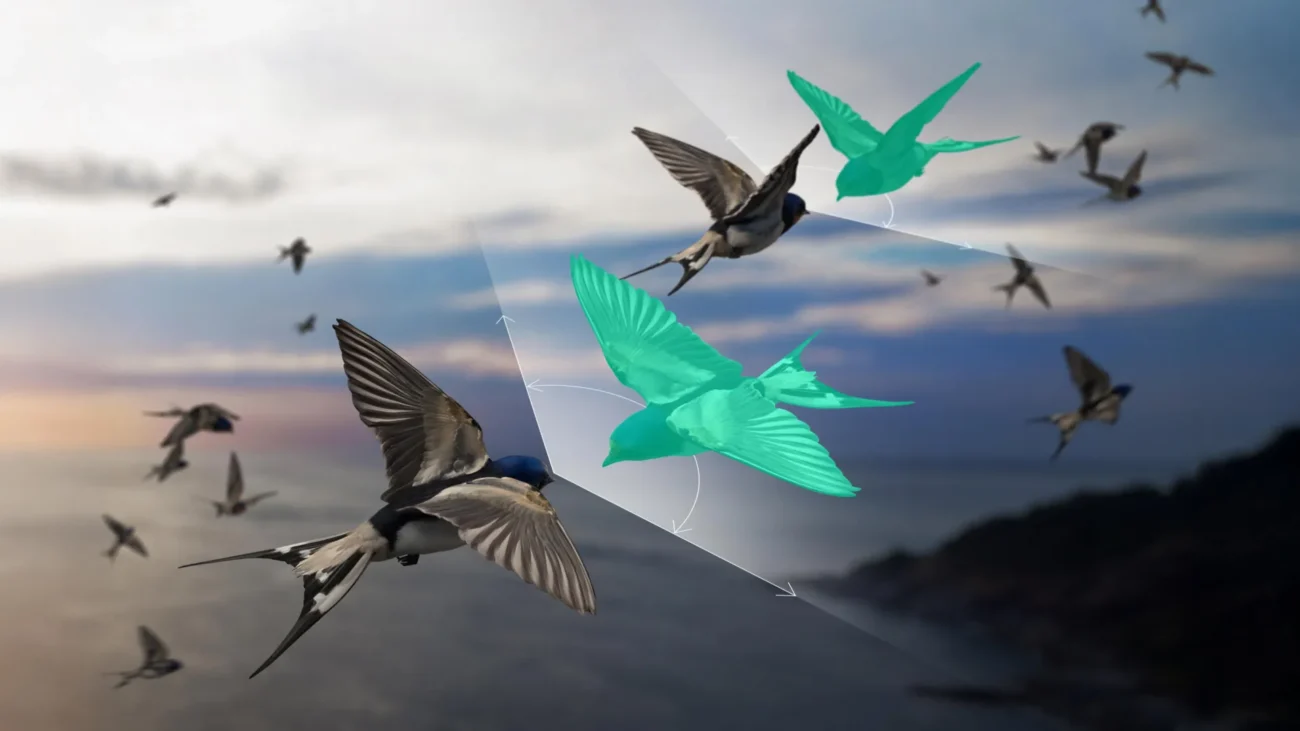
The seemingly simple act of birds flying in formation, a common and often beautiful spectacle in nature, has long presented a puzzling paradox for physicists. While Newton’s third law of motion, stating that for every action, there is an equal and opposite reaction, forms a bedrock of classical physics, the coordinated movements of flocks appear to defy this fundamental principle. Now, researchers in Dresden, Germany, have unveiled a groundbreaking theoretical framework that reconciles these observations, offering a powerful new tool for understanding a wide array of natural phenomena, from bacterial swarms to cellular tissues.
The Paradox of the Avian Dance
For centuries, Newton’s third law has been intuitively understood and rigorously applied across numerous scientific disciplines. Its elegant simplicity is evident in everyday experiences: the force exerted by our feet on the ground propels us forward, the recoil of a fired projectile, or the thrust generated by an escaping balloon. This action-reaction principle, a cornerstone of classical mechanics since its formulation over 300 years ago, dictates a perfect balance in all interactions. As Marin Bukov, a research group leader involved in the new study, notes, "Whatever we normally teach our students in theoretical mechanics, it ultimately rests on the action-reaction principle."
However, the collective motion of biological entities, such as birds in a flock, presents a challenge to this established order. While birds possess a broad field of vision, allowing them to perceive a significant portion of their surroundings, their focus within a flock narrows considerably. They primarily attend to the birds immediately beside them or ahead of them, adjusting their flight paths in response to these proximate neighbors. Crucially, they do not appear to align their movements with those birds positioned behind them. This selective attention means that the forces birds exert on each other are not reciprocated in a perfectly balanced, opposite manner.
This "one-way" or non-reciprocal interaction is not unique to avian formations. Scientists have observed similar behaviors in bacterial swarms, where individual bacteria respond to their immediate neighbors rather than the entire colony. Human crowds exhibiting emergent patterns of movement, and even the intricate collective behavior of cells within living tissues, also demonstrate this tendency to respond to only a portion of their surrounding environment. In all these instances, the traditional understanding of action and reaction, which assumes a symmetrical exchange of forces, falters.
The Struggle to Simulate Non-Reciprocal Systems
The implications of these non-reciprocal interactions extend beyond mere academic curiosity. Traditional physics models, meticulously designed for reciprocal systems where action and reaction are inherently balanced, have struggled to accurately simulate these emergent biological and social phenomena. This limitation has hindered scientific progress in crucial areas, including understanding the complex dynamics of biological processes, predicting crowd behavior during emergencies, and deciphering the intricate coordination of animal groups.
"Traditional theories were designed for reciprocal interactions, where action and reaction are equal," explains Dr. Ricard Alert, a biophysicist and colleague of Bukov. "Because of that limitation, scientists have struggled to accurately simulate non-reciprocal systems. Better simulations are important for understanding biological processes, crowd behavior, and the collective motion of animals."
A Dresden Breakthrough: Redefining Action and Reaction
The long-standing challenge of accurately modeling non-reciprocal systems has now been met with an innovative solution developed by a team of physicists in Dresden. Led by Roderich Moessner, a Principal Investigator at the Würzburg-Dresden Cluster of Excellence ctd.qmat – Complexity, Topology and Dynamics in Quantum Matter – and director of the Max Planck Institute for the Physics of Complex Systems, the researchers have devised a novel theoretical framework that extends the applicability of classical physics to these previously intractable systems.
"The research team has developed and proven a theory that makes much of what we teach our students applicable to non-reciprocal systems as well," states Bukov. "These systems, where Newton’s third law does not apply, can now finally be described exactly and simulated precisely – even using established methods. This is exactly the kind of tool that has been missing in recent years."
The Ingenious Introduction of Auxiliary Variables
The core of the Dresden team’s breakthrough lies in their ingenious approach to extending the traditional action-reaction framework. Instead of discarding established physics principles, they have found a way to adapt them. Their method allows non-reciprocal systems to be studied using many of the same analytical tools already employed for ordinary reciprocal systems. The key innovation is the introduction of what they term "artificial variables" or "auxiliary degrees of freedom."
In typical physical descriptions, scientists utilize mathematical variables that directly correspond to observable properties of a system. For instance, a bird’s position and speed, a fish’s location within a school, or a car’s position in traffic are all real, measurable attributes. The Dresden team’s strategy, however, is to construct a "partner" for each component within the system. These partners are not physically real entities but rather mathematical constructs designed to create a balanced, reciprocal interaction.
"The trick behind the new theory is that it constructs a partner for each component of the system – a fictitious partner that doesn’t exist in nature," elaborates Alert. "The original non-reciprocal interactions are replaced by reciprocal interactions with these auxiliary degrees of freedom."
The Imaginary Bird: A Practical Illustration
To illustrate the practical application of their theory, the researchers use the example of a flock of birds. Imagine simulating the complex dynamics of birds in flight. According to their new model, the system can be treated as if it were reciprocal, even though the underlying biological interactions are not. The elegant solution involves artificially introducing a "fictitious bird" in front of each real bird. This imaginary counterpart is positioned and oriented in precisely the opposite direction of the real bird’s intended movement or interaction.
These imaginary birds do not represent actual avian creatures; they are purely mathematical constructs. Their purpose is to serve as a mechanism for transforming the inherently one-way, non-reciprocal interactions of the real flock into a form that can be analyzed and simulated using well-established, reciprocal methods. This allows scientists to leverage the vast body of existing physics knowledge and computational tools, significantly streamlining the analysis of complex systems.
A Timeline of Discovery and Application
The conceptual journey leading to this breakthrough likely began with decades of observation and theoretical exploration into collective behavior. While the precise timeline of the Dresden team’s specific research project is not detailed in the initial report, the development of sophisticated theories for complex systems often involves iterative processes. Early theoretical explorations into non-reciprocal systems may have been documented in academic papers over the past few years, with the current work representing a significant advancement and validation of these concepts. The publication of their findings in the prestigious journal Nature Physics signifies the culmination of this research and its acceptance by the broader scientific community.
This new approach builds upon the broader field of many-body physics, which deals with systems composed of numerous interacting particles. By finding a way to apply these established frameworks to systems that deviate from standard assumptions, the Dresden team has opened new avenues for research.
Broader Impact and Future Implications
The implications of this research are far-reaching and extend across multiple scientific disciplines. The ability to accurately simulate non-reciprocal systems promises to revolutionize our understanding of:
- Biological Systems: From the coordinated movements of fish schools and insect swarms to the intricate self-organization of cells in developing organisms, a deeper understanding of non-reciprocal interactions could unlock new insights into fundamental biological processes, disease mechanisms, and potential therapeutic interventions. For example, understanding how bacteria form biofilms, which often exhibit non-reciprocal signaling, could lead to new strategies for combating antibiotic resistance.
- Social Dynamics: The collective behavior of human crowds, from pedestrian flow in urban environments to crowd management during large events, can be better modeled and predicted. This could have significant implications for urban planning, public safety, and emergency response.
- Materials Science and Quantum Physics: While the initial inspiration came from macroscopic phenomena, the underlying principles of non-reciprocity can also manifest at the quantum level. Roderich Moessner, in his capacity at the Cluster of Excellence ctd.qmat, hints at this broader relevance. "In Würzburg and Dresden, we study quantum matter whose particles interact under certain conditions in ways that give rise to new phenomena such as magnetism or lossless current transport," Moessner states. "The exciting question now is whether these exceptions to Newton’s law lead to entirely new forms of collective quantum behavior. We still know very little about this – and that is precisely what makes this so fascinating." This suggests that the research could lead to the discovery of novel quantum phenomena and the development of new quantum technologies.
The development of accurate simulation tools for non-reciprocal systems is not merely an academic exercise; it is a critical step towards addressing real-world challenges and pushing the boundaries of scientific knowledge. The Dresden team’s work provides a vital missing piece in the puzzle of complex emergent behaviors, offering a unified theoretical framework that bridges the gap between classical physics and the intricate dynamics of the natural world.
Expert Reactions and Endorsements
While direct quotes from external experts were not included in the original source material, the publication of this research in Nature Physics, a leading peer-reviewed journal, signifies its rigorous vetting and significant contribution. The endorsement from prominent physicists like Marin Bukov and Roderich Moessner, who are leaders in their respective fields, further underscores the importance and validity of the findings. The researchers themselves express optimism about the transformative potential of their work.
"This is exactly the kind of tool that has been missing in recent years," Bukov emphasizes, highlighting the practical demand for such a theoretical advancement. The ability to precisely simulate and describe systems that were previously difficult to analyze means that scientists can now explore these phenomena with greater confidence and accuracy, potentially accelerating discoveries across a spectrum of scientific inquiry.
The Path Forward: New Questions and Discoveries
The resolution of one scientific puzzle often serves as the catalyst for new questions and explorations. The Dresden team’s achievement in unifying the understanding of reciprocal and non-reciprocal systems is likely to ignite further research into the fundamental nature of interactions and emergent phenomena. The potential for discovering entirely new forms of collective behavior, particularly in the realm of quantum matter, represents a thrilling frontier for physics. As Moessner aptly puts it, "We still know very little about this – and that is precisely what makes this so fascinating." This new theoretical lens will undoubtedly allow scientists to probe these uncharted territories with greater precision and insight, promising a future rich with scientific discovery.

