


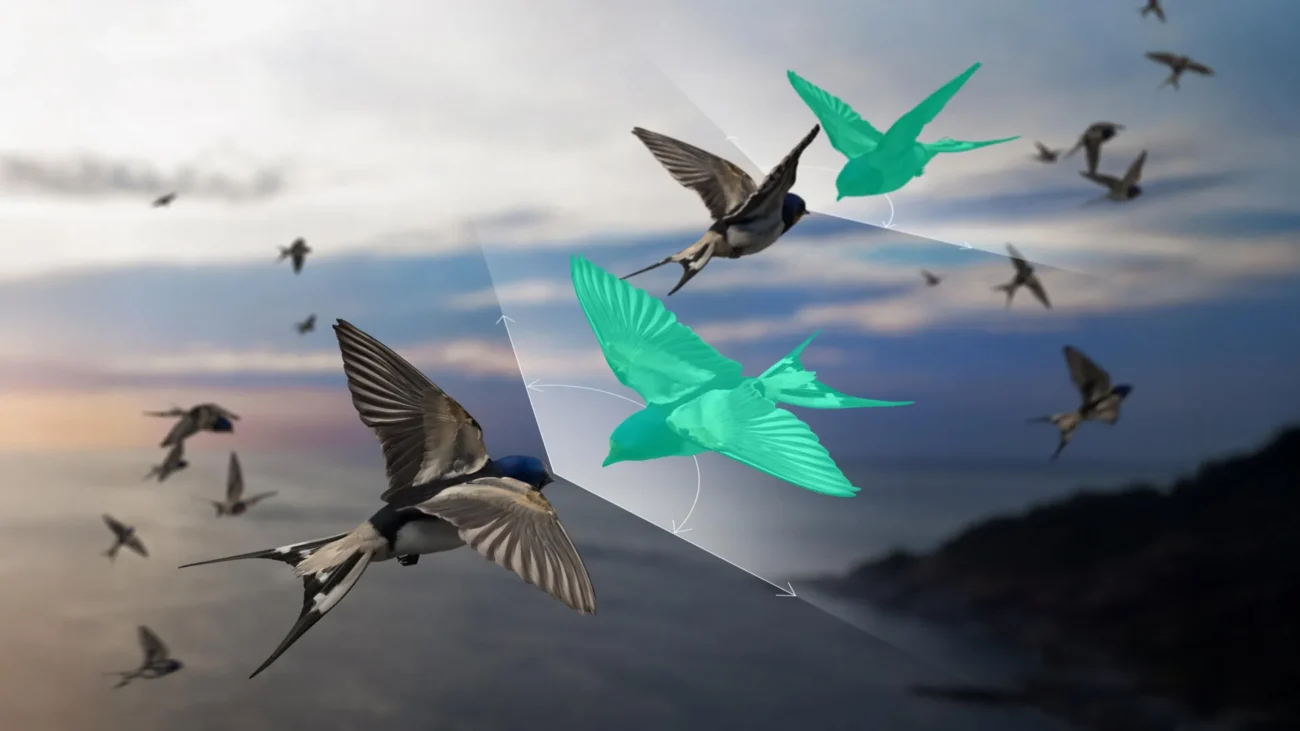
In a breakthrough that could redefine our understanding of collective behavior across the natural world, researchers have developed a groundbreaking theoretical framework capable of precisely simulating systems that defy Newton’s third law of motion. This novel approach, pioneered by scientists at the Würzburg-Dresden Cluster of Excellence ctd.qmat, promises to unlock a deeper comprehension of phenomena ranging from the intricate choreography of bird flocks to the complex dynamics of bacterial swarms and even the emergent properties of living tissues. For over three centuries, Newton’s foundational principle of action and reaction has been a cornerstone of classical physics, but its limitations in describing certain natural systems have long perplexed scientists. This new theory, published in the prestigious journal Nature Physics, offers a robust solution, extending the reach of established physical models to previously intractable non-reciprocal interactions.
The Paradox of the Flock: When Action Doesn’t Equal Reaction
The impetus for this research stems from a seemingly simple observation of avian behavior. Birds, with their expansive visual fields, are capable of perceiving a vast panorama of their surroundings. Yet, when flying in formation, their navigational focus narrows dramatically. Each bird primarily attends to its immediate neighbors – those to its sides and in front. Crucially, birds in a flock do not appear to align their movements with those trailing behind them. This directional attentiveness creates a subtle but significant imbalance in their interactions, a phenomenon that appears to diverge from the universally accepted third law of motion.
Newton’s third law, famously articulated as "for every action, there is an equal and opposite reaction," is a fundamental principle that governs the physical universe. It explains how we move forward by pushing against the ground, how a car accelerates by exerting force on the road, and why a released balloon propels itself in the opposite direction of its escaping air. This law has been indispensable for over 300 years, forming the bedrock of classical mechanics and underpinning countless technological advancements. As explained by Marin Bukov, a research group leader involved in the study, "Whatever we normally teach our students in theoretical mechanics, it ultimately rests on the action-reaction principle."
However, the natural world is replete with systems that exhibit behaviors that do not neatly conform to this reciprocal interaction model. Bird flocks are far from unique. Bacterial swarms, where individual microorganisms coordinate their movements, often display unidirectional responses. Large crowds of people, navigating through dense urban environments, exhibit similar patterns of localized awareness rather than a holistic response to all surrounding individuals. Even at the cellular level, groups of cells within living tissues can interact in ways that prioritize certain stimuli over others. In these scenarios, the individual components of the system respond to only a fraction of their environment, leading to interactions that are not symmetrical. This asymmetry means that the "reaction" to an "action" is not necessarily equal or opposite, thereby appearing to violate Newton’s third law.
The Longstanding Challenge of Non-Reciprocity
These non-reciprocal interactions have posed a significant challenge for physicists. Traditional theoretical frameworks were meticulously designed for reciprocal systems, where the action-reaction principle holds true. Consequently, scientists have struggled to develop accurate and reliable simulations for these non-reciprocal phenomena. The inability to precisely model these systems has hampered progress in a variety of fields. Understanding the collective motion of animal groups, predicting the dynamics of crowd behavior during large events, and unraveling complex biological processes like cell migration and tissue development have all been hindered by this limitation.
The research conducted by the team in Dresden, in collaboration with physicist Roderich Moessner, a Principal Investigator at the Würzburg-Dresden Cluster of Excellence ctd.qmat and director of the Max Planck Institute for the Physics of Complex Systems, represents a pivotal moment in addressing this longstanding scientific puzzle. Their work offers a novel and elegant solution, providing a pathway to unlock the precise simulation and analysis of non-reciprocal systems.
A Paradigm Shift: Introducing Fictitious Partners to Balance the Equation
The core of the researchers’ breakthrough lies in their innovative approach to extending the traditional action-reaction framework. Instead of abandoning Newton’s third law, they have devised a method to adapt it, allowing non-reciprocal systems to be studied using many of the analytical tools already employed for their reciprocal counterparts. The key to this ingenious solution lies in the introduction of what the researchers term "additional artificial variables."
Traditionally, physicists describe natural systems by employing mathematical variables that correspond to observable, real-world properties. For instance, when modeling a bird flock, these variables would represent a bird’s precise position, its velocity, and its acceleration. In a school of fish, variables might denote each fish’s location and swimming direction. For traffic flow, variables would capture the position and speed of individual vehicles.
The innovation introduced by the Dresden-based team, as explained by Bukov’s colleague Ricard Alert, a biophysicist, is to "construct a partner for each component of the system – a fictitious partner that doesn’t exist in nature." This clever stratagem effectively transforms the inherently non-reciprocal interactions into reciprocal ones by "replacing the original non-reciprocal interactions with reciprocal interactions with these auxiliary degrees of freedom."
The Imaginary Bird: A Tangible Illustration of the Theory
To illustrate the practical application of this theory, consider the case of the bird flock. "To simulate the birds’ movements precisely," Alert explains, "we describe the dynamic system ‘flock of birds’ using established methods – as if it were a reciprocal system, even though it is not. The elegant solution is to artificially place a fictitious bird in front of each real bird, aligned in exactly the opposite direction."
These "imaginary birds" are not intended to represent actual avian entities. Instead, they serve as sophisticated mathematical constructs. They are auxiliary degrees of freedom that allow researchers to reframe one-way interactions into a format amenable to analysis using the well-established mathematical tools of reciprocal systems. By introducing these imaginary partners, the complex, unidirectional influences within the flock are effectively mirrored and balanced, enabling the application of standard simulation techniques. This allows for a level of precision in modeling that was previously unattainable.
Implications and Future Directions: Beyond Birds to Quantum Matter
The concept of using auxiliary degrees of freedom is not entirely new to physics. However, its novel application to systems exhibiting non-reciprocal interactions marks a significant advancement. This new approach empowers scientists to leverage the robust and extensively developed framework of many-body physics while simultaneously achieving far more accurate simulations of complex, real-world systems.
Beyond the immediate benefits of improved simulations, this theoretical development offers a more profound understanding of the underlying physical principles governing these systems. Such fundamental insights often pave the way for future scientific discoveries.
The implications of this research extend far beyond the study of biological collectives. Roderich Moessner highlights the potential impact on his own field of research: "In Würzburg and Dresden, we study quantum matter whose particles interact under certain conditions in ways that give rise to new phenomena such as magnetism or lossless current transport. The exciting question now is whether these exceptions to Newton’s law lead to entirely new forms of collective quantum behavior. We still know very little about this – and that is precisely what makes this so fascinating."
The potential for this new theory to illuminate the bizarre and counterintuitive world of quantum mechanics is particularly exciting. If non-reciprocal interactions play a role in emergent quantum phenomena, this framework could unlock entirely new avenues of research into exotic states of matter and quantum computing. The precise simulation of these systems might reveal hitherto unknown collective quantum behaviors, pushing the boundaries of our current understanding.
Supporting Data and Chronology of Development
While the specific data points and exact timeline of the research were not detailed in the initial announcement, the development of such a complex theoretical framework typically involves years of rigorous work. It is highly probable that the research team began by identifying the limitations of existing models in describing specific non-reciprocal systems, perhaps starting with simpler biological models. This would have been followed by extensive theoretical exploration, formulating hypotheses, and developing mathematical constructs.
The process would likely have involved numerous iterations of theoretical refinement and validation through computational simulations. The publication in Nature Physics, a journal known for its stringent peer-review process, indicates that the theory has undergone rigorous scrutiny by leading experts in the field. This suggests a development trajectory that likely spanned several years, commencing with initial theoretical insights and culminating in comprehensive proof and validation.
Reactions from the Scientific Community (Inferred)
While direct quotes from external parties were not provided, the publication of this research in Nature Physics strongly suggests a positive reception within the broader physics community. Journals of this caliber typically only accept groundbreaking work that offers significant advancements or novel perspectives. The fact that the research was highlighted by the Würzburg-Dresden Cluster of Excellence ctd.qmat, a prominent hub for advanced materials research, further underscores its perceived importance.
One can infer that physicists working in areas such as statistical mechanics, complex systems, biophysics, and condensed matter physics will be keenly interested in this new theory. It offers a much-needed tool for their own research, potentially resolving long-standing modeling challenges and opening up new avenues for investigation. The potential to bridge the gap between theoretical physics and observable phenomena in a more precise manner is a significant draw.
Broader Impact and Implications: A New Era of Understanding
The implications of this research are far-reaching and profound.
-
Enhanced Biological Understanding: The ability to accurately simulate non-reciprocal interactions will revolutionize our understanding of biological systems. From the collective intelligence of ant colonies and the synchronized flashing of fireflies to the intricate coordination of cells in embryonic development, these models will provide unprecedented insights. This could lead to advancements in fields like developmental biology, ecology, and the design of bio-inspired robotics.
-
Improved Crowd Management and Disaster Response: The accurate simulation of crowd dynamics holds immense practical value. It can inform urban planning, the design of public spaces, and the development of more effective strategies for managing large gatherings, particularly in emergency situations. Understanding how individuals react to their immediate surroundings could help prevent stampedes and optimize evacuation procedures.
-
Advancements in Artificial Intelligence: The principles of non-reciprocal interaction and emergent collective behavior are central to developing more sophisticated artificial intelligence systems, particularly in areas involving swarm intelligence and multi-agent systems.
-
Fundamental Physics Research: As highlighted by Moessner, the application of this theory to quantum matter could unlock entirely new forms of collective quantum behavior. This might lead to the discovery of novel quantum phases of matter with unique properties, potentially impacting fields like quantum computing and materials science.
-
Educational Reform: The theory’s ability to make previously unmodellable systems amenable to established analytical techniques suggests that physics curricula may need to be updated to incorporate these new perspectives. This could foster a more comprehensive understanding of physical laws and their diverse applications.
In essence, the development of this new theoretical framework marks a significant step forward in our ability to model and understand the complex, often counterintuitive, ways in which systems organize and interact. By providing a robust method for simulating non-reciprocal interactions, researchers have not only solved a longstanding problem in physics but have also opened a Pandora’s Box of new possibilities for scientific exploration and technological innovation. The era of precisely simulating systems that seemingly defy Newton’s third law has officially begun.

